Tinnitus And Hearing Loss: Understanding The Connection And What You Can Do

Why Ear Ringing And Hearing Changes Often Occur Together, How They Are Diagnosed, And What Can Help
Tinnitus and hearing loss often occur together because changes in the inner ear can affect both how sound reaches the brain and how the brain processes auditory information. When hearing becomes reduced or damaged, the auditory system may respond in ways that contribute to ringing, buzzing, hissing, or other sounds that have no external source. However, not everyone with tinnitus has measurable hearing loss, and not everyone with hearing loss experiences tinnitus.
For many people, the connection becomes noticeable gradually. Conversations may seem less clear, television volume may increase, or ringing becomes more obvious in quiet rooms. Others notice tinnitus long before realizing that their hearing has changed.
Understanding this relationship can help you make informed decisions about your hearing health. A professional hearing evaluation can identify changes you might not recognize yourself, while hearing aids and other evidence-based management strategies may improve communication and reduce tinnitus-related difficulties.
This guide explains how tinnitus and hearing loss are connected, what different hearing tests can reveal, and what you can realistically expect from available treatments.
New to tinnitus? Explore our Tinnitus 101 Hub for beginner-friendly guides covering symptoms, causes, triggers, and practical ways to manage ear ringing.
Quick Answer: What Is The Connection Between Tinnitus And Hearing Loss?
Tinnitus frequently occurs alongside hearing loss because reduced auditory input can change activity within the brain’s hearing pathways. Noise exposure, aging, and certain inner-ear conditions can contribute to both problems. However, tinnitus can also occur when a standard hearing test shows normal results. An audiologist can evaluate hearing sensitivity, speech understanding, and related symptoms. For people with hearing loss, appropriately fitted hearing aids may improve communication and make tinnitus less noticeable, although they do not guarantee that the ringing will disappear.
Key Takeaways
Tinnitus and hearing loss are closely connected, but they do not always occur together. Changes in the inner ear can reduce hearing sensitivity while contributing to the brain activity associated with ringing or buzzing. A comprehensive hearing evaluation can uncover problems that may not be obvious during everyday conversations.
Hearing aids often help people with hearing loss communicate more comfortably and may also reduce tinnitus awareness. Protecting your ears, addressing treatable conditions, and exploring evidence-based management strategies can improve daily life. Sudden hearing loss, especially with new tinnitus, requires urgent medical attention.
What Are Tinnitus And Hearing Loss?
Although tinnitus and hearing loss frequently appear together, they describe different experiences.
What Is Tinnitus?
Tinnitus is the perception of sound when no corresponding external sound is present.
People commonly describe it as:
-
Ringing or whistling.
-
Buzzing or humming.
-
Hissing or static-like noise.
-
Roaring or rushing sounds.
-
Clicking or other intermittent sounds.
The sound may affect one ear, both ears, or seem to originate inside the head.
Tinnitus can be continuous, intermittent, quiet, or intrusive. Its perceived loudness may fluctuate depending on the environment, sleep quality, attention, and other factors.
Tinnitus is a symptom rather than a single disease. It may be associated with hearing loss, ear conditions, medication effects, or other medical problems.
What Is Hearing Loss?
Hearing loss occurs when a person has reduced ability to detect or understand sounds.
It can affect one or both ears and may develop gradually or suddenly.
Common signs include difficulty understanding conversations, especially in noisy environments, asking people to repeat themselves, or increasing the volume of electronic devices.
Hearing loss can be classified into three broad categories:
Sensorineural hearing loss: Usually involves changes in the inner ear or auditory nerve. Age-related and noise-related hearing loss commonly fall into this category.
Conductive hearing loss: Occurs when sound transmission through the outer or middle ear is impaired, such as with earwax obstruction or middle-ear fluid.
Mixed hearing loss: Involves both sensorineural and conductive components.
These distinctions matter because the cause and type of hearing loss influence which treatments may be appropriate.
Why Do Tinnitus And Hearing Loss Often Occur Together?
The connection involves both the structures responsible for detecting sound and the brain networks that interpret auditory signals.
Changes In The Inner Ear
Inside the cochlea are specialized sensory cells known as hair cells.
These cells help convert sound vibrations into electrical signals that travel through the auditory nerve to the brain.
Aging, excessive noise exposure, certain medications, and other conditions can damage these structures or affect auditory signaling.
When hearing signals become reduced or altered, the brain receives less information from certain sound frequencies.
Researchers believe this reduction in auditory input may contribute to changes in neural activity associated with tinnitus.
The Brain’s Response To Reduced Sound Input
Hearing is not simply a process of sound entering the ears.
The brain continuously interprets and organizes incoming auditory information.
When sound input decreases, the central auditory system may change its activity.
One proposed mechanism involves increased neural responsiveness, sometimes described as central gain.
In simplified terms, the brain may increase its sensitivity when normal auditory information becomes reduced.
This may contribute to the perception of sound even when no external sound is present.
However, tinnitus is complex. Central gain is one scientific explanation, not a complete account of every person’s symptoms.
Why Hearing Loss Does Not Always Cause Tinnitus
Many people with measurable hearing loss never experience tinnitus.
Likewise, some individuals with tinnitus have hearing thresholds within the normal range on standard audiometry.
This suggests that tinnitus depends on more than the amount of hearing loss alone.
Differences in neural processing, attention, emotional responses, and other auditory mechanisms may influence whether tinnitus develops and how noticeable it becomes.
Understanding these differences helps explain why two people with similar hearing tests can have very different tinnitus experiences.
Learn More: Explore our Common Tinnitus Causes: A Complete Guide To Why Your Ears May Be Ringing for a closer look at the medical conditions and hearing-related changes that may contribute to tinnitus.
Can You Have Tinnitus Without Hearing Loss?
Yes. Tinnitus can occur even when standard hearing tests show normal hearing sensitivity.
A conventional hearing test typically measures the quietest sounds a person can detect across selected frequencies.
However, hearing involves more than detecting faint tones.
Some people have difficulty understanding speech in noisy environments despite having normal pure-tone thresholds.
Others may have auditory changes outside the frequency range routinely tested.
What Does Normal Hearing On An Audiogram Mean?
A normal audiogram means that hearing sensitivity falls within the expected range for the frequencies tested.
It does not necessarily mean that every aspect of auditory function has been examined.
Researchers continue to investigate whether subtle changes in auditory nerve connections or other hearing mechanisms may contribute to tinnitus in some people with normal audiograms.
These proposed mechanisms should not be interpreted as proof that every person with tinnitus has hidden hearing damage.
Should You Still Get Your Hearing Tested?
Yes. A hearing evaluation is useful when tinnitus persists, interferes with daily life, or is accompanied by perceived hearing changes.
An audiologist can assess hearing sensitivity and determine whether additional testing is appropriate.
Normal results can also provide useful information and help guide further evaluation.
Common Causes Of Tinnitus With Hearing Loss
Several conditions can affect hearing and contribute to tinnitus.
1. Age-Related Hearing Loss
Age-related hearing loss, also called presbycusis, commonly develops gradually.
It often affects higher-frequency sounds first, making consonants and conversations in noisy environments harder to understand.
Tinnitus may accompany these changes, although it does not occur in everyone.
2. Noise-Induced Hearing Loss
Repeated exposure to loud sounds can damage sensitive structures within the inner ear.
Common sources include concerts, industrial equipment, power tools, firearms, and excessively loud headphones.
Noise-induced hearing loss may develop gradually or follow an intense exposure.
Tinnitus can occur alongside the hearing changes and may be temporary or persistent.
3. Earwax Blockage
Excessive earwax can obstruct sound transmission and occasionally contribute to tinnitus.
When earwax is responsible, professional removal may improve hearing and sometimes reduce the ringing.
Never insert sharp objects into the ear canal or attempt unsafe removal techniques.
4. Middle-Ear Conditions
Middle-ear infections, fluid accumulation, or problems involving the eardrum and hearing bones can cause conductive hearing loss.
Tinnitus may occur alongside these conditions.
Treating the underlying problem may improve hearing and sometimes reduce tinnitus.
5. Ménière’s Disease
Ménière’s disease is an inner-ear disorder associated with episodes of vertigo, fluctuating hearing loss, tinnitus, and ear fullness.
Not everyone with these symptoms has Ménière’s disease, and diagnosis requires appropriate clinical assessment.
6. Medication-Related Hearing Changes
Certain medications can affect hearing or cause tinnitus, particularly at specific doses.
Examples include some chemotherapy medications and particular antibiotics.
Medication-related effects may be temporary or permanent.
Never discontinue prescribed medication without consulting your healthcare professional.
Can Hearing Loss Make Tinnitus Sound Louder?
Hearing loss can make tinnitus more noticeable, particularly in quiet environments.
When fewer external sounds are heard, there may be less auditory information competing with the internal tinnitus perception.
For example, someone with high-frequency hearing loss may have difficulty hearing subtle environmental sounds that would otherwise provide background stimulation.
As a result, tinnitus may stand out more prominently.
However, perceived tinnitus loudness does not always correspond directly to the severity of hearing loss.
Some people with substantial hearing loss experience mild tinnitus, while others with relatively small hearing changes find the ringing highly intrusive.
Attention, emotional distress, and the listening environment can also influence tinnitus awareness.
This is one reason why treatment focuses on both hearing function and the personal impact of tinnitus.
How Audiologists Evaluate Tinnitus And Hearing Loss
A comprehensive hearing evaluation is one of the most useful steps for understanding tinnitus, particularly when hearing changes may be involved.
An audiologist is a healthcare professional trained to assess hearing and related auditory conditions.
The evaluation typically includes a discussion of symptoms, examination of the ears, and several hearing tests.
1. Medical And Hearing History
The audiologist may begin by asking questions such as:
-
When did the tinnitus begin?
-
Does the sound affect one ear or both?
-
Is the ringing constant or intermittent?
-
Have you noticed difficulty hearing conversations?
-
Have you experienced loud noise exposure?
-
Do you have dizziness, ear fullness, or ear pain?
-
Are you taking medications that could affect hearing?
These details help determine which tests are appropriate and whether medical referral is needed.
2. Otoscopy: Examining The Ear Canal
An otoscope allows the clinician to examine the outer ear canal and eardrum.
This examination can identify visible problems such as excessive earwax, inflammation, or certain eardrum abnormalities.
Some causes of conductive hearing loss can be identified during this initial examination.
3. Pure-Tone Audiometry
Pure-tone audiometry measures the softest sounds you can detect at different frequencies.
During the test, you wear headphones or earphones and respond when you hear tones.
The results are recorded on an audiogram.
Example of an audiogram showing high-frequency hearing loss
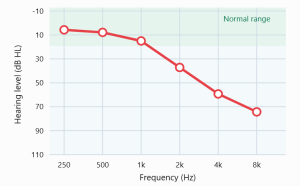
Illustrative example only, not a patient’s test result. The downward line represents poorer hearing sensitivity at higher frequencies; audiograms display greater hearing loss farther down the chart.
An audiogram can help identify whether hearing loss affects low, middle, or high frequencies and whether the pattern is similar in both ears.
4. Speech Audiometry
Speech testing evaluates how well you detect and understand spoken words.
This is particularly useful because hearing conversations involves more than detecting simple tones.
Some people can hear speech but struggle to distinguish words clearly, especially when background noise is present.
Speech testing can help audiologists understand these difficulties and guide hearing aid recommendations.
5. Tympanometry
Tympanometry measures how the eardrum and middle-ear system respond to changes in air pressure.
It may help identify middle-ear fluid, pressure-related problems, or other conditions affecting sound transmission.
It does not directly measure tinnitus.
6. Additional Testing When Needed
Depending on your symptoms, an audiologist may recommend other assessments, such as otoacoustic emissions testing or additional speech-in-noise measurements.
Tinnitus questionnaires may also be used to evaluate how much the sound affects sleep, concentration, emotional well-being, and everyday activities.
No single routine test can objectively measure the complete tinnitus experience or predict whether it will disappear.
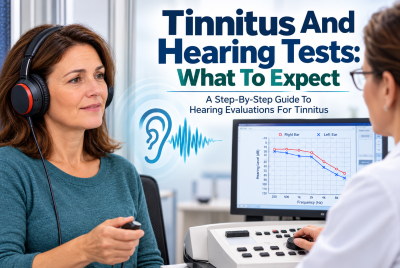
Learn More: Read our Tinnitus And Hearing Tests: What to expect guide for a detailed explanation of common hearing evaluations and how to understand your results.
Can Hearing Aids Help With Tinnitus And Hearing Loss?
Yes. Hearing aids can be helpful for people who experience both hearing loss and tinnitus.
Their primary purpose is to improve hearing, but some users also report that tinnitus becomes less noticeable.
However, hearing aids are not a guaranteed tinnitus treatment, and the degree of benefit varies.
How Hearing Aids May Reduce Tinnitus Awareness
Hearing aids amplify selected external sounds according to an individual’s hearing needs.
This can increase access to speech, background noise, and environmental sounds that might otherwise be difficult to hear.
For some people, the additional auditory input reduces the contrast between tinnitus and the surrounding environment.
For example, someone who notices ringing while sitting in a quiet living room may find that everyday sounds become more audible when wearing hearing aids.
The tinnitus may still be present, but it may attract less attention.
Hearing Aids Can Reduce Listening Effort
Hearing loss can make conversations mentally demanding.
A person may need to concentrate intensely to understand speech, especially in restaurants or group settings.
Properly fitted hearing aids can improve access to speech information and reduce some listening difficulties.
Better communication may also help reduce frustration and social withdrawal.
These improvements can be valuable even when tinnitus loudness does not change.
Do Hearing Aids Completely Stop Ringing?
Usually, hearing aids should not be expected to eliminate tinnitus permanently.
Some users experience noticeable relief, while others primarily benefit from improved hearing.
The available research supports considering hearing aids for people with hearing loss, but evidence that amplification alone consistently reduces tinnitus is limited.
The main reason to obtain hearing aids should be an appropriate hearing-related need, with potential tinnitus relief considered an additional benefit.
What Types Of Hearing Aids May Be Suitable?
Several hearing aid styles are available.
Receiver-In-Canal (RIC) Hearing Aids
Small devices that sit behind the ear, with a thin wire connecting to a receiver inside the ear canal. They are commonly used for many types of mild to severe hearing loss.
Behind-The-Ear (BTE) Hearing Aids
Devices worn behind the ear that transmit amplified sound through a tube or earmold. They can accommodate a wide range of hearing needs.
In-The-Ear (ITE) Hearing Aids
Custom devices designed to fit within the outer ear or ear canal. Suitability depends on hearing loss, ear anatomy, dexterity, and other factors.
Some hearing aids also include tinnitus-related sound features, such as gentle noise generators.
These features may help certain individuals, but research has not clearly established that they provide greater tinnitus relief than well-fitted amplification alone.
An audiologist can help determine which style and features are appropriate.
What If You Have Tinnitus But Do Not Need Hearing Aids?
Hearing aids are not automatically recommended for everyone with tinnitus.
If your hearing is within normal limits and you do not have meaningful hearing difficulties, other management approaches may be more appropriate.
Cognitive Behavioral Therapy
Cognitive behavioral therapy (CBT) has strong evidence for reducing tinnitus-related distress.
It helps people change unhelpful thought patterns and behaviors associated with the sound.
CBT does not necessarily reduce the auditory sensation itself, but it can improve quality of life, emotional well-being, and daily functioning.
Sound Enrichment
Gentle background sounds may make tinnitus less prominent in quiet environments.
Options include a fan, soft music, rainfall recordings, or other comfortable ambient sounds.
Keep sound levels safe and comfortable rather than attempting to overpower the tinnitus.
Tinnitus Education And Counseling
Understanding tinnitus can reduce uncertainty and help people develop realistic expectations.
An audiologist or qualified healthcare professional can explain your test results and discuss appropriate management strategies.
Learn More: Explore our Tinnitus Treatment And Management: What Options Are Available? Guide for a broader overview of evidence-based tinnitus care.
Everyday Habits That Support Hearing Health And Tinnitus Management
Protecting your remaining hearing and reducing unnecessary auditory stress can support long-term comfort.
Protect Your Ears From Harmful Noise
Wear properly fitted hearing protection when using loud equipment or attending noisy events.
Keep headphone volume at a comfortable level and take breaks during extended listening sessions.
Avoid unnecessary exposure to intense sounds, especially if you already have hearing loss.
Maintain Healthy Sleep Habits
Poor sleep can increase tinnitus awareness and make hearing-related difficulties feel more exhausting.
Maintain consistent sleep and wake times, create a comfortable bedroom environment, and consider low-volume background sound if silence makes ringing more noticeable.
Address Hearing Difficulties Early
Do not wait until hearing problems become severe before seeking advice.
Early evaluation can identify treatable conditions and help you explore communication strategies or hearing devices when appropriate.
Avoid Excessive Tinnitus Monitoring
Repeatedly checking whether tinnitus is louder can increase attention toward the sound.
Instead, focus on meaningful improvements in communication, sleep, concentration, and daily activities.
Review Medications With Your Healthcare Professional
Some medications can affect hearing or tinnitus.
If symptoms develop after starting a new medication, discuss the timing with your prescriber.
Never stop prescribed treatment without medical guidance.
Free Resource: Use our Tinnitus Trigger Tracker & 30-Day Symptom Diary to record changes in ringing, sleep, stress, and daily habits. Tracking patterns may help you prepare for a more productive discussion with your healthcare professional.
When Should You See A Doctor About Tinnitus And Hearing Loss?
Most tinnitus does not indicate a medical emergency. However, certain combinations of symptoms require prompt evaluation.
Seek immediate medical attention if you experience:
-
Sudden hearing loss in one or both ears, with or without tinnitus.
-
New tinnitus accompanied by sudden facial weakness, speech difficulties, or other neurological symptoms.
-
Severe acute vertigo accompanied by sudden hearing changes.
Sudden sensorineural hearing loss is time-sensitive. Seek urgent assessment, ideally within 24 hours, rather than waiting to see whether symptoms improve.
Arrange a medical appointment if tinnitus is persistent, affects only one ear, is synchronized with your heartbeat, or occurs alongside gradually worsening hearing.
An audiologist or ear, nose, and throat specialist can help determine whether further testing or treatment is necessary.
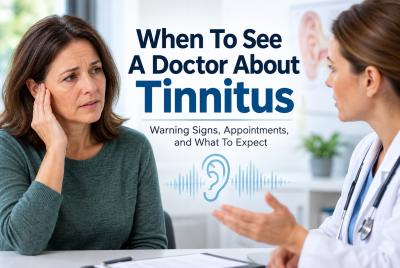
Free Resource: Prepare for your appointment with our Tinnitus Doctor Visit Checklist. Organize your symptoms, record important hearing changes, and bring useful questions to discuss with your doctor or audiologist.
What Can You Realistically Expect From Treatment?
The outlook for tinnitus and hearing loss depends on the underlying conditions.
Some causes of conductive hearing loss, such as earwax obstruction, may be reversible.
Age-related and noise-related sensorineural hearing loss are generally permanent, although hearing aids and other rehabilitation options can improve communication.
Tinnitus may improve when a treatable cause is addressed, but complete resolution cannot be guaranteed.
For people with chronic tinnitus, successful management often means hearing conversations more comfortably, sleeping better, and experiencing less distress.
It is also important to avoid products promising guaranteed tinnitus cures or complete hearing restoration without credible clinical evidence.
Frequently Asked Questions About Tinnitus And Hearing Loss
1. Does Having Tinnitus Mean You Are Losing Your Hearing?
Not necessarily. Tinnitus frequently occurs alongside hearing loss, but it can also affect people whose standard hearing tests show normal results. Ringing alone does not prove that your hearing is deteriorating. A professional hearing evaluation can identify measurable changes and help determine whether additional assessment is needed.
2. Can Hearing Aids Make Tinnitus Go Away?
Hearing aids may make tinnitus less noticeable for some people with hearing loss by improving access to external sounds. However, they do not reliably eliminate tinnitus or cure its underlying causes. Their primary purpose is to improve hearing and communication, with potential tinnitus relief considered an additional benefit.
3. Can Tinnitus And Hearing Loss Be Reversed?
Some hearing problems caused by earwax blockage or certain middle-ear conditions can improve with treatment. However, permanent sensorineural hearing loss generally cannot be reversed with current routine treatments. Tinnitus may improve or resolve in some cases, but its outcome depends on the underlying cause and individual circumstances.
4. Why Do I Have Ringing In My Ears If My Hearing Test Is Normal?
A standard hearing test measures sensitivity across selected sound frequencies but does not assess every aspect of auditory function. Tinnitus may occur with normal test results because several auditory and neurological mechanisms can contribute to the sound. Normal hearing thresholds do not mean the tinnitus is imaginary.
5. Should Everyone With Tinnitus Get A Hearing Test?
A hearing evaluation is recommended for persistent or bothersome tinnitus, particularly when hearing changes are suspected. It can help identify hearing loss, guide management, and determine whether further assessment is necessary. New tinnitus with sudden hearing loss requires urgent medical attention rather than a routine appointment.
Final Thoughts: Understanding Tinnitus And Hearing Loss
Tinnitus and hearing loss often occur together, but their relationship is not always straightforward.
Changes in the inner ear and auditory pathways can contribute to both conditions, yet tinnitus may also occur without measurable hearing loss.
A comprehensive hearing evaluation is one of the most valuable steps toward understanding your symptoms and identifying appropriate care.
For people with hearing loss, hearing aids may improve communication and make tinnitus less noticeable. Others may benefit more from CBT, counseling, sound enrichment, or treatment of an underlying condition.
The goal is not simply to eliminate ringing at any cost. It is to protect your hearing, address treatable problems, and improve everyday comfort and quality of life.
With appropriate guidance and realistic expectations, many people can manage tinnitus more effectively while continuing to enjoy conversations, social activities, and daily routines.
Medical Disclaimer: This article is intended for general educational purposes and does not replace professional medical advice, diagnosis, or treatment. Tinnitus and hearing loss can have different causes, and treatment recommendations should be individualized. Consult a qualified healthcare professional or audiologist about persistent symptoms or hearing changes. Sudden hearing loss, especially with tinnitus, requires urgent medical evaluation.
Medical References And Further Reading
1. National Institute on Deafness and Other Communication Disorders (NIDCD). Tinnitus — Causes, hearing-related mechanisms, and management options.
2. NIDCD. Age-Related Hearing Loss — Understanding hearing changes associated with aging.
3. NIDCD. Hearing Aids — How hearing aids work and who may benefit.
4. National Institute for Health and Care Excellence (NICE). Tinnitus: Assessment And Management — Evidence-based recommendations for tinnitus evaluation and care.
5. American Academy of Otolaryngology–Head and Neck Surgery Foundation. Clinical Practice Guideline: Tinnitus Update (2026) — Clinical recommendations for persistent, bothersome tinnitus.
Explore More Tinnitus Resources
Continue learning with these related guides from TinnitusCureGuide.com:
- Tinnitus Doctor Visit Checklist
- Tinnitus Trigger Tracker And 30-Day Symptom Diary
- The Complete Beginner’s Guide To Tinnitus
- Tinnitus Treatment And Management
- Tinnitus At Night: Complete Sleep Guide
- When To See A Doctor About Tinnitus: Warning Signs
- Tinnitus And Stress: Understanding The Cycle
- Tinnitus In One Ear Vs Both Ears
- Common Tinnitus Symptoms
- Tinnitus And Hearing Tests
- Common Tinnitus Causes
- Common Tinnitus Triggers
- What Is Pulsatile Tinnitus?
- Can Tinnitus Go Away?
- Living With Tinnitus