CBT For Tinnitus: How Cognitive-Behavioral Therapy Helps You Take Back Control Of Ear Ringing
Living With Tinnitus: Why Your Reaction To The Sound Matters
How can CBT for tinnitus help us? Living with tinnitus can be frustrating in a way that is difficult to explain to someone who has never experienced it. The ringing, buzzing, humming, hissing, clicking, or whooshing may follow you from the moment you wake up until you fall asleep. For some people, tinnitus is relatively easy to ignore. For others, it becomes something they monitor throughout the day.
You may notice it while working and may check whether it is louder when you enter a quiet room, or you may worry about whether it will interfere with sleep.
And during a tinnitus spike, you may wonder whether the louder sound will ever settle down again. Over time, the emotional reaction to tinnitus can become almost as difficult as the sound itself. That is where CBT for tinnitus, or cognitive-behavioral therapy, can be useful.
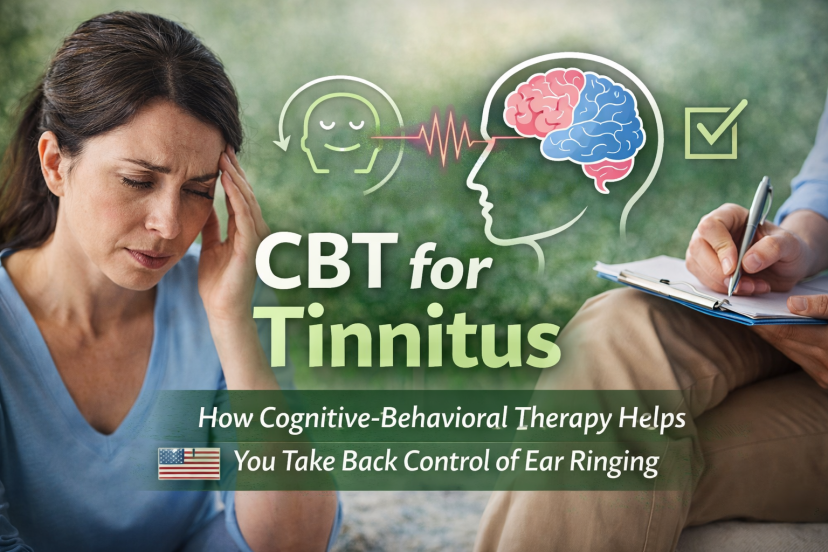
CBT does not attempt to switch off the tinnitus signal. Instead, it focuses on changing the thoughts, emotions, attention patterns, and behaviors that can make tinnitus more distressing.
The goal is not to convince yourself that tinnitus does not exist. The goal is to reach a point where tinnitus has much less control over your attention, emotions, sleep, and everyday life.
Quick Answer: How Does CBT For Tinnitus Help?
CBT for tinnitus helps people change unhelpful thoughts, emotional reactions, attention patterns, and behaviors associated with tinnitus. It generally does not make the tinnitus sound itself disappear. Instead, treatment aims to reduce tinnitus-related distress and make the sound less disruptive to everyday life.

CBT may include identifying unhelpful thoughts, learning relaxation and coping skills, changing avoidance behaviors, improving sleep habits, and gradually reducing the amount of attention given to tinnitus.
Clinical guidelines support tinnitus-related CBT as an option for people experiencing bothersome tinnitus or tinnitus-related distress.
Key Takeaways
Most likely benefit: CBT for tinnitus can help reduce the distress, fear, frustration, and disruption associated with tinnitus rather than eliminating the tinnitus sound itself.
Usually serious? Tinnitus itself is common, but new, sudden, one-sided, pulsatile, or otherwise unusual tinnitus should be medically evaluated to rule out causes requiring treatment.
First thing to check: Consider whether tinnitus is affecting your sleep, mood, concentration, work, relationships, or daily activities.
Best solution: If tinnitus is significantly affecting your quality of life, consider discussing tinnitus-focused CBT and a complete hearing or medical evaluation with an appropriate healthcare professional.
What Is Cognitive-Behavioral Therapy?
Cognitive-behavioral therapy is a structured form of psychological therapy based partly on the relationship between:
- Thoughts
- Emotions
- Physical reactions
- Attention
- Behaviors
Imagine that two people experience a similar tinnitus sound.
One thinks: There is that ringing again. It’s annoying, but I can continue what I’m doing.
The other thinks: It’s louder. Something must be getting worse. What if I can’t sleep tonight? What if this never stops?
The tinnitus may be similar, but the experience can be very different.
The second response may produce anxiety and increased monitoring of the sound. That increased attention can make tinnitus seem even more prominent, which creates additional anxiety.
CBT tries to interrupt this pattern.
Importantly, this does not mean tinnitus is imaginary or that people are simply “thinking about it incorrectly.”
Tinnitus is a real auditory perception.
CBT addresses what happens after you perceive it.
The Tinnitus Distress Cycle
One useful way to understand CBT for tinnitus is to think about a feedback loop.
Step 1: You Notice Tinnitus
Perhaps you enter a quiet bedroom and suddenly become aware of ringing.
Step 2: Your Brain Interprets The Sound
You might think, “Why is it louder tonight?”
Step 3: Worry Appears
That question can quickly become: “What if something is wrong?”
Step 4: Your Body Becomes More Alert
You may feel tense, anxious, frustrated, or restless.
Step 5: You Monitor The Tinnitus
Now you are actively listening to determine whether it has changed.
Step 6: The Sound Becomes Harder To Ignore
The more attention you give tinnitus, the more prominent it can seem.
Step 7: The Reaction Reinforces The Cycle
You conclude: “I knew it was getting worse.”
And the cycle begins again. CBT works at several points in this loop.
Instead of trying desperately to force the sound away, you learn to respond to it differently.
Why Attention Can Make Tinnitus Feel More Intrusive
Your brain receives an enormous amount of sensory information every second, but only a small amount reaches conscious awareness.
Think about the feeling of your shirt against your skin. It was there before you read that sentence. You simply weren’t paying attention to it.
Or consider a refrigerator humming in the kitchen. When you first walk into the room, you might notice it. A few minutes later, your attention may move elsewhere.
Tinnitus is more complicated because it can carry emotional significance.
If your brain begins treating the sound as important, threatening, frustrating, or something that must constantly be checked, it may become difficult to move it into the background.
This is one reason repeatedly checking tinnitus can become counterproductive.
You might ask yourself:
- Is it louder?
- Which ear is louder?
- Did that coffee make it worse?
- Can I hear it over the television?
- Is it changing pitch?
Occasionally noticing changes is normal. Constant monitoring, however, can train your attention toward tinnitus. CBT can help reduce that monitoring behavior.

What CBT For Tinnitus Actually Tries To Change
A common misunderstanding is that CBT teaches people to “think positively.”
That is not really the goal. Good CBT is more practical.
It helps identify patterns that may be increasing distress and then tests more useful ways of responding.
CBT May Target Catastrophic Thinking
Examples include:
- This sound will destroy my life.
- I’ll never sleep normally again.
- I won’t be able to concentrate anymore.
CBT does not replace these thoughts with unrealistic promises such as:
My tinnitus will definitely disappear.
Instead, you might develop a more balanced response:
My tinnitus is noticeable tonight, but I’ve had difficult evenings before and still managed to sleep.
That small difference matters.
Cognitive Restructuring: Changing The Story Around Tinnitus
Cognitive restructuring is one of the best-known CBT techniques.
It involves identifying an automatic thought and examining it more carefully.
Suppose your tinnitus suddenly seems louder.
Your immediate thought might be:
This spike means my tinnitus is permanently getting worse.
A CBT approach might ask:
What evidence supports that conclusion?
Maybe tinnitus has temporarily increased before and later settled.
Are there other explanations?
Perhaps you slept poorly, had a stressful day, spent time in a noisy environment, or simply noticed tinnitus more than usual.
Is the thought helpful?
Repeatedly predicting permanent worsening may increase anxiety without giving you useful information.
A more balanced thought might be:
My tinnitus is more noticeable right now. I don’t know whether this is temporary, so I’ll avoid repeatedly checking it and continue with my normal routine.
The objective isn’t forced optimism. It’s more accurate and useful thinking.
Reducing Tinnitus Checking
One practical CBT strategy that deserves more attention is reducing checking behavior. People with bothersome tinnitus may unknowingly check the sound dozens of times each day.
- You walk into the bathroom. Can I hear it?
- You turn off the television. How loud is it now?
- You wake at 3 a.m. Is the ringing still there?
- You get into the car. Can I hear it over the engine?
Every check tells your brain: This sound is important. Pay attention to it.
A therapist may help you recognize this pattern and gradually reduce unnecessary monitoring. The tinnitus may still be present, but you stop making it the subject of constant investigation.
Changing Avoidance Behaviors
Tinnitus can also change behavior. Someone might begin avoiding:
- Restaurants
- Social events
- Travel
- Exercise
- Quiet rooms
- Work meetings
- Movies
- Driving
- Going to bed at a normal time
Some avoidance is sensible—especially protecting your hearing around genuinely hazardous noise. But avoiding ordinary activities because you fear noticing tinnitus can gradually shrink your life.
CBT may help people return to normal activities gradually and safely.
The larger goal is important:
You don’t want tinnitus deciding where you go, what you do, or how you spend your day.
CBT For Tinnitus At Night
Nighttime is one of the most difficult periods for many people with tinnitus.
During the day, everyday sounds compete with tinnitus.
At night, the environment becomes quiet.
You lie down.
There are fewer distractions.
Suddenly the tinnitus seems to take center stage.
Then another problem develops.
You begin worrying about sleep.
- I need to fall asleep now.
- I’m going to be exhausted tomorrow.
- Why can’t I stop listening to this?
That frustration increases alertness—the exact opposite of what your body needs for sleep.
CBT Can Change The Nighttime Pattern
Depending on the individual and the treatment program, strategies may include:
- Maintaining a consistent sleep schedule
- Reducing clock-watching
- Creating a predictable wind-down routine
- Challenging catastrophic thoughts about poor sleep
- Using gentle background sound when helpful
- Practicing relaxation
- Getting out of bed temporarily when prolonged wakefulness becomes frustrating
For people who have significant insomnia as well as tinnitus, a clinician may also consider strategies used in cognitive-behavioral therapy for insomnia (CBT-I).
Relaxation Is Helpful—But It Isn’t The Whole Treatment
Relaxation exercises are frequently associated with CBT.
They can be useful, but CBT is much broader than relaxation.
The purpose of breathing exercises, progressive muscle relaxation, or similar techniques is not necessarily to make tinnitus quieter.
Instead, they can help reduce the physical arousal surrounding it.
If tinnitus triggers:
- Tight shoulders
- Jaw tension
- Rapid breathing
- Restlessness
- Racing thoughts
- A pounding heartbeat
then calming your body’s stress response may make the experience easier to manage.
A Simple Breathing Exercise
Try breathing gently through your nose for approximately four seconds.
Pause briefly if comfortable.
Then exhale slowly for approximately six seconds.
Continue for several minutes without forcing your breathing.
The exact number of seconds is less important than keeping the breathing comfortable and relaxed.
Think of this as a way of calming your nervous system—not as a test of whether you can make tinnitus disappear.
Attention-Shifting Without Fighting Tinnitus
There is an important difference between redirecting attention and desperately trying not to hear tinnitus.
If someone tells you, “Don’t think about a ringing sound.”
What happens? You probably think about it.
The same problem can occur when people repeatedly tell themselves, I must ignore my tinnitus.
That can turn ignoring tinnitus into another form of tinnitus monitoring.
Instead, CBT may encourage gentle attention shifting.
Notice the tinnitus without immediately reacting to it, then return your attention to something meaningful:
- A conversation
- Cooking
- Reading
- Gardening
- Walking
- Music
- Work
- A hobby
You don’t have to prove that you cannot hear tinnitus.
You are practicing the ability to hear it without giving it your full attention.
Acceptance Does Not Mean Giving Up
The word “acceptance” can initially sound discouraging.
Some people hear it as: There’s nothing anyone can do, so just live with it.
That isn’t the goal.
Acceptance means reducing the struggle against something you cannot immediately control while continuing to improve the things you can control.
- You can still seek appropriate medical evaluation.
- You can still protect your hearing.
- You can still address hearing loss.
- You can still improve your sleep.
- You can still use appropriate tinnitus-management strategies.
But you gradually stop organizing every moment around the question: How do I make this sound disappear right now?
That shift can be powerful.
Habituation And CBT: Are They The Same Thing?
Habituation describes the process by which a repeated, non-threatening stimulus may gradually receive less conscious attention.
You experience habituation constantly.
You may stop noticing:
- Air conditioning
- Traffic outside your home
- A ceiling fan
- The ticking of a clock
- The feeling of glasses on your face
Tinnitus is not identical to these examples, but they illustrate an important principle.
When a sound is repeatedly associated with fear, frustration, or danger, ignoring it becomes difficult.
Reducing the emotional importance attached to tinnitus may make it easier for attention to move elsewhere.
However, habituation shouldn’t become another performance target.
Constantly asking, “Have I habituated yet?”
can simply become another form of tinnitus checking.
Can CBT Make Tinnitus Quieter?
This distinction is important.
The primary purpose of CBT isn’t to reduce the physical loudness of tinnitus.
Research more consistently supports CBT for reducing the impact and distress associated with tinnitus.
Someone may therefore finish CBT and say: I can still hear it, but it doesn’t bother me nearly as much.
That is a meaningful outcome.
If tinnitus stops controlling sleep, concentration, mood, social activities, and daily decisions, quality of life can improve even when some auditory perception remains.
What Does Research Say About CBT For Tinnitus?
CBT is among the better-studied psychological approaches for bothersome tinnitus.
A Cochrane systematic review involving 28 studies and 2,733 participants found that CBT may reduce tinnitus’s negative impact on quality of life at the end of treatment compared with no treatment. The review also noted uncertainty around several secondary outcomes and limited longer-term follow-up evidence.
The 2024 U.S. Department of Veterans Affairs/Department of Defense clinical practice guideline suggests CBT delivered by a trained provider for adults with bothersome tinnitus. The guideline notes evidence of reduced tinnitus distress and possible improvements in related quality-of-life concerns, while also acknowledging limitations in the available evidence.
NICE guidance also includes tinnitus-related CBT within a stepped approach for adults whose tinnitus continues to affect emotional or social wellbeing and everyday activities.
The important takeaway is not that CBT “cures” tinnitus.
Rather, evidence supports its role in helping reduce the burden tinnitus places on everyday life.
What Happens During CBT For Tinnitus?
Programs vary, but treatment often starts with understanding your individual tinnitus experience.
A therapist may ask about:
- When tinnitus bothers you most
- Your thoughts when tinnitus becomes noticeable
- Sleep difficulties
- Anxiety
- Stress
- Activities you’ve stopped doing
- Situations you avoid
- How frequently you monitor the sound
- What you currently do during tinnitus spikes
You may then begin identifying patterns.
For example:
Situation: You wake at 2 a.m. and hear tinnitus.
Automatic thought: “I’m never getting back to sleep.”
Emotion: Anxiety.
Behavior: Check the clock, search tinnitus forums, repeatedly listen to the ringing.
Result: You become increasingly awake and distressed.
CBT looks for places where that sequence can be interrupted.
A Practical CBT-Style Tinnitus Diary
A diary can be helpful when it is used to understand patterns rather than obsessively measure tinnitus.
Instead of recording the loudness every hour, consider tracking situations where tinnitus causes meaningful distress.
You might record:
Situation: What was happening?
Thought: What immediately went through my mind?
Emotion: What did I feel?
Behavior: What did I do next?
Alternative response: What could I try next time?
For example:
Situation: Tinnitus became noticeable while reading in bed.
Thought: “It’s getting worse again.”
Emotion: Fear and frustration.
Behavior: Stopped reading and listened closely to the tinnitus.
Alternative response: It’s noticeable right now, but I don’t need to analyze it. I’ll return to my book and use gentle background sound if needed.
This turns tracking into a learning tool rather than a tinnitus-monitoring habit.
If your tinnitus changes from day to day, our Free Tinnitus Trigger Tracker And 30-Day Symptom Diary can help you record sounds, patterns, sleep, stress, noise exposure, and possible triggers without relying on memory.
What To Do During A Tinnitus Spike
A tinnitus spike can challenge even someone who normally copes well.
Instead of immediately analyzing the sound, try a simple CBT-inspired sequence.
1. Notice What Is Happening
My tinnitus is more noticeable today.
2. Notice Your Automatic Prediction
I’m worried this means it will stay this way.
3. Separate Facts From Predictions
The fact is that tinnitus seems more noticeable.
The prediction is that it will remain permanently worse.
Those are not the same thing.
4. Reduce Checking
Avoid repeatedly comparing the sound minute by minute.
5. Continue Normal Activities Where Possible
Go for your usual walk.
Make dinner.
Talk with family.
Watch television.
Continue your normal evening routine.
6. Give The Situation Time
Not every tinnitus fluctuation requires an immediate explanation.
Can You Practice CBT For Tinnitus At Home?
Some CBT principles can certainly be practiced outside therapy.
In fact, between-session practice is often an important part of CBT.
Helpful exercises can include:
- Identifying automatic thoughts
- Keeping a structured thought diary
- Practicing relaxation
- Reducing tinnitus checking
- Returning to avoided activities
- Developing healthier sleep routines
- Redirecting attention toward meaningful activities
However, self-help exercises aren’t necessarily equivalent to receiving structured CBT from a trained professional.
The 2024 VA/DoD guideline found support for CBT with provider involvement across delivery formats while noting insufficient evidence to recommend completely standalone self-administered CBT without therapist contact as equivalent care.
Digital CBT, guided online programs, group CBT, telehealth, and individual therapy may all be possibilities depending on availability and individual needs.
CBT And Sound Enrichment
Some people use gentle background sound as part of broader tinnitus management.
Examples might include:
- Fans
- Nature sounds
- Quiet music
- Environmental sounds
- White, pink, or brown noise
- Bedside sound machines
But there is an important distinction.
Sound doesn’t necessarily need to completely mask tinnitus.
For some people, simply reducing the contrast between tinnitus and a completely silent environment makes the sound easier to tolerate.
Evidence for individual sound-therapy approaches is less clear than the evidence supporting CBT for tinnitus-related distress. NICE, for example, did not make a specific practice recommendation for sound therapy because evidence was insufficient to identify a particular approach.
That makes it sensible to treat sound enrichment as an individualized management tool rather than a guaranteed tinnitus treatment.
CBT, Stress And Tinnitus
Stress and tinnitus can interact in frustrating ways.
- You notice tinnitus.
- You become stressed about tinnitus.
- Stress increases your overall arousal.
- You become more attentive to tinnitus.
- Tinnitus feels harder to ignore.
That creates more stress.
CBT can help interrupt this loop by addressing both the thoughts surrounding tinnitus and the behaviors that maintain constant vigilance.
Stress management might include:
- Regular physical activity
- Relaxation exercises
- Better sleep routines
- Taking breaks during stressful days
- Spending time outdoors
- Maintaining social connections
- Mindfulness or meditation when helpful
The objective is not to create a completely stress-free life. It is to become more resilient when stress occurs.
Don’t Build Your Entire Life Around Tinnitus Triggers
When people first begin researching tinnitus, they can encounter enormous lists of supposed “triggers.”
- Coffee.
- Salt.
- Sugar.
- Exercise.
- Alcohol.
- Headphones.
- Stress.
- Certain foods.
- Weather.
- Sleep.
This can make everyday life increasingly restrictive.
Individual patterns certainly exist, and protecting yourself from damaging noise is important. But it is usually better to look for repeatable personal patterns rather than assume every possible trigger applies to you.
If you suspect something makes your tinnitus more noticeable, track it sensibly over time. Avoid turning tinnitus management into an endless search for things to eliminate from your life.
How Long Does CBT For Tinnitus Take?
There isn’t one universal treatment schedule.
The 2024 VA/DoD guideline notes that typical CBT treatment may last roughly one to three months, although actual programs and individual needs vary.
Progress also isn’t necessarily linear.
You might have several good days followed by a difficult tinnitus spike.
That doesn’t mean the strategies have stopped working.
A better measure of progress may be asking:
- Am I checking tinnitus less?
- Am I sleeping better?
- Am I less frightened when tinnitus changes?
- Am I returning to activities I previously avoided?
- Does a tinnitus spike ruin my entire day?
- Can I concentrate on other things more easily?
- Am I spending less time researching tinnitus?
- Do I recover emotionally from difficult tinnitus days more quickly?
These changes may tell you more than repeatedly rating tinnitus loudness.
Who Can Provide CBT For Tinnitus?
Depending on where you live and the services available, tinnitus-focused CBT may involve a psychologist or another appropriately trained behavioral-health professional, sometimes as part of multidisciplinary tinnitus care.
Audiologists may also play an important role in tinnitus assessment, education, hearing evaluation, and broader management.
Because tinnitus often crosses several areas—hearing, sleep, stress, attention, and emotional wellbeing—a coordinated approach can sometimes be particularly useful.
When CBT May Be Especially Worth Considering
You may want to discuss CBT with a healthcare professional if tinnitus is:
- Creating significant anxiety
- Interfering with sleep
- Affecting concentration
- Making work difficult
- Causing you to withdraw socially
- Leading you to avoid ordinary activities
- Creating persistent fear about your health
- Triggering repeated tinnitus checking
- Making you feel unable to cope
You do not need to wait until tinnitus becomes unbearable before seeking help.
When Tinnitus Needs Medical Evaluation
CBT addresses tinnitus-related distress. It does not replace appropriate medical or hearing evaluation.
Seek prompt medical advice for tinnitus associated with concerning symptoms.
For example, tinnitus accompanied by sudden hearing loss needs urgent assessment. NICE recommends that tinnitus with hearing loss developing suddenly over three days or less within the previous 30 days be assessed within 24 hours.
Medical assessment is also particularly important for tinnitus that is:
- Persistent in only one ear
- Pulsatile or synchronized with your heartbeat
- Associated with significant dizziness or balance problems
- Associated with neurological symptoms
- Accompanied by sudden or rapidly changing hearing
- Following a significant head injury
Persistent unilateral or pulsatile tinnitus may warrant specialist assessment even when other symptoms aren’t present.
And if tinnitus is causing severe emotional distress, depression, or thoughts of self-harm, seek immediate professional support.
Learn more about the Tinnitus Doctor Visit Checklist on our questions and symptoms to write down before your appointment
7 Practical CBT Principles You Can Remember
If you are learning to live more comfortably with tinnitus, these seven principles provide a useful summary:
1. Don’t treat every tinnitus change as danger.
Notice the difference between what you know and what you fear might happen.
2. Reduce unnecessary checking.
You don’t need to measure tinnitus throughout the day.
3. Keep living your normal life.
Try not to let tinnitus gradually remove activities you value.
4. Work on sleep separately.
Poor sleep can make almost everything harder to manage.
5. Use relaxation to reduce arousal—not to force tinnitus away.
Making relaxation dependent on tinnitus becoming quieter can create additional frustration.
6. Redirect attention rather than fighting the sound.
You don’t have to eliminate tinnitus from awareness before focusing on something else.
7. Measure progress by your life, not just the sound.
Sleeping, working, socializing, traveling, exercising, and enjoying quiet moments again may be more meaningful measures of improvement.
FAQs About CBT For Tinnitus
1. Does CBT Cure Tinnitus?
No. CBT is not considered a cure for tinnitus and generally isn’t intended to eliminate the tinnitus signal. Its primary purpose is to reduce tinnitus-related distress and improve the person’s ability to cope with tinnitus.
2. Can CBT Actually Make Tinnitus Less Noticeable?
Potentially. CBT does not necessarily reduce tinnitus loudness, but reducing fear, monitoring, and emotional reactions may make tinnitus less intrusive in everyday awareness. A person may still hear tinnitus when deliberately listening for it while spending much less of the day noticing it.
3. How Long Does CBT For Tinnitus Take To Work?
Treatment length varies. Structured CBT programs may run for several weeks or a few months. Some people notice changes relatively early, while others need longer to develop and consistently use the skills.
4. Can CBT Help With Tinnitus At Night?
Yes, particularly when thoughts and behaviors surrounding tinnitus contribute to sleep difficulty. Treatment may address nighttime anxiety, sleep habits, clock-watching, relaxation, and unhelpful beliefs about sleep. People with substantial insomnia may also benefit from discussing CBT-I with an appropriate professional.
5. Can I Do CBT For Tinnitus Online?
Digital and internet-delivered CBT approaches have been studied, and some clinical guidance includes digital tinnitus-related CBT among psychological treatment options. Availability, professional involvement, program quality, and suitability vary, so discuss options with an appropriate healthcare professional.
6. Is CBT Only For People With Severe Tinnitus?
No. What matters isn’t simply how loud tinnitus seems. The more relevant question is how much it affects your life. Someone with relatively quiet tinnitus may experience substantial anxiety, while someone with louder tinnitus may experience little distress.
CBT focuses primarily on that functional and emotional impact.
7. Does Going To CBT Mean My Tinnitus Is Psychological?
No. Using CBT does not mean tinnitus is imaginary or “all in your head.” CBT is used to change the distress, thoughts, attention, and behavioral patterns associated with a real symptom.
8. What If CBT Doesn’t Make My Tinnitus Quieter?
That doesn’t necessarily mean treatment has failed. Ask whether tinnitus has become less frightening, less disruptive, or less central to your day. If you’re sleeping better, concentrating more easily, returning to activities, and thinking about tinnitus less frequently, those can be meaningful improvements even if the perceived sound hasn’t disappeared.
Final Thoughts: Taking Back Attention From Tinnitus
One of the most frustrating things about tinnitus is the feeling that you cannot control the sound. CBT offers a different goal. Instead of asking, “How can I control tinnitus?” you begin asking, “How much control am I going to give tinnitus over my day?” You may not be able to decide whether you hear ringing when you enter a quiet room.
But you can gradually change what happens next.
- You can learn not to immediately assume the worst.
- You can reduce constant checking.
- You can stop measuring every tinnitus fluctuation.
- You can work on sleep without turning bedtime into a nightly battle with your ears.
- You can return to activities you’ve been avoiding.
- You can learn that hearing tinnitus and being distressed by tinnitus are not necessarily the same thing.
That is the central idea behind CBT for tinnitus. The objective isn’t pretending the sound isn’t there. It’s reaching the point where tinnitus becomes one part of your sensory environment rather than the center of your attention. For many people, that change can be just as important as changing the sound itself.
Medical Disclaimer: This article is for general educational and informational purposes only and does not substitute for professional medical advice, diagnosis, or treatment. Always consult an appropriately qualified healthcare professional regarding tinnitus, hearing changes, mental health concerns, or treatment options.
 Explore more:
- Sound Therapy Tinnitus Relief
- Noise Induced Tinnitus Prevention
- What Causes Tinnitus Ringing In The Ears?
- Tinnitus Trigger Tracker And 30-Day Symptom Diary