
Medical Disclaimer: This resource is for general educational and organizational purposes only and is not a diagnostic tool or a substitute for professional medical advice, diagnosis, or treatment.
A doctor’s appointment can go by quickly, especially when you’re trying to explain something as personal and sometimes difficult to describe as tinnitus. You may know exactly what you want to discuss beforehand, only to realize afterward that you forgot an important symptom, medication, question, or detail about when the ringing started.
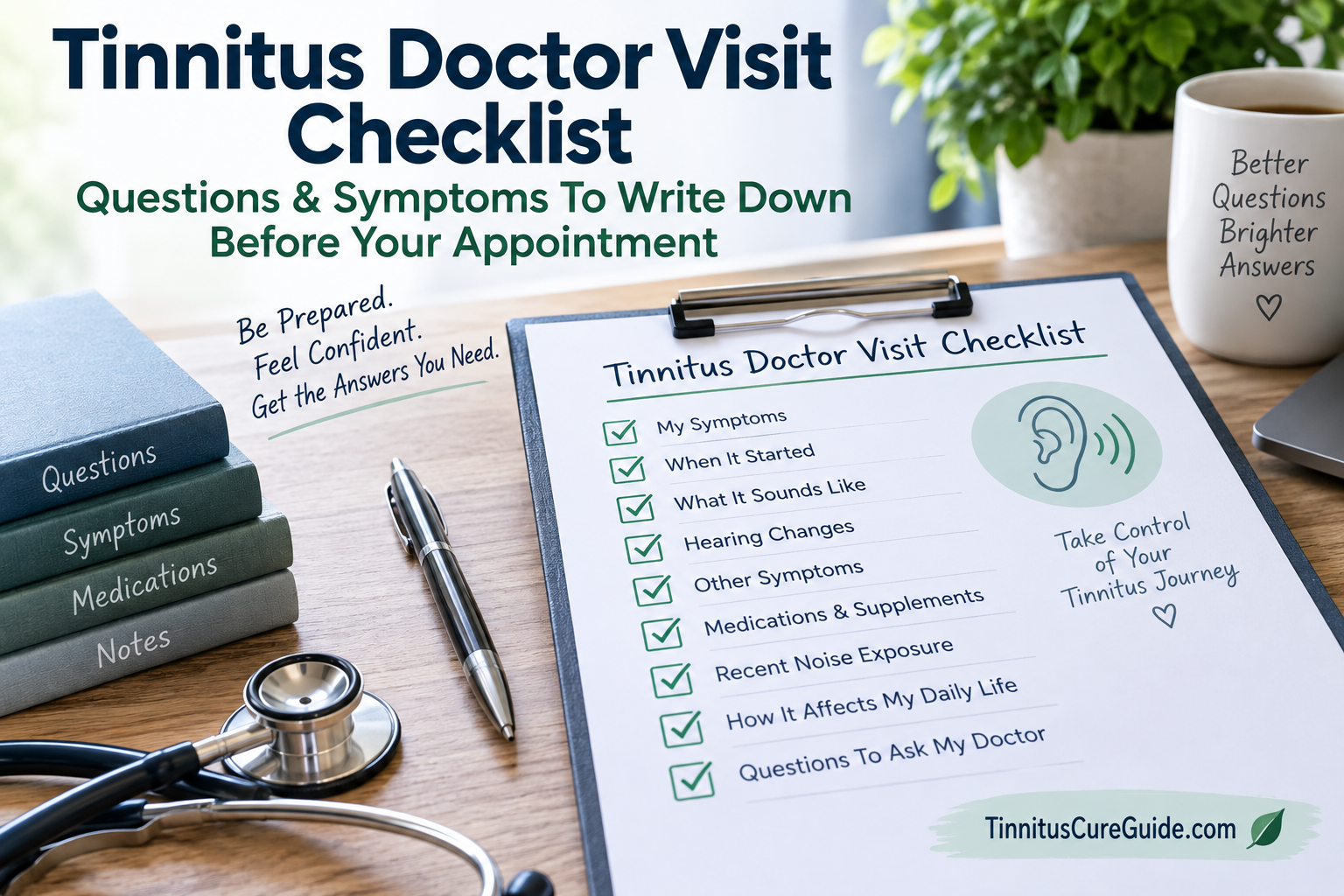
This Tinnitus Doctor Visit Checklist is a simple, free resource designed to help you organize that information before your appointment.
You can use the checklist to write down what your tinnitus sounds like, when you first noticed it, whether it comes and goes, which ear you hear it in, other symptoms you’ve noticed, recent noise exposure, medications and supplements, and questions you’d like to ask.
You don’t need to complete every question. Simply fill in the sections that apply to you and take your notes to your appointment.
This checklist does not diagnose tinnitus or determine its cause. Its purpose is simply to help you remember and communicate information that may be useful to your healthcare professional.
What Should I Write Down Before A Doctor Visit For Tinnitus?
Before an appointment about tinnitus, it can be helpful to write down when the sound started, where you hear it, what it sounds like, whether it is constant or intermittent, whether it seems to pulse with your heartbeat, any hearing changes or other symptoms, recent noise exposure, medications and supplements, and how tinnitus affects your daily life.
The National Institute on Deafness and Other Communication Disorders (NIDCD) notes that tinnitus evaluation can include questions about medical history, medications, what the tinnitus sounds like, and when it began. Depending on the situation, hearing evaluation or referral to an ear, nose, and throat specialist may also be appropriate.
Why Prepare For A Tinnitus Appointment?
Tinnitus can be surprisingly difficult to describe.
You may experience ringing, buzzing, humming, hissing, clicking, roaring, whistling, or another sound. It might occur in one ear, both ears, or seem to be inside your head. It may be constant or come and go. NIDCD notes that tinnitus experiences can vary considerably from person to person.
Writing things down beforehand means you don’t have to rely entirely on memory during your appointment.
A checklist can also help you organize your thoughts into a few basic areas:
- What you’re experiencing
- When it started
- How it has changed
- Other symptoms you’ve noticed
- Possible relevant events or changes
- Medications and supplements you take
- How tinnitus affects your everyday life
- Questions you want to ask
Your doctor can then decide which details are medically relevant.
How To Use This Tinnitus Doctor Visit Checklist
You can copy and paste the checklist into Google Docs or Microsoft Word, print it, or write your answers on paper. Or you can download the free printable PDF.
Download The Free Printable Tinnitus Doctor Visit Checklist PDF
Don’t worry about providing perfect answers.
If you don’t know something, simply write “Not sure.”
Try to describe what you’ve actually experienced rather than trying to determine what caused it yourself.
For example, instead of writing: “My tinnitus is caused by my neck.”
You could record: “The sound sometimes seems to change when I move my neck.”
That gives your healthcare professional the observation without making a diagnosis.
Tinnitus Doctor Visit Checklist
1. When Did Your Tinnitus Start?
When did you first notice the tinnitus?
Date or approximate date:
Did it seem to begin:
☐ Suddenly
☐ Gradually
☐ I’m not sure
What were you doing or what was happening around the time you first noticed it?
Has the tinnitus changed since it first began?
☐ Yes
☐ No
☐ Not sure
If yes, what changed?
2. Where Do You Hear The Tinnitus?
Check the option that best describes your experience.
☐ Left ear
☐ Right ear
☐ Both ears
☐ Seems to be inside my head
☐ Difficult to tell
☐ Other: ________________________________
NIDCD notes that tinnitus can be perceived in one ear, both ears, or in the head, so this is a useful basic detail to record.
3. What Does Your Tinnitus Sound Like?
Check any that apply.
☐ Ringing
☐ Buzzing
☐ Hissing
☐ Humming
☐ Whistling
☐ Roaring
☐ Clicking
☐ Squealing/high-pitched tone
☐ Whooshing
☐ Another sound: _________________________
Describe the sound in your own words:
There isn’t one universal tinnitus sound. NIDCD describes tinnitus as potentially including ringing, buzzing, roaring, whistling, humming, clicking, hissing, squealing, and other perceived sounds.
4. How Often Do You Notice It?
☐ Constantly
☐ Several times a day
☐ Once or twice a day
☐ A few times a week
☐ Occasionally
☐ It varies
☐ Not sure
If it comes and goes, approximately how long does an episode last?
Is there a particular time when you notice it more?
☐ Morning
☐ Afternoon
☐ Evening
☐ Bedtime
☐ During the night
☐ In quiet environments
☐ No obvious pattern
☐ Other: ________________________________
5. Does The Sound Seem To Follow Your Heartbeat?
☐ Yes
☐ No
☐ Sometimes
☐ I’m not sure
If yes, describe what you notice:
This is worth specifically recording. NIDCD notes that tinnitus can, in some cases, pulsate rhythmically, often in time with the heartbeat, and evaluation may differ for pulsatile tinnitus.
6. Have You Noticed Any Hearing Changes?
☐ No hearing changes that I’ve noticed
☐ Hearing seems worse in my left ear
☐ Hearing seems worse in my right ear
☐ Hearing seems worse in both ears
☐ Sounds seem muffled
☐ I have difficulty understanding conversations
☐ I turn up the TV/music more than before
☐ I’m more sensitive to certain sounds
☐ Ear feels blocked or full
☐ Other: ________________________________
Describe anything else you’ve noticed about your hearing:
Hearing information can be relevant because tinnitus is commonly associated with hearing loss, and hearing evaluation may form part of a tinnitus assessment.
7. Other Symptoms Or Changes You’ve Noticed
Check anything you would like to remember to mention.
☐ Ear pain or discomfort
☐ Ear pressure/fullness
☐ Dizziness
☐ Balance problems
☐ Headaches
☐ Ear drainage
☐ Jaw discomfort
☐ Jaw clicking
☐ Neck discomfort
☐ Changes in hearing
☐ Difficulty sleeping
☐ Difficulty concentrating
☐ Other: ________________________________
Additional details:
This list is for organizing observations, not determining whether a symptom is related to your tinnitus.
8. Recent Noise Exposure
Think about the period before your tinnitus began or changed.
Have you recently experienced:
☐ Concert or live music
☐ Loud headphones/earbuds
☐ Power tools
☐ Lawn equipment
☐ Loud workplace
☐ Sporting event
☐ Fireworks
☐ Other unusually loud environment
☐ Sudden extremely loud sound
☐ No unusual noise exposure that I remember
What happened and approximately when?
Noise exposure is one factor associated with tinnitus and hearing damage, so it can be useful information to mention during an appointment.
9. Recent Health Or Lifestyle Changes
Have there been any recent changes that you want your healthcare professional to know about?
☐ Recent illness
☐ Cold or congestion
☐ Ear infection
☐ Head or neck injury
☐ Dental work
☐ Increased stress
☐ Major sleep changes
☐ New medication
☐ Medication dose change
☐ New supplement
☐ Other: ________________________________
Details:
You don’t need to decide whether any of these things caused your tinnitus. Simply record anything you think might be useful to discuss.
10. Medications And Supplements
Bring an up-to-date medication list if you have one.
Don’t forget prescription medications, over-the-counter medicines, vitamins, and supplements.
| # | Medication / Supplement | Dose (If Known) | How Often | When Started |
|---|---|---|---|---|
| 1 | ||||
| 2 | ||||
| 3 | ||||
| 4 | ||||
| 5 |
NIDCD notes that tinnitus can occur as a side effect of some medications, making an accurate medication history useful during an evaluation.
Don’t stop or change a medication because you suspect it may be related to tinnitus without discussing it with the appropriate healthcare professional.
11. How Is Tinnitus Affecting Your Daily Life?
Tinnitus isn’t only about the sound itself.
Think about whether it affects:
☐ Falling asleep
☐ Staying asleep
☐ Concentration
☐ Work
☐ Reading
☐ Relaxing
☐ Conversations
☐ Social activities
☐ Mood
☐ Everyday activities
☐ It currently has little effect on my daily life
The biggest difficulty tinnitus causes me is:
NIDCD notes that for some people tinnitus can interfere with sleep, concentration, mood, and other aspects of daily life.
Questions To Ask Your Doctor About Tinnitus
You don’t have to ask every question below. Choose the ones that matter to you and add your own.
☐ Are there any possible causes of my tinnitus that should be evaluated?
☐ Should my hearing be tested?
☐ Would seeing an audiologist be appropriate?
☐ Would seeing an ENT specialist be appropriate?
☐ Could any of my medications or supplements be relevant?
☐ Are there other symptoms or changes I should watch for?
☐ What can I safely do to make tinnitus less disruptive?
☐ What options are available if tinnitus is affecting my sleep or concentration?
☐ Should I schedule a follow-up appointment?
☐ What should make me seek medical attention sooner?
My Own Questions
1. ________________________________________
2. ________________________________________
3. ________________________________________
4. ________________________________________
5. ________________________________________
What To Bring To Your Appointment
Before leaving home, consider taking:
☐ This completed tinnitus checklist
☐ Your current medication and supplement list
☐ Your 30-Day Tinnitus Symptom Diary, if you’ve completed one
☐ Information about previous hearing tests, if available
☐ Relevant medical information your healthcare provider has asked you to bring
☐ Your list of questions
☐ Pen or phone for taking notes
You don’t need to arrive with your own diagnosis. The purpose of preparing is simply to make it easier to communicate what you’ve experienced.
When Not To Wait For A Routine Appointment
This checklist is intended to prepare for an appointment; it shouldn’t be used to decide whether potentially urgent symptoms can wait.
For example, NIDCD advises prompt physician evaluation for sudden or rapidly worsening hearing loss, and its guidance also identifies one-sided tinnitus or hearing differences, ear pain or discharge, and vertigo with hearing loss as reasons to seek medical evaluation. Sudden sensorineural hearing loss is considered a medical emergency. (NIDCD)
The American Academy of Otolaryngology–Head and Neck Surgery also identifies features such as sudden or rapidly progressive hearing loss, recurrent dizziness, one-sided tinnitus, and pulsatile tinnitus as findings that can warrant medical evaluation. (AAO-HNS)
If you develop sudden hearing loss or severe or rapidly changing symptoms, or believe you may be experiencing a medical emergency, seek appropriate medical care rather than waiting to complete this checklist.
After Your Appointment
Keep the checklist if you think it may be useful later.
You can use the notes section to record:
Date of appointment: ______________________
Healthcare professional: ___________________
Things I want to remember:
Next appointment or follow-up:
Questions I still have:
Medical Disclaimer
This Tinnitus Doctor Visit Checklist is provided for general informational, educational, and personal organizational purposes only.
It is not a medical questionnaire, screening test, diagnostic tool, or substitute for professional medical advice, diagnosis, or treatment. Completing the checklist cannot determine the cause of tinnitus or whether you have a medical condition.
The questions are provided simply to help you organize information you may wish to discuss with an appropriately qualified healthcare professional.
Do not start, stop, or change medications or treatment based on this checklist or information on TinnitusCureGuide.com without consulting an appropriately qualified healthcare professional.
If you have tinnitus, hearing changes, or other symptoms that concern you, seek professional medical advice. Seek prompt medical attention for sudden or severe symptoms or whenever you believe you may be experiencing a medical emergency.
Make Your Appointment A Little Easier
You don’t need to remember everything about your tinnitus while sitting in the doctor’s office.
Take a few minutes beforehand to write down when it started, what it sounds like, where you hear it, how often you notice it, other changes you’ve experienced, medications you take, and the questions you want answered.
That’s all this Tinnitus Doctor Visit Checklist is designed to do: help you arrive at your appointment with your observations and questions organized, so you can spend more of your visit discussing what matters to you.
Sources & Further Reading: The medical background used in preparing this resource was checked against current information from the U.S. National Institute on Deafness and Other Communication Disorders and the American Academy of Otolaryngology–Head and Neck Surgery.
Explore more tools:
- Download The Free Printable Tinnitus Doctor Visit Checklist PDF
- Tinnitus Trigger Tracker & 30-Day Symptom Diary