Common Tinnitus Causes: A Complete Guide To Why Your Ears May Be Ringing
Possible Reasons Why Your Ears May Be Ringing
If you’ve started hearing ringing, buzzing, humming, hissing, or another sound that nobody else seems to hear, one of your first questions is probably: Why is this happening? Tinnitus can appear suddenly or gradually, affect one or both ears, and remain constant or come and go. Understanding the common tinnitus causes can help you make sense of what you’re experiencing and determine whether there is an obvious factor worth investigating.
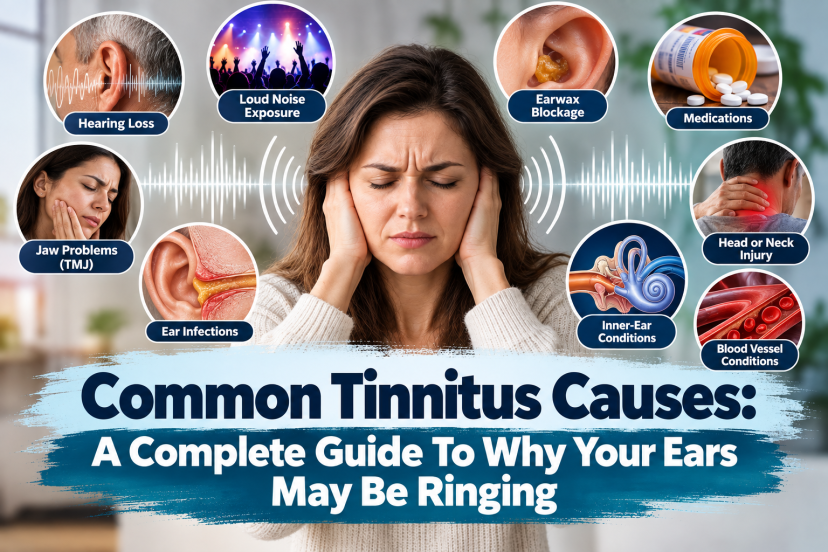
Tinnitus itself is not usually considered a disease. It is a symptom—the perception of sound when there is no corresponding external sound source. Hearing loss and noise exposure are strongly associated with tinnitus, but earwax, ear infections, certain medications, jaw problems, head or neck injuries, blood-vessel conditions, and other health conditions can also be involved. Sometimes, no specific cause can be identified at all.
That uncertainty can be frustrating. You may find yourself thinking back over everything you’ve done recently, wondering whether your headphones, coffee, stress, diet, sleep, or something more serious caused your ears to ring.
A more useful approach is to understand the major categories of tinnitus causes, look for relevant clues, and know when a new or changing symptom deserves professional evaluation.
Quick Answer: What Are The Most Common Tinnitus Causes?
Some of the most common tinnitus causes are hearing loss and exposure to loud noise. Tinnitus can also be associated with earwax blockage, ear infections, certain medications, jaw-joint problems, head or neck injuries, Ménière’s disease, and some blood-vessel or other medical conditions. However, tinnitus does not always have one identifiable cause.
The circumstances surrounding your tinnitus can provide useful clues. Consider when it started, whether it affects one or both ears, whether your hearing has changed, whether the sound pulses with your heartbeat, and whether you recently experienced loud noise, illness, an injury, or a medication change.
A healthcare professional can examine your ears, review your medications and medical history, check for problems such as earwax or infection, and arrange a hearing evaluation or further testing when appropriate.
Key Takeaways
Most likely cause: Hearing changes and previous noise exposure are among the most important possibilities, although there are many potential common tinnitus causes.
Usually serious? Tinnitus is usually not associated with a serious medical problem, but certain patterns and accompanying symptoms deserve prompt evaluation.
First thing to check: Think about hearing changes, recent loud noise, ear blockage or infection, new medications, jaw symptoms, and whether the tinnitus affects one or both ears.
Best solution: Rather than guessing at the cause, document your symptoms and relevant changes. Persistent, worsening, one-sided, pulsatile, or otherwise concerning tinnitus can be discussed with a healthcare professional or hearing specialist.
Understanding What Causes Tinnitus
One reason tinnitus can be confusing is that there isn’t a single explanation that applies to everyone.
Two people can hear an almost identical high-pitched ringing and have very different circumstances behind it.
One person may have age-related hearing changes.
Another may have years of occupational noise exposure.
Someone else may have an earwax blockage, jaw problem, medication-related tinnitus, or an inner-ear condition.
And another person may go through a full evaluation without finding a specific cause.
Tinnitus Is A Symptom, Not One Single Condition
Tinnitus describes the experience of hearing sound without an external sound source.
That sound might resemble:
- Ringing
- Buzzing
- Hissing
- Humming
- Roaring
- Clicking
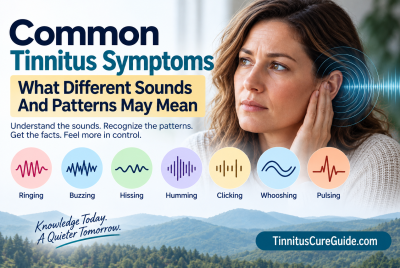
- Squealing
- Whooshing
- Pulsing
The sound may be high- or low-pitched, soft or loud, intermittent or constant. It can occur in one ear, both ears, or feel as though it is somewhere inside the head.
Because tinnitus describes a symptom rather than one single disease, finding the reason behind it can require looking at several different areas.
The Ear And Brain Both Matter
Although tinnitus often feels as though the noise is coming directly from your ear, the auditory system includes both the ears and the brain.
NIDCD describes a leading theory in which inner-ear damage alters the signals traveling to brain areas responsible for processing sound. Changes in neural activity may then contribute to the perception of tinnitus. Researchers continue studying the exact mechanisms involved.
This helps explain why tinnitus can continue even when there isn’t an actual sound being produced inside the ear.
Cause And Trigger Are Not The Same Thing
This distinction is particularly useful.
A cause may help explain why you developed tinnitus.
A trigger may simply make existing tinnitus more noticeable.
For example, long-term loud-noise exposure could contribute to hearing damage associated with tinnitus.
Later, poor sleep or stress might make that existing tinnitus harder to ignore.
That does not necessarily mean poor sleep caused the original tinnitus.
Keeping these two concepts separate can prevent you from unnecessarily blaming every bad tinnitus day on something you ate, drank, or did.
10 Potential Tinnitus Causes
The following ten possibilities cover several of the major categories associated with tinnitus.
They are not intended as a self-diagnosis checklist. Instead, use them to understand which clues may be worth discussing with a healthcare professional.
Hearing And Noise-Related Causes
1. Hearing Loss
Hearing loss is one of the most important conditions associated with tinnitus.
Most people with tinnitus have some degree of hearing loss, although many people with hearing loss never develop tinnitus. Hearing changes may result from aging, noise exposure, or other problems affecting the auditory system.
You may already know your hearing isn’t what it used to be.
But hearing loss can also be subtle.
Signs Worth Noticing
You might:
- Have difficulty understanding speech in restaurants
- Ask people to repeat themselves
- Turn the television volume higher
- Struggle to hear higher-pitched sounds
- Find conversations harder when background noise is present
You may still feel that your hearing is “normal” in everyday situations.
That is why a formal hearing test can be useful when tinnitus persists.
If tinnitus and hearing loss occur together, hearing aids may sometimes help by making external sounds easier to hear and reducing the prominence of tinnitus.
Learn more: Tinnitus And Hearing Loss: What’s The Link?
2. Loud Noise Exposure
Noise exposure is another major tinnitus-related factor.
This can happen after one extremely intense sound or through repeated exposure over many years.
Examples include:
- Concerts
- Power tools
- Heavy machinery
- Loud workplaces
- Motorcycles
- Sporting events
- Fireworks
- High-volume headphones or earbuds
NIDCD notes that harmful noise can damage sensitive structures within the inner ear. Noise-induced hearing loss may develop gradually or follow a single intense sound, and tinnitus can accompany that damage.
Think About Your Lifetime Noise Exposure
Don’t only ask what happened yesterday.
Consider your history.
Perhaps you worked around machinery for 20 years.
Maybe you attended loud concerts frequently when you were younger.
Perhaps you spent years using power tools without hearing protection.
Tinnitus appearing today can sometimes be connected with hearing changes that developed over a much longer period.
Learn more: Tinnitus After Loud Music
Ear-Related Causes
3. Earwax Blockage
Earwax has an important job. It helps protect the ear canal.
However, excessive wax can sometimes block the ear canal and contribute to tinnitus or hearing changes.
This is one reason an ear examination can be useful when tinnitus begins.
Possible Clues
Along with tinnitus, you might notice:
- Ear fullness
- Muffled hearing
- A blocked sensation
- Reduced hearing in one ear
These symptoms do not prove that earwax is responsible.
A healthcare professional can examine the ear and determine whether there is actually a blockage.
Avoid repeatedly inserting cotton swabs or other objects deep into the ear in an attempt to find or remove wax yourself.
4. Ear Infection Or Middle-Ear Problems
Ear infections and fluid in the ear can also be associated with tinnitus.
NIDCD notes that blockage caused by fluid from an ear infection can trigger tinnitus, while Mayo Clinic includes ear infections and eustachian-tube problems among conditions involving ear structure and function that can be associated with tinnitus.
Look For Other Ear Symptoms
These may include:
- Ear pain
- Pressure
- Fullness
- Hearing changes
- Recent respiratory illness
- Discharge
If tinnitus began during or after an illness and does not improve, consider having the ear examined rather than assuming it is simply a permanent change.
Learn more: Tinnitus After Ear Infection
Medication-Related Causes
5. Certain Medications
Some medications can cause or worsen tinnitus.
NIDCD lists several medication categories associated with tinnitus, particularly at higher doses, including certain NSAIDs, antibiotics, anti-cancer medicines, anti-malaria medications, and antidepressants.
This does not mean everyone taking these medications will develop tinnitus.
It also does not mean you should stop taking a medication because you’ve noticed ringing.
What To Record
If your tinnitus appeared around a medication change, write down:
- Medication name
- Dosage
- When you started taking it
- Any recent dosage increase or decrease
- When tinnitus started
- Whether tinnitus affects one or both ears
Then discuss the timing with your doctor or pharmacist.
Do not abruptly stop prescribed medication without professional guidance. Mayo Clinic specifically advises discussing suspected medication-related tinnitus with a healthcare provider rather than stopping medication independently.
Jaw, Head And Neck Causes
6. Jaw Joint Problems And Teeth Grinding
The temporomandibular joint, commonly called the TMJ, sits close to the ear.
Problems involving this joint can sometimes cause or worsen tinnitus. Jaw clenching and tooth grinding may also affect surrounding tissues.
This possibility may be particularly worth investigating if you also experience:
- Jaw pain
- Clicking or popping
- Facial tension
- Morning jaw soreness
- Teeth grinding
- Headaches
- Difficulty opening your mouth comfortably
Does Moving Your Jaw Change The Sound?
Some people can temporarily change their tinnitus by:
- Opening their mouth
- Clenching their teeth
- Moving their jaw sideways
- Moving their head or neck
NIDCD describes this type of change with movement or touch as somatosensory tinnitus.
If you’ve noticed this pattern, mention it during your evaluation.
Learn more: TMJ Tinnitus Jaw Neck
7. Head Or Neck Injury
An injury involving the head or neck can affect structures involved in hearing, auditory nerves, or brain areas associated with sound processing.
Head and neck injuries are recognized potential causes of tinnitus.
The timing matters.
If your tinnitus started immediately or shortly after:
- A car accident
- A fall
- A sports injury
- A blow to the head
- Another significant injury
Tell your healthcare professional.
New tinnitus following head trauma should not simply be treated as an everyday tinnitus fluctuation.
Inner-Ear And Medical Causes
8. Ménière’s Disease And Other Inner-Ear Conditions
Ménière’s disease is an inner-ear disorder that can involve tinnitus, hearing loss, and balance problems.
Tinnitus by itself does not mean you have Ménière’s disease.
However, if tinnitus occurs alongside symptoms such as episodes of vertigo, ear pressure or fullness, and changing hearing, those additional details are important to tell your healthcare professional.
This illustrates an important principle when investigating tinnitus:
Don’t look at the ringing alone.
Associated symptoms can provide valuable clues.
9. Blood Vessel And Circulation-Related Conditions
Most tinnitus is subjective, meaning only the person experiencing it can hear it.
But there is another important pattern: tinnitus that seems to pulse rhythmically, often in time with the heartbeat.
This is commonly called pulsatile tinnitus.
Blood-vessel problems, including high blood pressure, atherosclerosis, and vascular abnormalities, can sometimes be associated with tinnitus.
Learn more: Vascular Tinnitus Causes
Pay Attention To The Rhythm
Ask yourself:
Does the sound seem synchronized with my heartbeat?
A pulsing or rhythmic whooshing sound is different from ordinary steady ringing.
The NHS advises seeking urgent medical assessment for tinnitus that beats in time with your pulse.
Don’t try to determine the vascular cause yourself.
The important step is recognizing the pattern and having it appropriately evaluated.
10. Other Health Conditions
Tinnitus has also been associated with a variety of health conditions.
NIDCD lists conditions including:
- Diabetes
- Migraine
- Thyroid disorders
- Anemia
- Certain autoimmune disorders
as being linked with tinnitus.
Again, this needs context.
If you have tinnitus, you should not read this list and conclude that you have diabetes, thyroid disease, anemia, or an autoimmune disorder.
Tinnitus is common and can have many explanations.
These associations simply demonstrate why your overall medical history may matter when a healthcare professional evaluates persistent or unusual tinnitus.
What If There Is No Obvious Cause?
This can be one of the most frustrating situations.
You’ve reviewed your medications.
Your ears aren’t blocked.
There was no recent concert.
You didn’t suffer an injury.
And you still have tinnitus.
This doesn’t necessarily mean something has been missed.
NIDCD notes that some people develop tinnitus without a known reason, while Mayo Clinic similarly states that healthcare professionals cannot identify an exact cause in many cases.
The goal of an evaluation therefore isn’t always to find one perfect explanation.
Sometimes it is to rule out important or treatable problems, assess hearing, understand the tinnitus pattern, and determine how best to manage its effects.
How To Identify The Possible Cause Of Your Tinnitus
Trying to diagnose tinnitus from a long list of possible causes can quickly become overwhelming.
A more practical approach is to build a timeline.
Start With When The Tinnitus Began
Ask yourself:
When did I first notice it?
Try to identify whether the onset was:
- Sudden
- Gradual
- After loud noise
- After an illness
- After an injury
- Around a medication change
- Around the same time as hearing changes
You may not remember the exact day.
That’s fine.
Even knowing approximately when it started can help.
Determine Whether It Is In One Ear Or Both
Does the tinnitus seem to be:
- In your left ear?
- In your right ear?
- In both ears?
- Somewhere inside your head?
This is useful information for your healthcare professional.
Persistent one-sided tinnitus, particularly when accompanied by asymmetric hearing loss or other symptoms, may require additional investigation.
Describe The Sound
“Ringing” is only one possibility.
Try describing what you actually hear.
For example:
- High-pitched tone
- Low hum
- Buzz
- Hiss
- Static
- Roar
- Click
- Whoosh
- Pulse
Don’t worry about finding perfect terminology.
Simply describing the sound as accurately as possible can help.
Ask Whether Your Hearing Has Changed
Consider whether you have noticed:
- Muffled hearing
- Difficulty understanding conversations
- Problems hearing in noisy environments
- Increased television volume
- One ear hearing differently from the other
A hearing test may reveal changes that aren’t obvious during ordinary daily activities.
Review Your Noise History
Think beyond recent exposure.
Consider:
- Previous jobs
- Hobbies
- Concert attendance
- Machinery
- Power tools
- Motorcycles
- Headphone habits
Years of accumulated noise exposure may matter.
Review Medications
Include prescription medicines, over-the-counter medications, and supplements when discussing tinnitus with your healthcare professional.
The timing between medication changes and tinnitus onset may be particularly useful.
Notice Other Symptoms
Write down whether tinnitus occurs alongside:
- Ear pressure
- Hearing loss
- Vertigo
- Dizziness
- Jaw pain
- Headaches
- Facial symptoms
- Neck pain
- Pulsing
- Recent illness
The tinnitus itself tells only part of the story.
How To Keep A Tinnitus Causes Diary
A tinnitus diary isn’t only useful for finding triggers.
It can also help you build a clearer picture of when your tinnitus started and what else was happening around that time.
You don’t need an elaborate spreadsheet.
A few minutes per day is enough.
Record The Date And Time
Note when tinnitus is most noticeable.
Is it:
- Mainly morning?
- Mainly evening?
- Constant?
- Intermittent?
- More obvious after certain activities?
Rate Your Tinnitus
Try a simple 0–10 scale.
For example:
0 = not noticeable
5 = clearly noticeable but manageable
10 = extremely intrusive
The number doesn’t medically measure tinnitus loudness.
It simply gives you a consistent way to compare days.
Record Which Ear Is Affected
Use:
- Left
- Right
- Both
- Head/uncertain
If the location changes, record that too.
Describe The Sound
A few words are enough:
“High ring.”
“Low hum.”
“Buzz.”
“Whooshing.”
“Heartbeat-like pulse.”
Over time, you may notice whether the character of your tinnitus is stable or changing.
Record Hearing And Ear Symptoms
Include:
- Muffled hearing
- Ear fullness
- Ear pain
- Congestion
- Recent infection
Record Relevant Events
Examples include:
- Loud concert
- Long headphone session
- New medication
- Medication dosage change
- Illness
- Head injury
- Increased jaw pain
- Dental problems
The purpose isn’t to document every detail of your life.
You are looking for medically useful context.
If your tinnitus changes from day to day, our Free Tinnitus Trigger Tracker And 30-Day Symptom Diary can help you record sounds, patterns, sleep, stress, noise exposure, and possible triggers without relying on memory.
What Not To Unnecessarily Avoid When Looking For Tinnitus Causes
When people cannot immediately identify why their ears are ringing, they often start eliminating things.
Coffee goes first.
Then chocolate.
Then salt.
Then exercise.
Then headphones.
Then restaurants.
Eventually tinnitus begins dictating more and more of daily life.
That isn’t the goal.
Don’t Confuse Causes With Triggers
If your tinnitus becomes more noticeable after a bad night’s sleep, poor sleep may have changed your awareness or tolerance of the sound.
That doesn’t necessarily mean poor sleep originally caused the tinnitus.
Likewise, stress may make tinnitus more bothersome without being the underlying reason it developed.
Understanding that distinction can prevent unnecessary restrictions.
Don’t Automatically Eliminate Foods
There isn’t one universal food that explains tinnitus in everyone.
Unless you have a medical reason to follow a particular diet or repeatedly notice a convincing personal pattern, you generally don’t need to start removing multiple foods simply because they appear on an online tinnitus list.
Don’t Automatically Stop Drinking Coffee
Caffeine is frequently discussed in relation to tinnitus, but it should not automatically be assumed to be the cause of your ear ringing.
If you suspect a relationship, track it rather than making an immediate assumption.
Abruptly changing a longstanding caffeine habit can also create its own unpleasant symptoms.
Don’t Avoid All Sound
Protecting your hearing from hazardous noise is important.
Avoiding ordinary everyday sound is different.
NIDCD recommends protecting your ears from harmful noise because loud or prolonged sound exposure can cause noise-induced hearing loss.
That does not mean normal conversations, household sounds, or other safe everyday sounds should be treated as dangerous.
Don’t Wear Hearing Protection Everywhere
Earplugs and earmuffs are valuable around genuinely loud environments.
But hearing protection does not need to become an all-day habit in ordinary safe environments unless a qualified professional has recommended it for a particular reason.
Use protection where it is needed rather than treating all sound as harmful.
Don’t Stop Exercising Simply Because You Notice Your Tinnitus
Physical activity may make you temporarily more aware of your heartbeat, breathing, or tinnitus.
That alone doesn’t establish exercise as the cause.
If exercise produces unusual pulsatile tinnitus, severe dizziness, chest symptoms, faintness, or other concerning symptoms, seek appropriate medical advice rather than simply abandoning activity.
Don’t Stop Medication Without Medical Advice
If you suspect medication is contributing to your tinnitus, document the timing and speak with your doctor or pharmacist.
Do not stop a prescribed medication on your own.
The risks of suddenly discontinuing certain medicines may be much more significant than the tinnitus itself.
When Tinnitus Changes Deserve Medical Evaluation
Many cases of tinnitus are not signs of a serious underlying problem.
Still, certain situations deserve more attention.
Tinnitus With Sudden Hearing Loss
Sudden hearing loss accompanied by tinnitus deserves prompt medical evaluation.
Don’t simply wait several weeks to see whether it disappears or assume the ear is blocked.
Mayo Clinic advises seeking medical care as soon as possible when tinnitus occurs with sudden hearing loss.
Tinnitus After A Head Injury
If tinnitus begins after a head injury, seek appropriate medical care.
The NHS identifies tinnitus following a head injury as requiring immediate medical attention, particularly because other injury-related problems may also be present.
Tinnitus With Vertigo Or Neurological Symptoms
Seek prompt medical attention when tinnitus occurs with symptoms such as:
- Sudden hearing loss
- Significant vertigo
- Facial weakness
- New numbness or weakness
These combinations shouldn’t simply be entered into your diary and monitored at home.
Pulsatile Tinnitus
Tinnitus that beats or pulses in time with your heartbeat should be medically evaluated.
Pulsatile tinnitus can sometimes be associated with blood-flow or vascular conditions, and identifying the underlying cause may require additional testing.
Persistent Or Worsening Tinnitus
Make an appointment if tinnitus:
- Happens regularly or constantly
- Is becoming worse
- Interferes with sleep
- Makes concentration difficult
- Causes substantial distress
The NHS recommends seeing a healthcare professional in these situations.
Tinnitus After A Respiratory Infection
Tinnitus can sometimes appear around colds or other respiratory illnesses.
Mayo Clinic recommends making an appointment when tinnitus begins after an upper respiratory infection and does not resolve within about a week.
What Happens When Tinnitus Is Evaluated?
Knowing what to expect can make the process less intimidating.
A primary care clinician may begin by examining your ears.
They can look for potentially treatable problems such as:
- Earwax blockage
- Ear infection
- Fluid
Your medical history and medications may also be reviewed.
NIDCD notes that people with tinnitus may then be referred to an ear, nose, and throat doctor (ENT) and/or an audiologist for further evaluation. Hearing can be measured, and additional tests may be considered depending on the tinnitus pattern. Imaging may sometimes be used, particularly when tinnitus is pulsatile, or another structural problem is suspected.
This is another reason your diary can be valuable.
Instead of saying:
“My ears ring sometimes.”
you may be able to explain:
“It began approximately six weeks ago, it’s mostly in my right ear, it’s a steady high-pitched tone, and I’ve also noticed that speech seems slightly muffled on that side.”
That is much more useful information.
Finding A Cause Without Letting The Search Take Over Your Life
Wanting to know why your ears are ringing is completely understandable.
But there is a point where investigating every possible explanation can become counterproductive.
Tinnitus can have many potential causes, and sometimes no exact cause is found.
Your goal doesn’t need to be:
“I must identify exactly what caused every sound I hear.”
A more practical goal is:
“I want to rule out important problems, identify anything treatable, understand my hearing, and learn how to make tinnitus less disruptive.”
For many people, that shift can make tinnitus feel more manageable.
Protect your hearing from excessive noise.
Pay attention to meaningful changes.
Keep track of useful patterns.
Have persistent or concerning symptoms appropriately evaluated.
And try not to build your entire daily routine around avoiding every theoretical cause you encounter online.
Frequently Asked Questions About Common Tinnitus Causes
What Is The Most Common Cause Of Tinnitus?
Hearing loss is strongly associated with tinnitus, including hearing changes related to aging and noise exposure. Most people with tinnitus have some degree of hearing loss, although hearing loss does not always cause tinnitus and some people develop tinnitus without an identifiable reason.
Can Tinnitus Happen Even If My Hearing Seems Normal?
Yes. You may experience tinnitus even if you haven’t noticed obvious difficulty hearing. Some hearing changes can be subtle, particularly in specific frequencies or noisy environments. If tinnitus persists, a formal hearing evaluation can provide more information than judging your hearing from everyday conversations alone.
Can Earwax Cause Tinnitus?
Earwax blockage can be associated with tinnitus because it can block the ear canal and alter hearing. Earwax is only one possible explanation, however. If you experience tinnitus along with ear fullness or muffled hearing, having the ear professionally examined can help determine whether wax is involved.
Can Medications Cause Ringing In The Ears?
Yes. Certain medications can cause or worsen tinnitus, including some NSAIDs, antibiotics, anti-cancer medicines, anti-malaria medications, and antidepressants. The relationship may depend partly on dosage. Never stop prescribed medication solely because tinnitus develops; discuss the timing and your options with your healthcare professional or pharmacist.
Why Did My Tinnitus Start Suddenly?
Sudden tinnitus can have several possible explanations, including noise exposure, hearing changes, ear problems, medication effects, or other medical factors. Sometimes no obvious cause is identified. Sudden tinnitus accompanied by sudden hearing loss, significant vertigo, neurological symptoms, or tinnitus following a head injury deserves prompt medical evaluation.
Final Thoughts On Common Tinnitus Causes
Understanding the common tinnitus causes can help you move from guessing to looking for useful clues.
Hearing loss and noise exposure are important possibilities, but tinnitus can also be associated with earwax, ear infections, medications, jaw-joint problems, injuries, inner-ear conditions, blood-vessel problems, and other health conditions. And sometimes there is no single identifiable explanation.
Rather than trying to diagnose yourself from one symptom, look at the bigger picture.
- When did your tinnitus begin?
- Is it in one ear or both?
- Has your hearing changed?
- Does it pulse with your heartbeat?
- Did it follow loud noise, illness, injury, or a medication change?
- Are there other symptoms?
Write those details down and look for patterns.
Most importantly, don’t let the search for a cause turn into avoiding everything you enjoy. Protect your hearing, pay attention to meaningful changes, and seek appropriate evaluation when tinnitus is persistent, worsening, pulsatile, associated with sudden hearing loss or neurological symptoms, or otherwise concerning.
Finding the exact cause isn’t always possible.
But understanding what deserves attention—and what doesn’t—can be an important first step toward living more comfortably with tinnitus.
Medical Disclaimer: The information in this guide is for general educational purposes only and does not substitute for professional medical advice, diagnosis, or treatment.
Explore more:
- Tinnitus Doctor Visit Checklist
- Tinnitus Trigger Tracker And 30-Day Symptom Diary
- The Complete Beginner’s Guide To Tinnitus
- Common Tinnitus Symptoms