Tinnitus And Stress: Understanding The Cycle And How To Break It

Why Stress Can Make Tinnitus More Noticeable — And What You Can Do About It
Tinnitus and stress operate in a measurable, self-reinforcing neurological loop: stress activates your fight-or-flight response, releasing adrenaline and cortisol that increase the gain of your brain’s sound-processing circuits, making the phantom sound feel louder and triggering more anxiety.
Tinnitus can be frustrating on an ordinary day. Add a stressful deadline, poor night’s sleep, family worries, financial pressure, or a particularly busy week, and suddenly that ringing, buzzing, humming, or hissing may seem impossible to ignore. If you’ve noticed a connection between tinnitus and stress, you’re not alone.
Many people report that their tinnitus seems more intrusive during stressful periods. At the same time, tinnitus itself can become a source of stress. You hear the sound, worry about it, monitor it, and become frustrated that you can’t switch it off. That increased stress may then make you pay even more attention to the tinnitus.
A cycle can develop:
You notice tinnitus → you become stressed about it → your attention focuses on the sound → tinnitus feels more intrusive → you become even more stressed.
Understanding this cycle is important because it gives you more than one place to intervene.

You may not be able to simply decide that tinnitus should disappear. But you can work on your response to it, your stress levels, your daily habits, your sleep, and how much attention you give the sound.
This guide explains the relationship between tinnitus and stress, why tinnitus may seem worse during difficult periods, and practical ways to make the cycle less disruptive to everyday life.
Quick Answer: Can Stress Make Tinnitus Worse?
Stress can make tinnitus more noticeable or distressing for some people, although the relationship varies from person to person.
Stress can increase physical and emotional arousal, interfere with sleep, contribute to muscle tension, and make it harder to redirect your attention away from tinnitus.
Tinnitus can also cause stress, particularly when the sound is new, unpredictable, or interfering with concentration or sleep.
This can create a feedback loop in which tinnitus increases stress and stress makes tinnitus harder to ignore.
Reducing stress does not guarantee that tinnitus will disappear. A more realistic goal is to reduce how strongly you react to the sound so that tinnitus occupies less of your attention and has less influence over your daily life.
Key Takeaways
Most likely cause: The relationship between tinnitus and stress often involves increased attention, emotional arousal, sleep disruption, and physical tension that can make an existing tinnitus sound feel more intrusive.
Usually serious? Increased tinnitus awareness during stressful periods does not automatically mean something dangerous is happening. However, new, sudden, one-sided, pulsatile, or rapidly changing tinnitus may need medical evaluation.
First thing to check: Consider whether changes in stress, sleep, noise exposure, caffeine, physical tension, or daily routine coincide with changes in how noticeable your tinnitus feels.
Best solution: Rather than trying to force tinnitus away, work on reducing stress, improving sleep, limiting excessive tinnitus checking, maintaining healthy routines, and getting professional help when tinnitus or stress is significantly affecting your quality of life.
Understanding The Tinnitus And Stress Cycle
One reason tinnitus can be so difficult is that the sound isn’t experienced in isolation.
Your brain is constantly deciding which sounds and sensations deserve your attention.
Consider how many sounds are around you right now.
You may have an air conditioner running, traffic outside, a computer fan humming, a refrigerator operating in another room, or people talking nearby.
Yet you probably aren’t consciously focusing on every one of those sounds.
Your brain filters information.
Tinnitus can become more challenging when the brain begins treating it as something important.
Perhaps the sound worries you.
Perhaps it frustrates you.
Perhaps you constantly wonder whether it is getting louder.
Every time tinnitus triggers a strong emotional response, the sound can become harder to push into the background.
Stress can intensify this process.
The Cycle Can Look Something Like This
You hear tinnitus, and you think: Why is it so loud today?
- You start listening to it.
- You compare today’s tinnitus with yesterday’s.
- You become worried or irritated.
- Your body becomes more alert.
- You check the tinnitus again.
Now it seems even more obvious. That doesn’t necessarily mean the underlying tinnitus signal suddenly increased dramatically.
Your attention and emotional reaction have changed too. Understanding that distinction can be reassuring because it means your response to tinnitus is something you may be able to influence.
Why Stress Can Make Tinnitus Feel Louder
People often describe their tinnitus as becoming “louder” when they’re stressed.
Sometimes the perceived sound may fluctuate. But there is another important possibility:
The tinnitus may simply become harder to ignore.
Imagine sitting in a quiet room with a clock ticking.
At first, you barely notice it.
Someone then says: That clock is incredibly annoying.
Suddenly you hear every tick. The clock hasn’t changed.
Your attention has. Something similar can happen with tinnitus.

Stress Makes Your Brain More Alert
Stress prepares the body to respond to potential challenges.
When you’re under pressure, you may become more vigilant and more aware of what is happening around you—and inside your body.
Small sensations can become more noticeable.
That can include tinnitus.
Stress Can Make It Harder To Redirect Attention
On a relaxed afternoon, you might hear tinnitus and then become absorbed in cooking, gardening, talking with someone, watching a movie, or working on a hobby.
During a stressful day, your brain may have a harder time disengaging.
You hear tinnitus.
Then you hear it again.
Then you check whether it has changed.
Soon, a sound that might normally remain in the background has become a major focus.
Attention Can Keep The Cycle Going
Attention is one of the most important pieces of the tinnitus-stress relationship.
This doesn’t mean tinnitus is imaginary.
The sound you perceive is real.
The question is how much of your limited attention it receives.
Tinnitus Checking Can Become A Habit
You may catch yourself asking:
- Is it louder today?
- Is it still in both ears?
- Has the pitch changed?
- Can I hear it over the television?
- Is it worse than this morning?
- What happens if I cover my ears?
- Is it still there when I go outside?
Occasionally noticing changes can be useful.
Constantly checking them may have the opposite effect.
Each check asks your brain to locate the tinnitus.
It’s like repeatedly searching a room for a particular object. The more often you search for it, the easier it becomes to spot.
Trying Too Hard To Ignore Tinnitus Can Also Backfire
Tell yourself: Do not think about tinnitus for the next minute.
What happens? You probably think about tinnitus.
Trying aggressively to suppress awareness can keep the sound mentally important.
A different approach is to acknowledge it without immediately reacting.
“I can hear it. I don’t need to investigate it right now.”
Then return your attention to whatever you were doing.
This is a skill, not a switch. It may become easier with practice.
How Your Stress Response Can Affect Tinnitus
Stress isn’t only an emotion.
It involves physical changes throughout the body.
You may notice:
- Faster breathing
- Increased heart rate
- Tight shoulders
- Jaw clenching
- Headaches
- Restlessness
- Difficulty concentrating
- Digestive changes
- Difficulty sleeping
These reactions are useful when you need to respond to an immediate challenge.
They become less helpful when stress continues day after day.
For someone with tinnitus, prolonged stress may create several problems simultaneously.
You’re more alert.
You’re sleeping poorly.
You’re physically tense.
You’re mentally tired.
And you may have fewer emotional resources available for ignoring or accepting an annoying internal sound.
This combination can make tinnitus feel much more intrusive.
Physical Tension, Jaw Clenching And Neck Stress
Stress often shows up physically. Many people tense their shoulders, tighten their neck muscles, grind their teeth, or clench their jaw without realizing it.
This is particularly interesting for people whose tinnitus changes when they move their jaw, neck, or head.
Some tinnitus has a somatic component, meaning sensory input from areas such as the jaw or neck can influence how the tinnitus is perceived.
That doesn’t mean every case of stress-related tinnitus is caused by tight muscles. But it does give you another pattern worth observing.
Watch For Jaw Clenching
Ask yourself occasionally: Are my teeth touching when they don’t need to be?
Some people unconsciously clench during concentrated work, driving, stressful conversations, or sleep.
If you regularly experience jaw discomfort, clicking, pain, tooth grinding, or tinnitus that changes with jaw movement, consider discussing it with an appropriate healthcare or dental professional.
Learn more: Why Does My Tinnitus Change When I Move My Jaw?
Notice Your Neck And Shoulders
Hours spent leaning over a laptop or looking down at a phone can contribute to neck and shoulder tension.
Combine poor posture with psychological stress, and you may finish the day feeling physically tight.
Gentle movement, comfortable posture, regular breaks, and appropriate exercise may help reduce unnecessary tension.
Learn more: Can Shoulder Pain Cause Tinnitus?
Everyday Stress Triggers That May Coincide With Tinnitus
Stress doesn’t always come from dramatic events.
Often it accumulates through ordinary life.
Examples include:
- Work deadlines
- Long commutes
- Family responsibilities
- Financial worries
- Poor sleep
- Illness
- Relationship difficulties
- Moving home
- Travel
- Major life changes
- Constant notifications
- Information overload
- Lack of downtime
- Caring for another person
- Uncertainty about your health
You may not notice the effect immediately. Sometimes tinnitus becomes particularly intrusive at the end of a demanding day when you finally stop moving.
That can create the impression that tinnitus suddenly appeared out of nowhere. In reality, your stress, fatigue, environment, and attention may all have changed at the same time.
Sleep Is One Of The Biggest Links Between Tinnitus And Stress
Tinnitus, stress, and sleep can form their own frustrating triangle.
Stress makes sleep difficult.
Poor sleep makes stress harder to manage.
Tinnitus can interfere with sleep.
Fatigue can make tinnitus harder to tolerate.
Then bedtime arrives, and you’re already worried about whether the tinnitus will keep you awake.
Why Tinnitus Often Feels Worse At Night
Your environment usually becomes quieter at night.
- There is less traffic.
- Fewer conversations.
- No workplace noise.
- No errands.
- No television if you’ve switched it off.
There are fewer visual distractions too. Suddenly, tinnitus has little competition. This can make it seem much louder even when the underlying tinnitus hasn’t dramatically changed.
Stress About Sleep Can Compound The Problem
You hear tinnitus and think: I need to sleep.
Then: If I don’t fall asleep soon, tomorrow will be terrible.
- You check the clock.
- You become frustrated.
- Your body becomes more alert.
Now you’re trying to force yourself to sleep while simultaneously monitoring tinnitus.
That is rarely a relaxing combination. Instead, focus on creating a comfortable environment and routine that allows sleep to occur rather than trying to force it.
Learn more: Tinnitus At Night: Complete Sleep Guide
How To Start Breaking The Tinnitus And Stress Cycle
Breaking the cycle doesn’t require eliminating all stress from your life.
That isn’t realistic. Instead, look for small points where you can interrupt the feedback loop.
1. Stop Treating Every Tinnitus Change As An Emergency
Tinnitus can fluctuate.
Some days may be easier than others.
If every small increase triggers an investigation, the sound can become increasingly important to your brain.
Notice meaningful changes, but try not to measure your tinnitus repeatedly throughout the day.
2. Give Your Attention Somewhere Else To Go
This isn’t about pretending tinnitus doesn’t exist.
It’s about engaging with life despite it.
Activities that absorb your attention can be especially useful.
That might include:
- Walking
- Cooking
- Gardening
- Reading
- Puzzles
- Conversation
- Hobbies
- Exercise
- Music
- Household projects
- Creative work
The best activity is one you actually enjoy and can realistically continue.
3. Use Background Sound When Helpful
Silence can make tinnitus more noticeable for some people.
You might prefer:
- A fan
- Soft music
- Nature sounds
- Quiet television
- Ambient noise
- A sound machine
The goal doesn’t have to be complete masking.
A little external sound may simply reduce the contrast between tinnitus and the environment.
4. Build Short Recovery Periods Into Your Day
You don’t need a 90-minute meditation session.
Five quiet minutes between demanding tasks may be more realistic.
Stand up.
Walk outside.
Stretch.
Make a cup of tea.
Take several slow breaths.
Look away from your screen.
Small recovery periods can prevent stress from accumulating uninterrupted from morning until bedtime.
Simple Relaxation Strategies To Try
Different techniques work for different people.
The important thing is finding something you can actually use consistently.
Slow Breathing
Sit or lie somewhere comfortable.
Allow your breathing to slow naturally.
Avoid forcing extremely deep breaths.
Simply pay attention to a relaxed inhale and a slightly slower exhale.
If tinnitus enters your awareness, you don’t need to fight it.
Notice it and gently return your attention to breathing.
Learn more: Does Deep Breathing Help Tinnitus?
Progressive Muscle Relaxation
This involves deliberately relaxing different muscle groups.
You might move gradually from your feet toward your face, noticing where you are holding unnecessary tension.
This can be particularly useful if stress tends to leave your jaw, shoulders, neck, or back tense.
Gentle Movement
Walking, stretching, yoga, gardening, or other comfortable physical activity can provide both mental and physical benefits.
Exercise doesn’t need to be intense to become part of a stress-management routine.
Choose activities appropriate for your health and fitness level.
Mindfulness
Mindfulness practices generally involve observing thoughts and sensations without immediately reacting to them.
For tinnitus, this may mean noticing the sound without automatically labeling it as dangerous, unbearable, or something that must disappear immediately.
That doesn’t mean you have to like tinnitus.
The objective is reducing the struggle surrounding it.
Don’t Let Tinnitus Management Become Another Source Of Stress
This is surprisingly easy to do. You begin with the goal of improving your tinnitus.
Soon you’re:
- Avoiding dozens of foods
- Tracking every tiny symptom
- Testing supplements
- Checking tinnitus every hour
- Reading tinnitus forums late at night
- Changing your routine constantly
- Worrying whenever tinnitus fluctuates
Now tinnitus management occupies more of your day than tinnitus originally did. Be careful about turning your life into an endless tinnitus experiment.
Change One Thing At A Time
If you want to test whether a habit influences your tinnitus, make one reasonable change and observe what happens.
Don’t simultaneously eliminate caffeine, change your diet, buy a new pillow, start three supplements, change your exercise schedule, and begin a new sound therapy program.
You won’t know what mattered.
And the process itself may become stressful.
Use A Tinnitus Trigger Tracker Without Obsessing
A simple diary can help you look for patterns between tinnitus and stress.
Useful things to track include:
- Tinnitus level
- Sleep
- Stress
- Caffeine
- Noise exposure
- Exercise
- Other symptoms
- Notes about unusual events
The purpose is not to document tinnitus every 15 minutes.
A simple daily entry is often enough to identify broad patterns.
For example, after several weeks you might notice:
High-stress days + poor sleep = more intrusive tinnitus the following day.
Or you might discover that your tinnitus varies without any obvious relationship to stress.
That information is useful too.
Avoid assuming that every fluctuation must have a specific trigger.
Tinnitus naturally varies for many people.
If you’re unsure whether sleep, stress, caffeine, noise exposure, or other daily factors are connected with difficult tinnitus nights, our free Tinnitus Trigger Tracker & 30-Day Symptom Diary can help you record patterns over time.
Protect Your Hearing Without Becoming Afraid Of Sound
Noise exposure can affect tinnitus, so appropriate hearing protection matters.
But there is an important distinction between protecting yourself from genuinely loud sound and trying to avoid ordinary everyday sound.
Hearing protection may be appropriate around:
- Power tools
- Lawn equipment
- Loud concerts
- Fireworks
- Shooting
- Other hazardous noise environments
Ordinary environments generally don’t require hearing protection simply because you have tinnitus.
Overprotecting your ears in normal environments may make everyday sound feel unusually prominent for some people and can reinforce anxiety around sound.
If you’re uncertain about safe noise exposure or hearing protection, an audiologist or other qualified hearing professional can provide personalized guidance.
Make Sleep A Priority
Because poor sleep can amplify stress and make tinnitus harder to tolerate, sleep deserves special attention.
Try to keep a reasonably consistent sleep schedule.
Create a short wind-down routine.
Make your bedroom comfortable.
Reduce excessive clock checking.
Experiment with gentle background sound if silence makes tinnitus difficult to ignore.
Be thoughtful about caffeine late in the day if it interferes with your sleep.
Most importantly, avoid expecting perfect sleep.
Everyone has occasional difficult nights.
The goal is creating habits that support sleep over time.
What About CBT For Tinnitus And Stress?
Cognitive behavioral therapy, commonly called CBT, is one approach used to help people manage tinnitus-related distress.
CBT doesn’t necessarily attempt to eliminate the tinnitus sound.
Instead, it can help people examine thoughts, emotional reactions, attention patterns, and behaviors surrounding tinnitus.
For example, someone might hear tinnitus and immediately think: This is getting worse. I won’t be able to cope.
That thought may increase anxiety. Anxiety increases attention to tinnitus.
The tinnitus then seems even more intrusive.
CBT can help people develop less distressing ways of responding to these patterns.
It may also address avoidance, excessive symptom monitoring, sleep difficulties, and other behaviors that can keep the tinnitus-stress cycle going.
If tinnitus is having a significant effect on your quality of life, ask an appropriate healthcare professional about evidence-based tinnitus management options.
Learn more: CBT For Tinnitus: How Cognitive-Behavioral Therapy Helps You Take Back Control Of Ear Ringing
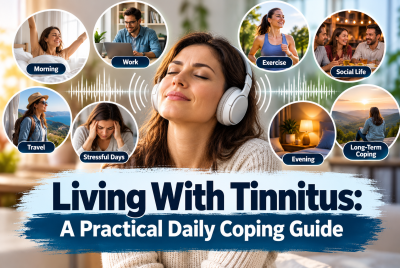
Create A Simple Daily Stress And Tinnitus Routine
You don’t need to organize your entire life around tinnitus.
In fact, the opposite may be more helpful.
Build a normal life that happens to include a few supportive habits.
Morning
Get some daylight when possible.
Move your body.
Avoid making tinnitus the first thing you evaluate when you wake up.
Begin your normal routine.
During The Day
Take short breaks during demanding tasks.
Pay attention to jaw, neck, and shoulder tension.
Use comfortable background sound if silence makes tinnitus intrusive.
Protect your hearing around genuinely loud noise.
Stay engaged with work, hobbies, relationships, and normal activities.
Evening
Gradually reduce stimulation.
Give yourself some separation between stressful work and bedtime.
Consider gentle stretching, reading, relaxing audio, or another activity that helps you transition toward rest.
Bedtime
Use background sound if helpful.
Avoid repeatedly checking your tinnitus.
Don’t constantly watch the clock.
Give yourself permission to rest rather than demanding immediate sleep.
The routine doesn’t need to be perfect.
Consistency matters more than complexity.
When Tinnitus And Stress Need Professional Help
Tinnitus can be frustrating, but you don’t have to manage significant distress alone.
Consider speaking with a healthcare professional if tinnitus is persistently interfering with:
- Sleep
- Concentration
- Work
- Relationships
- Daily activities
- Mood
- Your ability to enjoy life
A hearing evaluation may also be appropriate, particularly if you’ve noticed hearing changes.
Certain Tinnitus Changes Deserve Medical Attention
Seek appropriate medical evaluation if tinnitus is new or concerning, particularly when it is:
- Sudden
- Persistent in only one ear
- Pulsatile or synchronized with your heartbeat
- Associated with sudden hearing loss
- Accompanied by significant dizziness or other neurological symptoms
- Associated with other sudden or unusual symptoms
Sudden hearing loss accompanied by tinnitus warrants prompt medical attention.
Stress And Emotional Health Matter Too
Persistent tinnitus can take an emotional toll.
If you’re experiencing ongoing anxiety, low mood, severe distress, or difficulty coping, discuss it with an appropriate healthcare or mental health professional.
Getting support doesn’t mean tinnitus is “all in your head.”
It means you’re addressing one of the ways tinnitus is affecting your life.
Learn more about the Tinnitus Doctor Visit Checklist on our questions and symptoms to write down before your appointment
Frequently Asked Questions About Tinnitus And Stress
1. Can Stress Cause Tinnitus?
The relationship isn’t always straightforward. Stress may coincide with tinnitus onset or make existing tinnitus more noticeable for some people, but tinnitus can have many potential contributors, including hearing changes, noise exposure, medications, ear-related conditions, and other factors. If tinnitus is new or persistent, don’t automatically assume stress is the cause. Consider discussing it with a healthcare professional.
2. Why Does My Tinnitus Get Worse When I’m Stressed?
Stress can increase alertness, muscle tension, sleep difficulties, and attention to physical sensations. Together, these factors may make tinnitus more prominent or more difficult to tolerate. In some cases, the perceived tinnitus itself may fluctuate too. Tracking broad patterns can help you determine whether stressful periods consistently coincide with changes in your tinnitus.
3. Will Reducing Stress Make My Tinnitus Go Away?
Not necessarily. Reducing stress should not be viewed as a guaranteed tinnitus cure. However, better stress management may make tinnitus less intrusive and easier to cope with, particularly if stress is one of the factors that increases your awareness or distress. A useful goal is improving your quality of life rather than expecting every stress-reduction technique to eliminate the sound.
4. How Can I Stop Focusing On My Tinnitus?
Trying to force yourself not to hear tinnitus can sometimes make you think about it even more. Instead, practice redirecting attention toward meaningful activities, conversation, comfortable external sound, hobbies, exercise, or relaxation exercises. Also try to reduce unnecessary tinnitus checking. Over time, some people find that tinnitus occupies less of their attention even though they can still hear it.
5. Should I See A Doctor If Stress Makes My Tinnitus Worse?
If you’ve never had persistent tinnitus evaluated, discussing it with a healthcare professional can be worthwhile. You should be particularly attentive to tinnitus that appears suddenly, occurs persistently in one ear, pulses with your heartbeat, accompanies sudden hearing loss, or occurs with other concerning symptoms. You can also seek help specifically for stress, sleep problems, anxiety, or tinnitus-related distress. You don’t need to wait until tinnitus becomes unbearable before asking for support.
Final Thoughts: Breaking The Tinnitus And Stress Cycle
The connection between tinnitus and stress can feel like a trap.
- Tinnitus causes stress.
- Stress makes tinnitus harder to ignore.
- You focus on the tinnitus.
- It becomes even more intrusive.
Then the increased tinnitus creates more stress. But a cycle has an important characteristic: There is more than one place where you can interrupt it.
- You can reduce unnecessary tinnitus checking.
- You can improve your sleep habits.
- You can address jaw, neck, and shoulder tension.
- You can use comfortable background sound when silence makes tinnitus intrusive.
- You can take short breaks during stressful days.
- You can stay involved with activities that give your attention somewhere meaningful to go.
- You can track broad patterns rather than guessing about every fluctuation.
- You can seek professional support when tinnitus or stress begins significantly affecting your daily life.
The goal doesn’t have to be making tinnitus disappear before you can feel relaxed again.
A more practical goal is gradually changing the relationship you have with the sound—so that hearing tinnitus doesn’t automatically trigger stress, monitoring, frustration, and fear.
As that reaction becomes less intense, tinnitus may begin taking up less space in your attention. And that can be an important step toward getting more of your day—and your peace of mind—back.
Medical Disclaimer: This article is for general educational and informational purposes only and does not substitute for professional medical advice, diagnosis, or treatment. If you have new or concerning tinnitus, sudden hearing changes, persistent emotional distress, or other symptoms, consult an appropriately qualified healthcare professional.
Explore more:
- Tinnitus Doctor Visit Checklist
- Tinnitus Trigger Tracker And 30-Day Symptom Diary
- The Complete Beginner’s Guide To Tinnitus
- Tinnitus Treatment And Management
- Tinnitus At Night: Complete Sleep Guide
- Common Tinnitus Symptoms
- Common Tinnitus Causes
- Common Tinnitus Triggers
- Living With Tinnitus