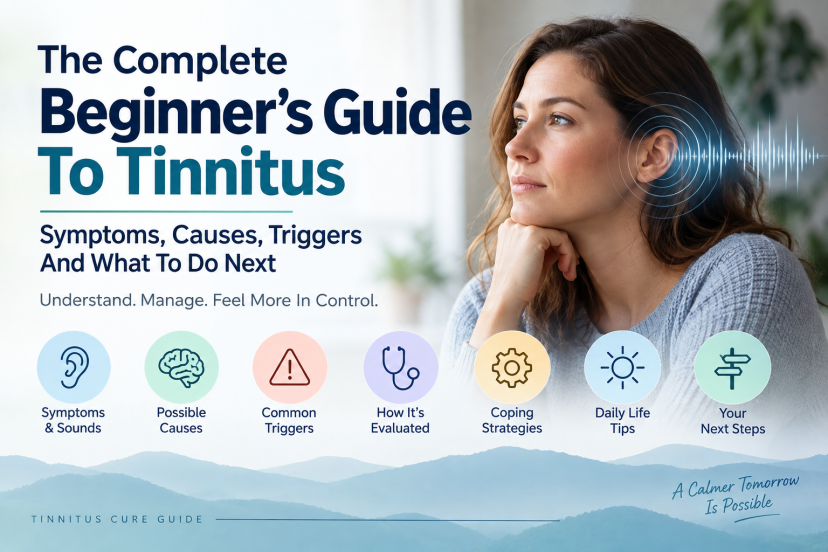
The Complete Beginner’s Guide To Tinnitus: Symptoms, Causes, Triggers And What To Do Next
New To Tinnitus? Start Here With Everything You Need To Know
If you have recently started hearing ringing, buzzing, hissing, humming, or another sound that nobody else seems to hear, this beginner’s guide to tinnitus can help you understand what may be happening — and whether you should be concerned.
This experience is commonly called tinnitus. For some people, tinnitus is a faint background sound they notice occasionally. For others, it can be persistent, distracting, or especially noticeable when trying to sleep, concentrate, or relax.
One of the confusing things about tinnitus is that there isn’t one universal experience. The sound can occur in one ear, both ears, or seem to come from somewhere inside the head. It can be constant or intermittent. It may remain fairly stable or seem to change from one day to another.
There are also many possible factors associated with tinnitus, from hearing loss and loud-noise exposure to ear problems, medications, jaw issues, and other health conditions. Sometimes there is no obvious explanation.
This complete beginner’s guide to tinnitus will help you understand what tinnitus is, the different sounds and patterns people experience, possible causes and triggers, how tinnitus is evaluated, practical coping strategies, and when it’s important to seek medical care.
Quick Answer: What Is Tinnitus?
Tinnitus is the perception of sound when there is no corresponding external sound source. It is often described as ringing in the ears, but tinnitus can also sound like buzzing, humming, hissing, roaring, clicking, whistling, or other noises.

Tinnitus itself is generally considered a symptom rather than a disease. It may be associated with hearing loss, noise exposure, ear conditions, certain medications, head or neck injuries, jaw problems, and other factors. Sometimes the cause isn’t clear.
Most tinnitus is not associated with a serious medical problem, but new, persistent, one-sided, pulsating, or suddenly changing tinnitus deserves appropriate medical attention — particularly when it occurs with sudden hearing loss, severe dizziness, facial weakness, or after a head injury.
Key Takeaways
What it is: Tinnitus is hearing a sound that does not have an external source. It is a symptom that can have many possible contributing factors.
What it may sound like: Ringing is common, but tinnitus may also sound like buzzing, hissing, humming, roaring, whistling, clicking, or pulsing.
Common influences: Hearing changes, loud-noise exposure, ear problems, medications, jaw or neck factors, stress, sleep, and other health issues may be involved.
What may help: Identifying underlying problems when possible, protecting your hearing from damaging noise, improving sleep and stress management, using appropriate background sound, and working with hearing or medical professionals can make tinnitus easier to manage.
When to get checked: Consider medical evaluation for new, persistent, changing, one-sided, or bothersome tinnitus. Seek prompt medical attention for tinnitus accompanied by sudden hearing loss or other concerning symptoms.
Understanding Tinnitus
Tinnitus can feel mysterious because you hear something even though there may be nothing in your surroundings producing that sound.
According to the National Institute on Deafness and Other Communication Disorders (NIDCD), tinnitus is the perception of sound without an external source. Surveys cited by the agency estimate that roughly 10% to 25% of adults experience tinnitus.
The important thing for beginners to understand is that tinnitus is not one single condition with one single cause.
Two people can both have tinnitus and have very different experiences.
One person may notice a high-pitched tone in both ears after years of working around loud machinery. Another may develop temporary ringing after a concert. Someone else may hear a sound that seems synchronized with their heartbeat.
That is why understanding your particular tinnitus pattern can be useful.
Is Tinnitus A Disease?
Tinnitus is generally regarded as a symptom rather than a disease by itself.
It can be associated with changes somewhere within the hearing system or with other conditions that affect the ear or surrounding structures.
Hearing loss is strongly associated with tinnitus, although not everyone who has tinnitus notices hearing difficulty, and not everyone with hearing loss develops tinnitus.
Sometimes a healthcare professional can identify an underlying issue that can be addressed, such as impacted earwax or an ear infection.
In other cases, there may not be one obvious cause.
Is Tinnitus Always Permanent?
No. Tinnitus may be temporary or persistent.
You might notice temporary ringing after exposure to loud music, for example. Other people experience tinnitus for months or years.
NIDCD considers tinnitus lasting three months or longer to be chronic. The agency notes that tinnitus can improve or disappear over time in some people, while it may persist or worsen in others.
If your tinnitus has only recently started, don’t assume that what you’re experiencing today predicts what you will experience permanently.
What Does Tinnitus Sound Like?
The word “tinnitus” is often used interchangeably with “ringing in the ears,” but ringing is only one possible tinnitus sound.
People describe tinnitus in many ways, including:
- Ringing
- Buzzing
- Hissing
- Humming
- Whistling
- Roaring
- Clicking
- Squealing
- Whooshing
- Pulsing
The sound may be high-pitched or low-pitched, quiet or intrusive. It may be easy to ignore during a busy afternoon but seem surprisingly noticeable when you get into bed at night.
These variations are common. NIDCD notes that tinnitus may occur in one ear, both ears, or seem to be located in the head, and it can be intermittent or constant.
Tinnitus In One Ear Vs Both Ears
Some people hear tinnitus primarily in one ear. Others hear it in both.
You may even have difficulty identifying exactly where the sound is coming from.
Persistent tinnitus that is clearly limited to one ear deserves discussion with a healthcare or hearing professional because the pattern can sometimes influence what evaluation is appropriate.
It does not automatically mean something serious is wrong, but it is useful information to mention during an appointment.
Constant Vs Intermittent Tinnitus
Tinnitus doesn’t necessarily stay present 24 hours a day.
You might experience:
- Constant tinnitus
- Tinnitus that comes and goes
- Several quiet days followed by a louder day
- Tinnitus that appears primarily in certain situations
- Short bursts of ringing
- A background sound that changes in intensity
Keeping track of these patterns can provide useful information if you later discuss the symptoms with a doctor or audiologist.
Why Does Tinnitus Seem Louder In Silence?
A common experience is noticing tinnitus much more when everything else becomes quiet.
During the day, your brain is processing conversations, traffic, television, music, household sounds, and countless other noises. These sounds can compete with or reduce your awareness of tinnitus.

At bedtime, many of those competing sounds disappear.
Your tinnitus hasn’t necessarily become dramatically louder. It may simply be more noticeable against a quiet background.
This is one reason gentle background sound helps some people at night.
Learn more: Why Is My Tinnitus Worse At Night?
Tinnitus That Changes With Movement
Some people find that moving their head, neck, jaw, or eyes — or touching certain areas of the body — temporarily changes the loudness or character of their tinnitus.
NIDCD describes this as somatosensory tinnitus.
If jaw clenching, neck movement, posture, or other physical movements reliably change your tinnitus, mention that pattern during an evaluation.
Pulsatile Tinnitus
Pulsatile tinnitus is different from the typical steady ringing or buzzing many people associate with tinnitus.
It often sounds rhythmic and may seem to follow your heartbeat.
Because pulsatile tinnitus can sometimes be associated with blood-flow or structural issues, it warrants medical evaluation rather than simply assuming it is ordinary tinnitus. The NHS, for example, recommends urgent medical assessment for tinnitus that beats in time with the pulse.
What Can Cause Tinnitus?
There is no single tinnitus cause.
Sometimes tinnitus is associated with a relatively straightforward problem. In other cases, multiple factors may be involved, and sometimes no specific cause is found.
Here are several of the better-established possibilities.
Hearing Loss
Hearing loss and tinnitus frequently occur together.
One theory is that when input from the inner ear changes, the auditory system and brain adapt to those changes in ways that contribute to the perception of tinnitus.
Research continues into exactly how these processes work, and there is unlikely to be one mechanism that explains every person’s tinnitus.
You can also have tinnitus even if your everyday hearing seems normal.
A person may be able to carry on conversations, watch television at an ordinary volume, and function normally while still benefiting from a formal hearing test.
Loud-Noise Exposure
Loud sound can damage sensitive structures within the inner ear and cause noise-induced hearing loss.
Potential sources include:
- Loud concerts
- Power tools
- Machinery
- Gunfire
- Explosions
- Motorsports
- Very loud headphones or earbuds
- Repeated occupational noise exposure
Noise-induced hearing loss may develop gradually or result from an extremely intense sound. Loud-noise exposure can also cause tinnitus.
This is why hearing protection is important when sound levels are genuinely hazardous.
At the same time, someone with tinnitus doesn’t generally need to spend everyday life avoiding normal environmental sounds.
The goal is sensible hearing protection, not living in silence.
Earwax And Ear Infections
Sometimes the explanation may be much closer to the ear itself.
Earwax blocking the ear canal or fluid related to an ear infection can trigger tinnitus in some people.
This is one reason an ear examination can be worthwhile.
If a treatable underlying problem is identified, addressing it may reduce the tinnitus.
Avoid attempting to remove deeply impacted earwax yourself with objects inserted into the ear canal. A healthcare professional can determine whether wax is actually present and recommend safe treatment.
Medications
Tinnitus can occur as a side effect of certain medications.
NIDCD lists several medication categories associated with tinnitus, particularly in some circumstances or at higher doses, including certain nonsteroidal anti-inflammatory drugs, antibiotics, cancer medications, antimalarial drugs, and antidepressants.
That does not mean you should stop a medication because you develop tinnitus.
If you suspect a medication may be related, talk with your doctor or pharmacist. They can consider the medication, dose, timing, alternatives, and the risks of changing treatment.
Head And Neck Injuries
Injuries affecting the head or neck can sometimes contribute to tinnitus by affecting the ear, auditory pathways, or related structures.
New tinnitus following a significant head injury deserves medical attention rather than self-diagnosis.
Jaw Problems
The temporomandibular joint, commonly called the TMJ, is located close to the ear.
Jaw clenching, teeth grinding, and problems affecting this area may sometimes cause or aggravate tinnitus.
Clues might include tinnitus that changes when you:
- Clench your teeth
- Open your mouth widely
- Move your jaw sideways
Jaw pain, clicking, stiffness, or frequent teeth grinding are additional details worth discussing with an appropriate healthcare or dental professional.
Other Health Conditions
Tinnitus can also occur alongside several other conditions.
NIDCD lists associations including Ménière’s disease, blood-vessel disorders, migraines, thyroid disorders, anemia, diabetes, and certain autoimmune disorders. Rarely, tumors involving auditory pathways may also be associated with tinnitus.
These associations should not be used as a checklist for self-diagnosis.
Most people who develop tinnitus do not need to assume that an unusual or serious disease is responsible.
The purpose of evaluation is to look at your particular symptoms and decide whether further investigation is appropriate.
What Can Trigger Or Make Tinnitus More Noticeable?
A tinnitus cause and a tinnitus trigger are not necessarily the same thing.
For example, hearing changes might contribute to the development of tinnitus, while a stressful week might make existing tinnitus much harder to ignore.
Understanding that difference can prevent you from assuming every bad tinnitus day means the underlying condition is getting worse.
Stress
Stress and tinnitus can become an unpleasant cycle.
Tinnitus creates worry or frustration. That increases stress and attention toward the sound. Increased attention may make tinnitus feel more intrusive, creating still more stress.
Stress management doesn’t mean tinnitus is “all in your head.”
Rather, your emotional state and attention can affect how disruptive a sensory experience feels.
Relaxation exercises, physical activity where appropriate, enjoyable activities, counseling, and other stress-management strategies may help reduce tinnitus-related distress.
Learn more: Can Stress Make Tinnitus Worse?
Poor Sleep And Fatigue
A bad night’s sleep can make almost everything feel harder the following day.
Tinnitus is no exception.
When you’re exhausted, you may have less ability to redirect your attention away from tinnitus. Then tinnitus makes it harder to relax at bedtime, potentially creating another cycle:
Tinnitus → difficulty sleeping → fatigue → increased tinnitus awareness → more difficulty sleeping
Improving sleep can therefore be an important part of tinnitus management even when sleep isn’t the original cause.
Loud Sound
Some people notice temporary tinnitus or increased tinnitus after loud-noise exposure.
Repeated exposure to damaging noise can also harm hearing, so prevention matters.
Use appropriate hearing protection around genuinely hazardous sound and reduce volume or increase your distance from loud sources when possible. NIDCD emphasizes volume, distance, and duration of exposure as important factors in noise-related hearing damage.
Silence
Silence doesn’t necessarily cause tinnitus to worsen.
Instead, removing competing environmental sounds can make tinnitus stand out.
You may notice this while:
- Reading alone
- Working in a quiet office
- Sitting in a silent room
- Going to bed
- Waking during the night
Gentle environmental sound can sometimes reduce the contrast.
Personal Triggers
You may encounter long lists online claiming that everyone with tinnitus must eliminate caffeine, particular foods, exercise, or other everyday activities.
Be careful with universal rules.
Tinnitus experiences vary substantially between individuals.
Instead of unnecessarily restricting your life, look for repeatable personal patterns.
A simple symptom diary can help you record:
- Tinnitus intensity
- Sleep
- Stress
- Noise exposure
- Illness or congestion
- Medication changes
- Jaw or neck symptoms
- Other factors you suspect may matter
Patterns observed over several weeks are generally more informative than conclusions based on one unusually loud tinnitus day.
How Is Tinnitus Evaluated?
If tinnitus is new, persistent, changing, one-sided, pulsatile, or significantly affecting your life, consider discussing it with a healthcare professional.
An evaluation isn’t simply about finding something “wrong.”
It can help identify treatable problems, assess your hearing, document your symptoms, and determine whether additional testing is appropriate.
Start With Your Symptoms And History
Your healthcare professional may ask:
- When did the tinnitus begin?
- Did it start suddenly or gradually?
- Is it in one ear or both?
- Is it constant or intermittent?
- What does it sound like?
- Does it follow your heartbeat?
- Have you noticed hearing changes?
- Have you experienced dizziness?
- Have you recently been exposed to loud noise?
- Have you had an ear infection?
- Do you have jaw or neck symptoms?
- What medications and supplements do you take?
- Does anything make the tinnitus better or worse?
Writing this information down beforehand can make the appointment easier.
Ear Examination
A clinician may examine your ears for problems such as impacted earwax or signs of infection.
These relatively simple possibilities are worth checking before assuming tinnitus has a more complicated explanation.
Hearing Tests
You may be referred to an audiologist for a hearing evaluation.
A standard hearing test can measure how well you hear sounds at different frequencies and intensities.
This is useful even when you believe your hearing is normal.
Tinnitus and hearing loss are strongly associated, and subtle hearing changes aren’t always obvious in everyday life.
Additional Testing
Not everybody with tinnitus needs scans or extensive testing.
Additional tests may be considered depending on the pattern of symptoms and examination findings. NIDCD notes that imaging such as MRI, CT, or ultrasound may be used in some cases, particularly when tinnitus is pulsatile, and a structural or medical cause needs investigation.
The appropriate evaluation should therefore be individualized rather than assuming everyone with tinnitus needs the same tests.
When Tinnitus Needs Prompt Medical Attention
Certain combinations of symptoms deserve more urgent assessment.
Sudden hearing loss should be treated as a medical emergency. NIDCD warns that delaying diagnosis and treatment of sudden sensorineural hearing loss can reduce treatment effectiveness.
Seek prompt or emergency medical care according to local medical guidance if tinnitus occurs with symptoms such as:
- Sudden hearing loss
- Significant spinning dizziness/vertigo
- Facial weakness
- A significant head injury
Tinnitus that pulses in time with your heartbeat also warrants prompt medical evaluation.
What Can You Do About Tinnitus?
One of the first questions most people ask is, “How do I make it stop?”
Unfortunately, there isn’t currently one treatment that reliably eliminates tinnitus for everyone.
But that does not mean nothing can be done.
When an underlying issue can be identified, treating that problem may improve tinnitus. When tinnitus persists, several strategies can reduce how intrusive it feels and help people cope more comfortably.
Protect Your Hearing From Harmful Noise
If you regularly work around loud equipment or participate in noisy activities, appropriate hearing protection is important.
Depending on the situation, that might include:
- Earplugs
- Protective earmuffs
- Reducing volume
- Increasing your distance from the sound
- Limiting exposure time
But don’t automatically wear earplugs throughout normal daily life simply because you have tinnitus.
Protection should generally be focused on potentially damaging sound unless a healthcare professional has advised otherwise.
Use Background Sound When Helpful
Sound doesn’t necessarily need to completely cover your tinnitus.
Sometimes simply reducing the contrast between tinnitus and silence is enough to make it easier to ignore.
You might experiment with:
- A fan
- Quiet music
- Nature sounds
- Rain sounds
- A tabletop sound generator
- Low-level environmental sound
NIDCD includes sound therapy devices and hearing aids among approaches used to reduce tinnitus symptoms or their impact.
Keep sound at a comfortable, safe volume.
Address Hearing Loss
If testing identifies hearing loss, hearing aids may help some people with both communication and tinnitus awareness.
Amplifying external sound can make the surrounding environment easier to hear while making tinnitus less prominent for some users.
An audiologist can help determine whether hearing aids are appropriate for your particular hearing profile.
Find out here: Why Is My Ear Ringing But My Hearing Seems Normal?
Consider Cognitive Behavioral Therapy
Cognitive behavioral therapy, or CBT, doesn’t pretend that the tinnitus sound isn’t there.
Instead, it can help change the patterns of thought, attention, emotion, and behavior that make tinnitus particularly distressing.
NIDCD reports that studies have found CBT can improve well-being among people with tinnitus.
For someone whose tinnitus is creating significant anxiety, frustration, sleep problems, or difficulty functioning, addressing the emotional response can be an important part of treatment.
Be Careful With “Miracle Cures”
Tinnitus can be frustrating enough that promises of a fast cure become extremely appealing.
Be cautious. NIDCD states that vitamins, herbal extracts, and dietary supplements commonly promoted as tinnitus cures have not been proven effective for treating tinnitus.
A product being described as “natural” does not automatically mean it is effective, necessary, or free of side effects or interactions.
Living With Tinnitus Day To Day
Managing tinnitus isn’t only about what happens inside a clinic.
Much of the real challenge happens during ordinary life: working, sleeping, driving, exercising, socializing, and trying to relax.
Small adjustments can sometimes make those situations much easier.
Tinnitus At Work
If tinnitus interferes with concentration, complete silence may not be your ideal working environment.
Try gentle background sound at a comfortable level.
Regular breaks can also help if you find yourself becoming tense or intensely focused on the tinnitus.
If your workplace is genuinely noisy, appropriate hearing protection becomes especially important.
Tinnitus In Quiet Rooms
You don’t need to fear quiet environments, but you also don’t have to force yourself to sit in complete silence if tinnitus becomes distracting.
Try opening a window, running a fan, playing quiet background audio, or introducing another unobtrusive sound.
The objective isn’t necessarily to drown tinnitus out.
It is often simply to give your brain something else to hear.
Exercise And Tinnitus
For most people, having tinnitus doesn’t automatically mean avoiding physical activity.
Regular movement can support general health, stress management, and sleep.
However, individual health circumstances differ. If exercise causes unusual pulsating tinnitus, significant dizziness, chest symptoms, sudden hearing changes, or other concerning symptoms, seek appropriate medical advice rather than assuming the reaction is harmless.
Traveling With Tinnitus
Travel introduces several possible challenges:
- Poor sleep
- Stress
- Loud transportation
- Changes in routine
- Long periods of sitting
- Unfamiliar sleeping environments
Planning ahead can help.
Bring appropriate hearing protection for genuinely loud environments, but don’t overuse it during ordinary sound exposure. If background sound helps you sleep, consider keeping a familiar sound app or other comfortable sound source available.
Tinnitus At Night
Nighttime is one of the most common situations where tinnitus becomes difficult to ignore.
Instead of chasing perfect silence, create a comfortable sleep environment.
You might try:
- A consistent bedtime routine
- Gentle background sound
- A fan
- Relaxation exercises
- Reducing stimulating activities close to bedtime
- Keeping the bedroom comfortable and dark
- Avoiding repeatedly checking whether the tinnitus is still there
If tinnitus has led to persistent insomnia, discuss the sleep problem with a healthcare professional. Treating the sleep difficulty can be valuable even if tinnitus remains present.
Find here How To Fall Asleep With Tinnitus: 10 Practical Ways
Difficult Tinnitus Days
Tinnitus can fluctuate.
A louder day doesn’t necessarily mean you’ve permanently damaged your hearing or that tinnitus will stay at that level.
Before panicking, consider what has changed.
- Did you sleep poorly?
- Were you exposed to unusual noise?
- Are you stressed?
- Are you sick or congested?
- Have you changed medication?
- Have you been clenching your jaw?
Sometimes there won’t be an obvious explanation.
Rather than checking your tinnitus every few minutes, continue with normal activities when possible and note the change in your symptom diary.
Common Questions Beginners Have About Tinnitus
Can Tinnitus Go Away?
Yes, tinnitus can improve or disappear for some people, particularly when it is temporary or related to an underlying issue that resolves. Other people develop persistent or chronic tinnitus. It is not possible to predict the long-term course based simply on one day or week of symptoms.
Does Tinnitus Mean I’m Losing My Hearing?
Not necessarily.
Tinnitus is strongly associated with hearing loss, but tinnitus alone doesn’t prove that you are losing your hearing.
A hearing test is the appropriate way to evaluate your hearing rather than trying to determine it from tinnitus volume.
Can You Have Tinnitus With Normal Hearing?
Yes. Some people who experience tinnitus may not notice any obvious hearing difficulty.
A standard hearing evaluation can still be worthwhile because everyday impressions of hearing and formal measurements are not the same thing.
Why Is My Tinnitus Louder Some Days?
Tinnitus perception can fluctuate.
Sleep, stress, noise exposure, attention, illness, jaw tension, and other individual factors may influence how noticeable it seems.
Instead of judging changes from a single day, look for repeatable patterns over time.
Can Stress Make Tinnitus Worse?
Stress may make tinnitus feel more intrusive or difficult to ignore.
That can create a cycle in which tinnitus increases stress, and increased stress makes tinnitus more bothersome.
Reducing stress doesn’t necessarily remove the tinnitus signal, but it may reduce the distress surrounding it.
Why Is Tinnitus Worse At Night?
Quiet surroundings make tinnitus more noticeable for many people because fewer external sounds compete for your attention.
Fatigue and worry about sleep may also make the sound harder to ignore.
Low-level background sound and a consistent sleep routine can help some people.
Should I See A Doctor About Tinnitus?
Consider an evaluation if tinnitus is new, persistent, changing, primarily one-sided, pulsatile, or interfering with sleep or everyday life.
Seek prompt medical attention if it occurs with sudden hearing loss or other concerning neurological or balance symptoms.
Your Next Steps
When you’re new to tinnitus, it is easy to become overwhelmed by everything you read online.
You don’t need to solve everything today.
Start with a few practical steps.
1. Understand Your Tinnitus Pattern
Pay attention to the basics:
- What does it sound like?
- Which ear do you hear it in?
- Is it constant or intermittent?
- When did it start?
- Does anything reliably change it?
You aren’t trying to diagnose yourself. You’re simply gathering useful information.
2. Track Possible Triggers
If your tinnitus changes frequently, consider keeping a simple diary for several weeks.
Record sleep, stress, loud-noise exposure, illness, jaw symptoms, medication changes, and anything else that appears relevant.
Look for patterns rather than reacting to individual days.
Learn more: Free Tinnitus Trigger Tracker And 30-Day Symptom Diary
3. Protect Your Hearing Sensibly
Avoid unnecessary exposure to damaging sound.
Lower the volume, move farther from loud sources, reduce exposure time, and use appropriate hearing protection when necessary. Noise-related hearing damage is preventable.
At the same time, don’t assume normal everyday sound is dangerous simply because you have tinnitus.
4. Work On Sleep And Stress
Sleep and stress can strongly influence how manageable tinnitus feels.
Build routines that help you relax, maintain regular sleep habits, and consider gentle background sound if silence makes tinnitus difficult at night.
5. Consider A Professional Evaluation
If tinnitus is persistent, changing, bothersome, one-sided, or otherwise concerning, talk with an appropriate healthcare professional.
An ear examination and hearing evaluation can provide useful information and help determine whether further investigation is needed.
6. Prepare For Your Appointment
Write down your tinnitus history, symptoms, medications, possible triggers, hearing changes, and questions before your appointment.
The more clearly you can describe your experience, the easier it is to have a useful conversation with your healthcare provider.
Most importantly, remember that tinnitus is highly individual.
The fact that someone else’s tinnitus became worse doesn’t mean yours will. The fact that one strategy helped another person doesn’t guarantee it will help you.
Learning your own pattern, protecting your hearing appropriately, addressing identifiable health or hearing issues, and finding coping strategies that fit your life can make tinnitus much less overwhelming.
You don’t have to spend every day fighting the sound.
For many people, the longer-term goal becomes learning how to give tinnitus less attention, less emotional weight, and less control over everyday life — while still knowing when a change deserves professional attention.
Medical Disclaimer: The information in this guide is for general educational purposes only and does not substitute for professional medical advice, diagnosis, or treatment.
Explore more: