What Is Pulsatile Tinnitus: A Complete Guide To Hearing Your Heartbeat In Your Ear
Why You May Hear A Whooshing, Pulsing, Or Heartbeat Sound — And When It Should Be Checked
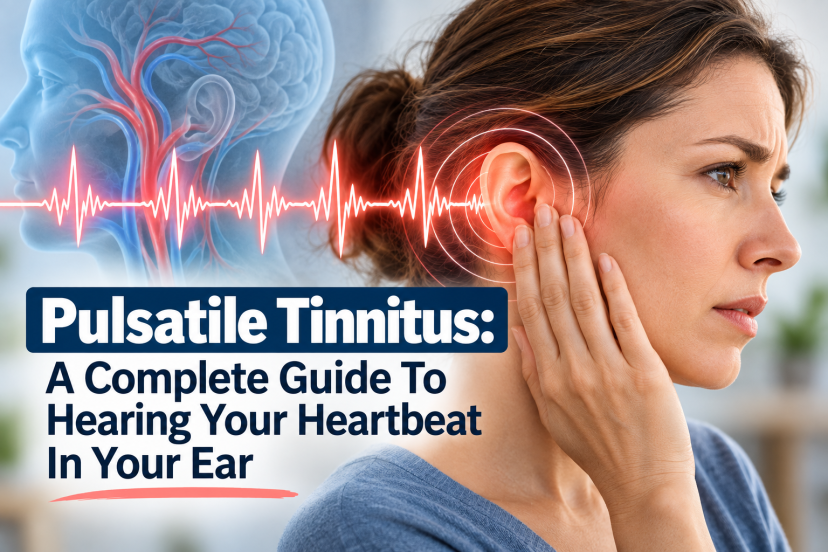
What Is Pulsatile Tinnitus? Hearing a sound that seems to match your heartbeat can be unsettling, especially when the room is quiet and you suddenly notice a rhythmic whooshing, thumping, pulsing, or beating inside one ear or your head.
This experience is often called pulsatile tinnitus.
Unlike the more familiar form of tinnitus, often described as ringing, buzzing, hissing, or a high-pitched tone, pulsatile tinnitus often has a recognizable rhythm. Many people describe it as hearing their heartbeat in their ear because the sound appears to speed up and slow down along with their pulse.
You may notice it in one ear, both ears, or somewhere inside your head. It may be constant or intermittent. Some people hear it mainly at night, after exercise, or when lying down, while others notice it throughout the day.
There are many possible reasons this can happen. Some are relatively straightforward, while others involve changes in blood flow or structures near the ear that require medical investigation.
For that reason, pulsatile tinnitus should generally be medically evaluated rather than assumed to be ordinary tinnitus.
The good news is that identifying a specific underlying cause is sometimes possible, and treatment may focus directly on that cause.
This complete guide explains what pulsatile tinnitus sounds like, how it differs from regular tinnitus, why you may hear your heartbeat in your ear, what doctors may look for, which symptoms deserve more urgent attention, and what you can do while waiting for an evaluation.
Quick Answer: What Is Pulsatile Tinnitus?
Pulsatile tinnitus is the perception of a rhythmic sound—often described as whooshing, beating, thumping, or pulsing that may occur in time with your heartbeat.
It differs from typical non-pulsatile tinnitus because it can sometimes be related to blood flow, blood vessels, pressure changes, or other physical processes near the ear and head.
Pulsatile tinnitus does not automatically mean that something dangerous is wrong. However, because some underlying causes can require treatment, new or persistent pulsatile tinnitus should be discussed with a healthcare professional.
Seek prompt medical attention if the sound develops suddenly or occurs with symptoms such as sudden hearing loss, severe headache, new neurological symptoms, significant dizziness, vision changes, or other sudden concerning symptoms.
Key Takeaways
Most likely cause: There is no single cause of pulsatile tinnitus. It can be associated with changes in blood flow, blood vessels, blood pressure, pressure around the brain, ear conditions, or other medical factors.
Usually serious? Often it is not caused by a dangerous problem, but pulsatile tinnitus deserves medical evaluation because some less common causes require treatment.
First thing to check: Determine whether the sound actually follows your heartbeat, whether it affects one or both ears, when it started, and whether you have other symptoms such as hearing changes, dizziness, headache, or vision problems.
Best solution: Arrange an appropriate medical evaluation rather than trying to diagnose the cause yourself. Treatment for pulsatile tinnitus depends on identifying and addressing the underlying reason for the rhythmic sound.
What Does Pulsatile Tinnitus Sound Like?
The word “tinnitus” often makes people think of a continuous high-pitched ringing.
Pulsatile tinnitus can sound very different.
People describe it as:
- Whooshing
- Swishing
- Thumping
- Beating
- Pounding
- Fluttering
- Pulsing
- A rhythmic hum
- A heartbeat in the ear
- Blood rushing through the ear
- A washing-machine-like rhythmic sound
The defining feature is usually rhythm.
If you place your fingers on your wrist or neck to feel your pulse, you may discover that the tinnitus occurs at approximately the same rate.
For example: Whoosh…whoosh…whoosh…
Rather than: Eeeeeeeeeee…
That distinction is useful when explaining the symptom to a healthcare professional.
Is Hearing Your Heartbeat In Your Ear Really Tinnitus?
It can be. Tinnitus simply refers to hearing a sound without a corresponding external sound source. The sound does not have to be ringing.
When the perceived sound is rhythmic and synchronized with your heartbeat, clinicians may describe it as pulse-synchronous pulsatile tinnitus.
However, not every repetitive sound in the ear is necessarily pulse-synchronous tinnitus.
Muscle contractions and certain other ear-related problems can sometimes create clicking, fluttering, or rhythmic noises that do not precisely follow the heartbeat.
That is why one of the most useful things you can do is determine whether the rhythm appears to match your pulse.
You do not need to monitor yourself obsessively. Check it briefly and make a note for your healthcare provider.
Pulsatile Tinnitus Vs Regular Tinnitus
Understanding the difference between pulsatile and non-pulsatile tinnitus is important.
Typical Non-Pulsatile Tinnitus
More common tinnitus may sound like:
- Ringing
- Hissing
- Buzzing
- Static
- Whistling
- Humming
- A continuous high-pitched tone
It may be associated with hearing loss, noise exposure, medications, ear conditions, or other factors.
The sound generally does not follow the heartbeat.
Pulsatile Tinnitus
Pulsatile tinnitus is usually rhythmic.
You may describe it as:
- A heartbeat
- A pulse
- A repetitive whoosh
- Blood rushing
- Rhythmic pounding
Because blood vessels and blood flow can sometimes contribute to these sounds, the medical evaluation may be different from the evaluation for ordinary tinnitus.
That distinction matters.
If you tell a healthcare professional only that you have “tinnitus,” they may initially imagine conventional ringing.
Be specific. You might say: I hear a whooshing sound in my right ear that seems to occur at the same rate as my heartbeat.

That description provides considerably more useful information.
Why Can You Hear Your Heartbeat In Your Ear?
Your head and neck contain a network of arteries and veins carrying blood close to the structures involved in hearing.
Normally, you do not consciously hear this blood flow.
But under certain circumstances, changes in blood flow, the surrounding tissues, or your perception of internal sound may make a rhythmic sound noticeable.
One simple way to think about it is that pulsatile tinnitus can sometimes occur when:
- Blood flow becomes faster or more forceful.
- Blood flow becomes turbulent rather than smooth.
- A blood vessel has an anatomical change.
- Sound from normal blood flow becomes easier for the ear to perceive.
- Pressure or structural changes affect the surrounding area.
These are broad categories rather than diagnoses.
A healthcare professional may need an examination, hearing testing, laboratory testing, or medical imaging to determine what is actually happening.
Possible Causes Of Pulsatile Tinnitus
There are numerous possible explanations, and they range from relatively common conditions to uncommon vascular problems.
This is exactly why searching symptoms online cannot reliably identify the cause.
Changes In Blood Flow
Anything that increases the amount or speed of blood circulating through the body can potentially make vascular sounds more noticeable.
Depending on the individual, clinicians may consider conditions associated with increased blood flow.
For example, anemia can cause the heart to work harder to deliver oxygen throughout the body, while an overactive thyroid can increase heart rate and circulation.
Pregnancy can also produce major changes in blood volume and circulation.
These conditions have many possible symptoms, and pulsatile tinnitus alone cannot diagnose any of them.
High Blood Pressure
Blood pressure can influence the force of blood moving through blood vessels.
Some people become particularly aware of pulsatile sensations when their blood pressure is elevated.
However, you cannot determine your blood pressure from the loudness of tinnitus.
If blood pressure is a concern, it needs to be measured properly.
Persistent or significantly elevated blood pressure should be managed with appropriate medical guidance rather than relying on tinnitus as an indicator.
Atherosclerosis And Blood Vessel Changes
Arteries can become narrower or less flexible because of plaque buildup and other vascular changes.
Changes in the way blood flows through an artery may sometimes create turbulence that becomes audible.
Age, cardiovascular risk factors, and medical history can influence what a healthcare professional considers during an evaluation.
Again, the sound itself cannot tell you whether an artery is narrowed.
Venous Causes
Not all pulsatile tinnitus originates from arteries.
Veins carrying blood away from the brain can also contribute to pulsatile sounds.
Certain anatomical variations or changes in venous blood flow can produce noise that is transmitted to the structures around the ear.
For some patients, clinicians can gather clues from whether the sound changes with body position or certain other circumstances.
Do not repeatedly press on your neck or blood vessels to experiment with the sound yourself.
Describe naturally occurring changes to your doctor instead.
Idiopathic Intracranial Hypertension
Idiopathic intracranial hypertension (IIH) is a condition involving increased pressure around the brain without another obvious cause explaining that pressure.
Pulsatile tinnitus can be one of its symptoms.
Other symptoms can include:
- Headaches
- Temporary visual disturbances
- Double vision
- Blind spots or other vision changes
Because increased intracranial pressure can potentially affect vision, pulsatile tinnitus accompanied by headaches or visual symptoms deserves appropriate medical evaluation.
Having pulsatile tinnitus does not mean you have IIH. It is simply one of several conditions clinicians may consider depending on the overall symptom pattern.
Structural Changes Around The Ear
The middle and inner ear sit close to major blood vessels.
Differences in bone, tissue, or nearby structures can sometimes make vascular sounds easier to hear.
In these situations, blood flow itself may not necessarily be abnormal. Instead, there may be less insulation between the sound of circulating blood and the hearing structures.
Specialized imaging may sometimes help identify these anatomical causes.
Vascular Abnormalities
Less commonly, abnormal connections or structural changes involving blood vessels can cause pulsatile tinnitus.
Examples doctors may investigate include vascular malformations, abnormal artery-to-vein connections, aneurysms, or other vascular conditions.
These possibilities are one reason persistent pulsatile tinnitus should not simply be treated with background noise indefinitely without an appropriate medical evaluation.
They are not the explanation for every case, but clinicians may need to rule them out.
Certain Tumors Near The Ear
Some uncommon tumors involving structures around the middle ear, head, or neck can be highly vascular and may produce pulsatile tinnitus.
These are relatively uncommon causes.
Reading about them can understandably create anxiety, but having a heartbeat sound in your ear does not mean you have a tumor.
A proper evaluation is much more useful than trying to determine the cause from symptoms alone.
Ear Conditions
Not every explanation involves an abnormal blood vessel.
Problems affecting the middle ear can change how internal sounds are transmitted or perceived.
For example, conditions affecting the eardrum or middle ear may alter the way a person hears internal body sounds.
An ear examination can therefore be an important part of the evaluation.
Pulsatile Tinnitus In One Ear
Some people hear the pulse only in the left or right ear.
This is called unilateral pulsatile tinnitus.
For example: I can hear my heartbeat only in my right ear.
That is important information to give your healthcare provider.
One-sided pulsatile tinnitus may encourage clinicians to investigate structures on that side more closely.
They may consider the ear itself as well as nearby arteries, veins, and surrounding anatomy.
Unilateral pulsatile tinnitus does not automatically indicate a serious problem, but persistent one-sided symptoms should be evaluated rather than ignored.
Pulsatile Tinnitus In Both Ears
Other people hear rhythmic tinnitus in both ears or perceive the sound throughout their head.
Bilateral pulsatile tinnitus may sometimes occur when a factor affects circulation or pressure more generally, although there are many possibilities.
The same principle applies:
Location is only one clue.
Doctors also consider:
- Your age
- Medical history
- Blood pressure
- Hearing
- Headaches
- Vision symptoms
- When symptoms began
- Whether the tinnitus is truly pulse-synchronous
- Whether it changes with activity or position
- Other neurological or ear-related symptoms
The entire pattern matters more than whether the sound affects one or two ears.
Why Is Pulsatile Tinnitus More Noticeable At Night?
A common experience is: I hear my heartbeat in my ear when I lie down at night.
Sometimes this does not mean the underlying sound suddenly became much stronger.
The environment changed.
During the day, your brain has plenty of competing sounds:
Traffic.
Conversations.
Television.
Music.
Air conditioning.
Computers.
Household appliances.
At night, many of these sounds disappear.
Against a nearly silent bedroom, a subtle internal sound may suddenly seem prominent.
Body position may also affect how some people perceive pulsatile tinnitus.
If you consistently notice that the sound becomes dramatically different in a particular position, mention this to your healthcare provider.
Why Can Exercise Make The Pulsing Louder?
Your cardiovascular system responds naturally to physical activity.
During exercise:
- Your heart beats faster.
- Cardiac output increases.
- Blood flow increases to working tissues.
If you already perceive a vascular sound, it may temporarily become faster or more noticeable when your pulse increases.
That does not identify the cause.
What matters is whether the symptom is new, persistent, worsening, or accompanied by concerning symptoms.
If you develop unusual pulsatile tinnitus with chest pain, fainting, severe shortness of breath, neurological symptoms, or another acute problem, seek appropriate medical attention rather than assuming exercise alone explains it.
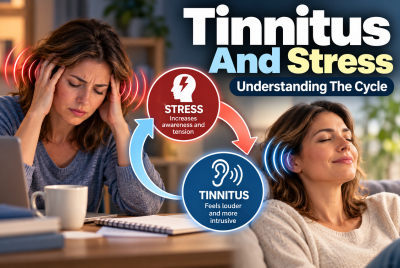
Can Stress Make Pulsatile Tinnitus Worse?
Stress can affect tinnitus in several ways.
When you feel anxious, you may become more alert to physical sensations.
You may notice:
- Your heartbeat
- Your breathing
- Muscle tension
- Tinnitus
- Minor changes in your body that normally escape your attention
Stress can also temporarily influence heart rate and blood pressure.
This means pulsatile tinnitus may feel more intrusive during stressful periods.
But it is important not to dismiss persistent pulse-synchronous tinnitus as “just anxiety.”
Stress can increase awareness of a symptom without being its underlying medical cause.
You can work on stress management while still getting the tinnitus appropriately evaluated.
Learn more: Tinnitus And Stress: Understanding The Cycle
Can Caffeine Cause Pulsatile Tinnitus?
People with tinnitus frequently wonder whether they should eliminate coffee, tea, or other caffeinated beverages.
Caffeine can temporarily affect alertness, heart rate, and blood pressure in some people, but responses vary considerably.
If you notice a clear, repeatable relationship between caffeine and your symptoms, tracking that pattern may be useful.
However, unnecessarily eliminating numerous foods and beverages based on tinnitus myths can make everyday life more restrictive without solving the problem.
The more important step with persistent pulsatile tinnitus is identifying whether there is an underlying medical explanation.
Is Pulsatile Tinnitus Dangerous?
Pulsatile tinnitus itself is a symptom, not a diagnosis. Many people with pulsatile tinnitus will not turn out to have a dangerous underlying condition.
However, some causes involve blood vessels, blood flow, or pressure changes that should be identified and treated.
Therefore, the better question is not: Is pulsatile tinnitus dangerous?
It is: What is causing my pulsatile tinnitus?
That distinction explains why medical evaluation is important. You should not panic because you hear your heartbeat in your ear. But you also should not automatically treat persistent pulsatile tinnitus as harmless ordinary ringing.
When To Seek Medical Attention
New or persistent pulsatile tinnitus should be discussed with a healthcare professional.
Make an appointment especially if:
- The sound repeatedly follows your heartbeat.
- It occurs consistently in one ear.
- It has become persistent.
- It is getting progressively stronger.
- You also have hearing changes.
- You experience headaches.
- You have visual disturbances.
- You experience dizziness or balance problems.
- You have significant ear symptoms.
- It is disrupting your sleep or everyday activities.
Certain situations require more immediate attention.
Pulsatile Tinnitus Red Flags
Seek urgent medical care when pulsatile tinnitus occurs with sudden or severe symptoms such as:
- Sudden hearing loss
- New weakness or numbness
- Facial weakness
- Difficulty speaking
- Confusion
- A sudden severe headache
- Significant new vision changes
- Severe acute dizziness
- Fainting or loss of consciousness
- Other sudden neurological symptoms
The appropriate urgency depends on the exact symptoms and circumstances.
If something feels suddenly and significantly different, do not rely on an online tinnitus guide to determine whether it can wait.
What Doctor Should You See For Pulsatile Tinnitus?
There is no single pathway that applies to everyone.
You may begin with your primary-care physician, particularly if you also have blood-pressure concerns, headaches, medication questions, or other general health symptoms.
Depending on your symptoms, evaluation may also involve:
- An audiologist
- An ear, nose, and throat doctor (ENT/otolaryngologist)
- A neurologist
- A neurotologist
- An ophthalmologist
- A vascular specialist
- Other specialists
The right referral depends on what the initial examination and testing reveal.
What To Tell Your Doctor
Try to describe the sound precisely.
Instead of saying: My ear is making a weird noise.
Consider explaining: For the last three weeks, I have heard a whooshing sound in my left ear that seems synchronized with my heartbeat. It is most noticeable when I lie down at night.
Useful details include:
Which ear?
Left, right, both, or inside your head?
What does it sound like?
Whooshing, thumping, beating, humming, or clicking?
Does it match your pulse?
Always, sometimes, or are you not sure?
When did it begin?
Suddenly or gradually?
How often does it occur?
Constantly, daily, occasionally, or only in certain positions?
What changes it?
Exercise, lying down, standing, stress, or nothing obvious?
Any other symptoms?
Hearing changes, headache, dizziness, vision problems, ear pressure, or pain?
This information can help guide the evaluation.
Learn more about the Tinnitus Doctor Visit Checklist on our questions and symptoms to write down before your appointment
How Pulsatile Tinnitus Is Diagnosed
There is no single test that identifies every cause.
Evaluation generally begins with your medical history and symptoms.
Medical History
Your healthcare professional may ask about:
- When the tinnitus started
- Whether it is pulse-synchronous
- Which ear is affected
- Cardiovascular history
- Blood pressure
- Hearing problems
- Headaches
- Vision changes
- Medications
- Previous ear problems
- Recent illness or injury
- Other medical conditions
Do not worry about knowing the “correct” answers.
Simply describe what you actually experience.
Physical Examination
A clinician may examine your ears and assess other parts of the head and neck.
Depending on the circumstances, they may also listen for abnormal vascular sounds using a stethoscope.
In some cases, a clinician can hear the sound that is producing the patient’s tinnitus. This is sometimes referred to as objective tinnitus, although most tinnitus cannot be heard by another person.
Hearing Test
An audiological evaluation may measure:
- Hearing thresholds
- Differences between your ears
- Middle-ear function
- Other aspects of auditory function
Even if your hearing seems normal, formal testing may identify changes you had not noticed.
Blood Tests
Depending on your history and symptoms, a doctor may consider laboratory tests to look for conditions such as anemia or thyroid abnormalities.
Blood testing is not automatically necessary for everyone with pulsatile tinnitus.
The appropriate tests depend on your individual situation.
Medical Imaging
Imaging can be particularly important in some cases of pulsatile tinnitus.
Depending on what doctors suspect, testing might involve different forms of:
- CT imaging
- MRI
- Angiographic imaging
- Ultrasound
- Other specialized vascular imaging
Different tests reveal different structures.
One scan is therefore not automatically the right test for every patient.
Your healthcare team determines which type of imaging is appropriate based on the tinnitus pattern, examination, and medical history.
Can Pulsatile Tinnitus Be Treated?
Sometimes, yes.
One important difference between pulsatile tinnitus and many forms of non-pulsatile tinnitus is that clinicians may occasionally identify a specific physical cause that can be treated.
The treatment depends entirely on the diagnosis.
For example, treatment might involve managing:
- Blood pressure
- Anemia
- Thyroid disease
- An ear condition
- Intracranial pressure
- A specific vascular abnormality
- Another identified medical problem
In certain structural or vascular cases, specialized procedures may be considered.
This does not mean everyone with pulsatile tinnitus needs surgery or an invasive procedure.
Many do not.
The central principle is:
Find the cause first.
Treatment decisions should follow the diagnosis rather than the other way around.
What If Doctors Cannot Find A Cause?
Sometimes a thorough evaluation does not identify a clear explanation.
That can be frustrating.
However, ruling out important medical causes can itself be valuable.
If the tinnitus persists after appropriate investigation, management may shift toward reducing how intrusive the sound feels.
This can include strategies similar to those used for other forms of tinnitus.
Using Sound At Night
A pulsing sound can be especially distracting when you are trying to sleep.
Gentle background sound can reduce the contrast between tinnitus and a silent bedroom.
You could experiment with:
- A bedside fan
- White noise
- Pink noise
- Rain sounds
- Soft nature sounds
- Quiet ambient music
- A sound machine
Keep the volume comfortable.
You do not necessarily need to drown out the pulsatile tinnitus completely.
The goal can simply be to give your brain another neutral sound to focus on.
Sleep Strategies For Pulsatile Tinnitus
Repeatedly listening for your pulse can create a difficult nighttime cycle:
Hear pulse → focus on pulse → become worried → become more alert → hear pulse even more clearly.
A consistent bedtime routine may help reduce this heightened state of attention.
Try:
- Going to bed at a reasonably consistent time
- Keeping the room comfortable
- Using gentle background sound
- Reducing stimulating activities shortly before bed
- Practicing a relaxing routine
- Avoiding repeatedly checking whether the sound is still there
Importantly, coping strategies should complement medical evaluation, not replace it.
Track Pulsatile Tinnitus Without Obsessing Over It
A short symptom diary can be useful.
You might track:
| Date | Ear | Sound | Pulse-Synchronous? | Activity/Position | Other Symptoms |
|---|---|---|---|---|---|
| Monday | Left | Whooshing | Yes | Worse lying down | None |
| Tuesday | Left | Whooshing | Yes | More noticeable after walk | Mild headache |
| Wednesday | Left | Faint pulse | Yes | Mostly at bedtime | None |
You do not need to record the tinnitus every hour. Once daily, or whenever something meaningfully changes, is usually more practical. The purpose is to identify patterns that can help you communicate with your healthcare provider.
If your tinnitus changes from day to day, our Free Tinnitus Trigger Tracker And 30-Day Symptom Diary can help you record sounds, patterns, sleep, stress, noise exposure, and possible triggers without relying on memory.
Questions To Ask At Your Appointment
It can be difficult to remember questions once you are sitting in the doctor’s office.
Consider writing down a few beforehand:
- Does this sound like pulse-synchronous tinnitus?
- Should my hearing be tested?
- Could my blood pressure or another health condition be contributing?
- Do I need imaging?
- Are any of my medications relevant?
- What symptoms should make me seek urgent care?
- Should I see an ENT or another specialist?
- If testing is normal, what can I do to manage the sound?
Bring your medication list and any relevant medical information as well.
What Not To Do If You Hear Your Heartbeat In Your Ear
The unusual nature of pulsatile tinnitus can make people experiment with home remedies or spend hours searching for explanations.
A few things are best avoided.
Don’t Diagnose Yourself From The Sound Alone
A “whoosh” does not tell you which blood vessel, if any, is responsible.
Many different conditions can produce similar perceptions.
Don’t Repeatedly Press On Your Neck
You may read online that changing pressure around the neck can help identify whether tinnitus is arterial or venous.
Do not repeatedly compress blood vessels in your neck to perform your own diagnostic tests.
Leave vascular examination to healthcare professionals.
Don’t Stop Prescription Medication On Your Own
If you suspect a medication is contributing to tinnitus, discuss it with your doctor or pharmacist.
Stopping some medications suddenly can be harmful.
Don’t Assume It’s Just Stress
Stress may increase tinnitus awareness, but persistent pulse-synchronous tinnitus still deserves evaluation.
Don’t Assume The Worst
The opposite extreme is also unhelpful.
Internet searches can quickly lead to descriptions of rare vascular disorders or tumors.
Those conditions exist, which is why medical evaluation matters, but they are only part of a much larger range of possible explanations.
Gather useful information and get appropriately evaluated rather than attempting to diagnose yourself from search results.
Living With Pulsatile Tinnitus While You Wait For Answers
Waiting for appointments or testing can be difficult, particularly when every quiet moment reminds you of your heartbeat.
Try to separate two goals:
Goal 1: Find out whether there is an identifiable medical cause.
Goal 2: Reduce how much the sound disrupts your daily life while that process is happening.
You can work on the second goal without assuming anything about the first.
Gentle background sound, good sleep habits, normal enjoyable activities, stress management, and avoiding unnecessary tinnitus monitoring may help make the symptom less dominant.
If anxiety about tinnitus is becoming overwhelming, tell your healthcare provider.
The emotional impact of tinnitus deserves attention too.
Pulsatile Tinnitus And The Attention Cycle
One of the frustrating things about tinnitus is how quickly attention can amplify its importance.
Imagine noticing a faint whoosh one evening.
You wonder: What was that?
You listen for it.
There it is again.
Then you check your pulse.
It matches.
Now you are waiting for every beat.
The physical sound may not have changed dramatically, but your brain has identified it as important.
- Attention increases.
- Concern increases.
- Awareness increases.
Soon the sound feels impossible to ignore.
Understanding this cycle does not mean pulsatile tinnitus is psychological or imaginary.
You should still have it appropriately evaluated.
But after urgent or treatable causes have been addressed, reducing constant monitoring can be an important part of coping.
Can Pulsatile Tinnitus Go Away?
It can. Whether pulsatile tinnitus improves depends heavily on its cause.
If an underlying medical condition is identified and successfully treated, the sound may decrease or disappear.
Some people experience intermittent pulsatile tinnitus that changes over time. Others continue to experience it even after evaluation.
There is no universal timeline. That is why promises such as “cure pulsatile tinnitus naturally in seven days” should be treated cautiously.
The appropriate treatment is based on the underlying cause—not a one-size-fits-all tinnitus remedy.
FAQs About What Is Pulsatile Tinnitus?
Why Can I Hear My Heartbeat In My Ear?
Hearing a rhythmic sound that matches your heartbeat may be pulsatile tinnitus. It can have several possible explanations involving blood flow, blood vessels, pressure changes, ear structures, or other health factors. Persistent symptoms should be medically evaluated to determine the cause.
Is Pulsatile Tinnitus Usually Serious?
Pulsatile tinnitus does not automatically mean that you have a serious condition. However, some underlying causes require treatment, so new or persistent pulse-synchronous tinnitus should generally be evaluated rather than assumed to be harmless.
Why Do I Hear A Whooshing Sound In My Ear At Night?
A quiet bedroom can make subtle internal sounds much easier to notice. Body position may also influence symptoms in some people. If the whooshing follows your heartbeat and continues to occur, mention it to a healthcare professional even if you hear it mainly at night.
Can Pulsatile Tinnitus Be In Only One Ear?
Yes. Pulsatile tinnitus may affect one ear, both ears, or feel as though it comes from inside the head. Persistent one-sided pulsatile tinnitus is useful information for your healthcare provider and deserves appropriate evaluation.
Can Pulsatile Tinnitus Be Treated?
Treatment depends on the cause. When doctors identify an underlying condition—such as a medical, ear-related, pressure-related, or vascular problem—treating that condition may reduce or sometimes resolve the pulsatile tinnitus. When no treatable cause is found, management can focus on reducing the symptom’s impact on sleep and daily life.
Final Thoughts: Understanding What Is Pulsatile Tinnitus
Pulsatile tinnitus is different from the steady ringing or buzzing many people associate with tinnitus.
Instead, you may hear:
Whoosh…whoosh…whoosh.
Thump…thump…thump.
It may feel as if you can hear your heartbeat inside your ear.
Sometimes the explanation is related to increased blood flow, blood pressure, an ear condition, or another manageable health factor. In other cases, clinicians may investigate structural or vascular causes that require more specialized treatment.
The important point is not to panic, but also not to ignore persistent pulse-synchronous tinnitus.
Start by noticing a few basic details:
- Is it in one ear or both?
- Does it truly follow your heartbeat?
- Did it begin suddenly or gradually?
- Is it constant or intermittent?
- Does it change with activity or position?
- Do you have hearing changes, headaches, vision problems, dizziness, or other symptoms?
Then discuss those observations with an appropriate healthcare professional.
Unlike trying random supplements, restrictive diets, or internet remedies, an appropriate evaluation gives you the opportunity to identify what is actually causing the sound.
And while you are looking for answers, practical strategies such as gentle background sound, better sleep routines, stress management, and avoiding constant symptom checking can help prevent the heartbeat sound from taking over every quiet moment of your day.
Medical Disclaimer: This article is intended for general informational and educational purposes only and does not substitute for professional medical advice, diagnosis, or treatment. Pulsatile tinnitus can have many possible causes. Seek appropriate medical evaluation for new, persistent, worsening, or concerning symptoms, and seek urgent medical care for sudden neurological symptoms, sudden hearing loss, severe sudden headache, significant new vision changes, or other acute symptoms.
Explore more:
- Tinnitus Doctor Visit Checklist
- Tinnitus Trigger Tracker And 30-Day Symptom Diary
- The Complete Beginner’s Guide To Tinnitus
- Tinnitus Treatment And Management
- Tinnitus At Night: Complete Sleep Guide
- Tinnitus And Stress: Understanding The Cycle
- Tinnitus In One Ear Vs Both Ears
- Common Tinnitus Symptoms
- Common Tinnitus Causes
- Common Tinnitus Triggers
- Living With Tinnitus