How To Fall Asleep With Tinnitus: 10 Practical Ways To Quiet The Night And Sleep Better
How to fall asleep with tinnitus? If you’ve ever turned off the lights only to have the ringing, buzzing, humming, or whooshing in your ears suddenly seem twice as loud, you know how frustrating tinnitus can be at bedtime. You may feel exhausted, yet the moment your bedroom becomes quiet, your attention locks onto the sound. Stress about not sleeping can then make tinnitus even harder to ignore.
Learning how to fall asleep with tinnitus isn’t necessarily about making the sound disappear. For many people, the better approach is reducing the contrast between tinnitus and silence while helping the brain and body settle into sleep.
Simple changes—such as gentle background sound, relaxation exercises, a consistent bedtime routine, and better daytime habits—can make nighttime tinnitus less intrusive. Below are practical strategies you can experiment with to create a calmer relationship with tinnitus and make sleep feel easier again.
🌙 Quick Answer: How To Fall Asleep With Tinnitus
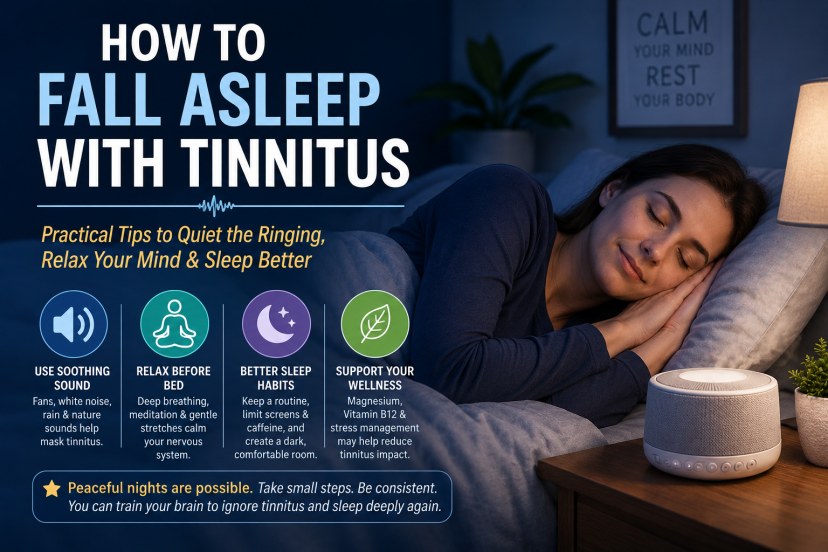
The best way to fall asleep with tinnitus is to avoid complete silence and reduce your body’s nighttime stress response. Use low-level background sound such as a fan, white noise, rainfall, or soft music while keeping a consistent sleep schedule. Deep breathing, progressive muscle relaxation, and limiting late caffeine may also help. The goal is not to drown out tinnitus completely, but to make it less noticeable while your brain transitions toward sleep.
Key Takeaways
Most likely cause: Tinnitus often seems louder at night because the environment becomes quiet, leaving fewer external sounds to compete for your brain’s attention.
Usually serious? Usually not. However, sudden, one-sided, pulsatile, or rapidly changing tinnitus deserves medical evaluation.
First thing to check: Notice whether complete silence makes your tinnitus more intrusive and whether gentle background sound makes it easier to ignore.
Best solution: If you’re learning how to fall asleep with tinnitus, combine low-level sound enrichment with relaxation, consistent sleep habits, and treatment of underlying hearing or medical problems when appropriate.
🔔 Why Does Tinnitus Seem Louder At Night?
Your tinnitus may not actually become louder when you get into bed. What changes dramatically is your environment.
During the day, your brain processes hundreds of sounds—people talking, traffic, television, air conditioning, music, footsteps, appliances, and outdoor noise.

These sounds partially mask tinnitus and give your brain something else to process.
At night, those distractions disappear.
When your bedroom becomes nearly silent, the contrast between tinnitus and your surroundings increases. The ringing can suddenly dominate your attention.
There is also a psychological component. If you start thinking, “I won’t be able to sleep because of this ringing,” your body may become more alert.
That creates an unpleasant cycle:
Tinnitus → worry → increased alertness → difficulty sleeping → more attention to tinnitus.
Breaking that cycle is one of the most useful strategies for sleeping with tinnitus.
🎧 1. Use Gentle Sound Instead Of Complete Silence
Sound enrichment is one of the simplest ways to make nighttime tinnitus less intrusive.
Instead of sleeping in complete silence, introduce a comfortable background sound.
Good options include:
- White noise
- Pink or brown noise
- Rainfall
- Ocean waves
- A quiet fan
- Soft instrumental music
- Nature sounds
- Air purifier noise
- Tinnitus sound apps
Apps such as myNoise, Calm, Headspace, and Insight Timer provide various background and relaxation sounds. You can also use a bedside sound machine or smart speaker.
Keep the volume low and comfortable.
You generally don’t need to completely mask your tinnitus. Having another neutral sound in the room may be enough to reduce the contrast and help your brain stop focusing on the ringing.
🛏️ 2. Build A Predictable Tinnitus Bedtime Routine
Your brain responds well to predictable patterns.
If your evenings involve television, work emails, scrolling social media, and worrying about tinnitus right until bedtime, your nervous system may remain too stimulated for sleep.
Create a 30–60 minute wind-down period.
For example:
9:30 p.m. – Dim the lights and put away work.
9:45 p.m. – Take a warm shower or read something relaxing.
10:00 p.m. – Turn on gentle background sound.
10:10 p.m. – Practice slow breathing or meditation.
10:30 p.m. – Lights out.
The exact routine matters less than consistency.
Repeating similar calming activities every evening helps your brain associate them with sleep rather than tinnitus-related frustration.
🧘 3. Calm Your Nervous System Before Bed
Tinnitus and stress often reinforce each other.
The sound causes anxiety, while anxiety makes you monitor the sound more closely. This increased attention can make tinnitus feel louder and more threatening.
Relaxation techniques can help interrupt this feedback loop.
Try Slow Breathing
Get comfortable and breathe slowly through your nose.
Allow your abdomen to expand naturally. Then exhale gently and slightly longer than you inhaled.
As you exhale, consciously soften your:

- Jaw
- Forehead
- Shoulders
- Hands
- Abdomen
Continue for several minutes without trying to force yourself to sleep.
The goal is simply to lower physical tension.
Try Progressive Muscle Relaxation
Progressive muscle relaxation involves gently tensing and releasing different muscle groups.
Start with your feet and gradually work upward through your legs, abdomen, hands, shoulders, jaw, and face.
As your attention shifts toward physical sensations, tinnitus may temporarily become less central to your awareness.
☕ 4. Pay Attention To Caffeine And Alcohol
You don’t necessarily need to eliminate coffee because you have tinnitus.
However, caffeine consumed late in the day can interfere with sleep, particularly if you’re sensitive to it.
If falling asleep is difficult, experiment with avoiding coffee, energy drinks, caffeinated soda, and strong tea during the late afternoon and evening.
Alcohol presents another problem.
Although alcohol can initially make you sleepy, it may disrupt sleep later in the night. Poor-quality sleep can leave you tired and more sensitive to tinnitus the following day.
Rather than assuming a particular food or drink affects everyone, track your own patterns.
A simple tinnitus and sleep diary can help identify personal triggers.
📱 5. Reduce Stimulation Before Bed
Learning how to fall asleep with tinnitus also means creating conditions that allow natural sleepiness to develop.
Bright screens, emotionally stimulating videos, late-night news, work emails, and endless scrolling can keep your brain active.
Try reducing screen use during the final 30–60 minutes before bedtime.
Instead, consider:
- Reading a paper book
- Taking a warm shower
- Listening to quiet music
- Stretching gently
- Journaling
- Meditating
- Preparing your bedroom for sleep
If you use your phone for tinnitus sounds, turn down the screen brightness and avoid switching between apps once you’re in bed.
🌡️ 6. Make Your Bedroom Sleep-Friendly
Your bedroom should help your brain recognize that it is time to sleep.
For many adults, that means keeping the room dark, comfortable, quiet—but not necessarily silent—and slightly cool.
Blackout curtains or an eye mask can help reduce unwanted light.
If outside noises wake you unpredictably, steady background sound from a fan or sound machine may help smooth out those sudden changes.
A comfortable pillow and mattress also matter. Physical discomfort can keep you awake and give your brain more time to focus on tinnitus.
If tinnitus affects only one ear, avoid repeatedly changing sleeping positions in an attempt to “turn off” the sound. Choose the position that feels physically comfortable and use background sound to reduce your attention to tinnitus.
🚶 7. Improve Your Daytime Habits
Better nighttime sleep often begins hours before bedtime.
Regular physical activity can support sleep quality and reduce stress. You don’t need an intense workout. Walking, cycling, swimming, gardening, or another enjoyable form of movement can help.
Try to get natural daylight earlier in the day as well. Light exposure helps regulate your body’s circadian rhythm—the internal system that influences when you feel awake and sleepy.
A useful routine might include:
- Getting daylight after waking
- Staying physically active
- Avoiding long late-afternoon naps
- Eating regular meals
- Managing stress during the day
- Keeping a consistent wake-up time
These habits may not directly eliminate tinnitus, but they can make sleep more resilient.
💊 8. Be Careful With Tinnitus Supplements
People searching for nighttime tinnitus relief often encounter supplements such as ginkgo biloba, magnesium, and vitamin B12.
It’s important to keep expectations realistic.
Ginkgo biloba has been studied extensively for tinnitus, but research has not consistently demonstrated reliable benefits for most people with tinnitus.
Magnesium is involved in normal nerve and muscle function. Vitamin B12 is also essential for neurological health. If you have a genuine nutritional deficiency, correcting it may benefit your overall health.
However, taking extra magnesium or B12 when you’re not deficient has not been proven to eliminate tinnitus.
Supplements can also interact with medications. Ginkgo, for example, can affect bleeding risk in some circumstances.
Talk with your physician or pharmacist before adding supplements, especially if you take prescription medications or have ongoing medical conditions.
⏰ 9. Stop Watching The Clock
One of the worst things you can do during a difficult tinnitus night is repeatedly calculate how little sleep you’re getting.
You look at the clock.
12:47 a.m.
Then again.
1:26 a.m.
Now you’re thinking, “If I fall asleep immediately, I’ll only get five hours.”
That calculation creates pressure to sleep, and pressure creates alertness.
Turn your clock away from the bed and resist checking your phone.
Instead of thinking, “I have to fall asleep,” remind yourself that resting quietly is still worthwhile.
Reducing the struggle around sleep often makes sleep more likely to happen naturally.
💤 10. Get Out Of Bed If You’re Wide Awake
If you’ve been lying awake for a while and becoming increasingly frustrated, staying in bed may reinforce an association between your bed, tinnitus, and stress.
Get up and do something quiet in dim light.
You might:
- Read something calming
- Listen to gentle audio
- Practice breathing
- Sit comfortably
- Do light relaxation exercises
Return to bed when you begin feeling sleepy.
This approach is also used in cognitive behavioral therapy for insomnia (CBT-I), an evidence-based treatment for persistent sleep difficulties.
For people whose tinnitus has created long-term insomnia, CBT or CBT-I can be particularly valuable because it helps change the thoughts and behaviors that keep the tinnitus-sleep cycle going.
🎵 Sound Therapy, Hearing Aids And Professional Tinnitus Care
If tinnitus regularly prevents you from sleeping, you don’t have to manage it entirely on your own.
An audiologist can perform a hearing evaluation and discuss tinnitus-management options.
If hearing loss is present, hearing aids may help by restoring environmental sounds that tinnitus has been competing with.
Some modern hearing devices also include tinnitus sound features.
Sound therapy may use broadband noise, nature sounds, customized sound programs, or everyday environmental sounds to reduce tinnitus awareness.
Counseling approaches such as cognitive behavioral therapy may also help reduce tinnitus-related distress.
The goal isn’t necessarily to erase every trace of tinnitus. Instead, successful management often means reaching the point where your brain treats the sound as unimportant background information.
🩺 When To See An ENT Or Audiologist
Occasional tinnitus is common, but persistent tinnitus deserves attention—particularly when it interferes with sleep or daily life.
Consider scheduling an evaluation with an audiologist or ENT if your tinnitus persists, becomes increasingly bothersome, or occurs alongside noticeable hearing difficulty.
Seek prompt medical care if tinnitus:
- Appears suddenly with sudden hearing loss
- Develops predominantly in one ear
- Pulses with your heartbeat
- Follows a significant head injury
- Is accompanied by severe dizziness
- Changes dramatically without explanation
- Occurs with neurological symptoms
Sudden hearing loss accompanied by tinnitus should be treated as a medical urgency because early treatment can matter.
❓ FAQs: How To Fall Asleep With Tinnitus
How Can I Fall Asleep Quickly With Tinnitus?
Use low-level background sound, keep your bedroom comfortable, and practice slow breathing rather than focusing on the tinnitus. Avoid repeatedly checking the clock or trying to force yourself to sleep.
What Is The Best Sound To Sleep With Tinnitus?
There isn’t one best sound for everyone. White noise, pink noise, brown noise, rainfall, ocean waves, fans, and gentle nature sounds are popular choices. Experiment until you find a sound that feels neutral and relaxing.
Should I Sleep In Silence With Tinnitus?
Complete silence can make tinnitus more noticeable for some people. Low-level background sound may reduce the contrast between tinnitus and your environment, making the ringing easier to ignore.
Why Is My Tinnitus So Loud When I Go To Bed?
Your tinnitus may not actually be louder. Bedrooms are usually much quieter than daytime environments, so there are fewer external sounds competing for your attention. Stress and fatigue can also increase tinnitus awareness.
What Sleeping Position Is Best For Tinnitus?
There is no medically proven sleeping position that works for everyone with tinnitus. Choose the position that is most comfortable for your neck and body. Background sound is usually more useful than repeatedly changing position to escape tinnitus.
Can Lack Of Sleep Make Tinnitus Worse?
Poor sleep can increase fatigue, stress, and sensitivity to tinnitus, potentially making it feel more intrusive. Improving sleep may therefore reduce tinnitus distress even if the underlying sound remains.
Can Tinnitus Stop You From Sleeping?
Yes. Tinnitus can contribute to difficulty falling or staying asleep, particularly when anxiety and increased attention to the sound develop. Sound enrichment, relaxation, good sleep habits, CBT-I, and professional tinnitus care can help break this cycle.
🌅 Final Thoughts: Sleeping Better With Tinnitus
Learning how to fall asleep with tinnitus usually isn’t about discovering one trick that instantly switches off the ringing. It’s about creating an environment where your brain has fewer reasons to pay attention to it.
Start simply tonight.
Choose a gentle background sound. Dim your lights earlier. Put the clock out of sight. Relax your jaw and shoulders, breathe slowly, and give yourself permission to rest without constantly checking whether you’re falling asleep.
Then repeat those habits consistently.
Tinnitus may still be present, but your reaction to it can change. With better sleep habits, appropriate sound enrichment, stress management, and professional support when needed, many people can make nighttime tinnitus far less disruptive and regain confidence around bedtime.
Medical Disclaimer: This article is for general educational purposes only and is not a substitute for professional medical advice, diagnosis, or treatment. Consult a qualified healthcare professional about persistent or concerning tinnitus.
 Explore more:
- Can I Have Tinnitus After Sinus Infection?
- Does Tinnitus Go Away? What’s New In 2026
- Can I Have Tinnitus After Wisdom Tooth Removal?