When To See A Doctor About Tinnitus: Warning Signs, Appointments, And What To Expect
How To Know When Tinnitus Needs Medical Evaluation
When to see a doctor about tinnitus? Hearing a ringing, buzzing, humming, hissing, or other unexplained sound in your ears can be unsettling, especially when tinnitus appears for the first time. You may immediately wonder whether something is wrong.
Should you make a doctor’s appointment? Should you wait a few days to see if the ringing settles down? And what symptoms mean you should seek medical attention more quickly?
Knowing when to see a doctor about tinnitus can help you respond appropriately without assuming that every episode of ear ringing is an emergency.
Tinnitus is common, and it is often not associated with a serious medical problem. It can occur after loud noise exposure, alongside hearing changes, or for reasons that are not immediately obvious. However, certain patterns deserve medical evaluation, particularly tinnitus that is persistent, affects only one ear, pulses with your heartbeat, occurs with hearing changes, or is accompanied by neurological symptoms.
The purpose of an appointment is not necessarily to find a quick “cure.” Instead, a healthcare professional can look for potentially treatable causes, check your hearing, identify symptoms that require further investigation, and help you find ways to make tinnitus less disruptive.
This guide explains when a routine appointment may be appropriate, when you should seek evaluation sooner, which warning signs should not be ignored, who you may see, what happens during a tinnitus evaluation, and how to prepare for your visit.

Quick Answer: When To See A Doctor About Tinnitus
Consider making an appointment if tinnitus persists, repeatedly returns, affects your sleep or concentration, occurs mainly in one ear, or is accompanied by noticeable hearing changes.
Evaluation becomes more important for one-sided tinnitus, pulsatile tinnitus that follows your heartbeat, asymmetric hearing loss, or tinnitus associated with dizziness or other concerning symptoms. Sudden hearing loss, especially in one ear, is considered a medical emergency and should be evaluated immediately rather than watched at home.
Most tinnitus is not caused by a dangerous condition, but you do not need to diagnose the cause yourself. If something about your tinnitus seems unusual, changes suddenly, or concerns you, getting professional advice is reasonable.
Key Takeaways
Most likely cause: Tinnitus is commonly associated with changes in the auditory system, including hearing loss and noise exposure, although there are many possible causes.
Usually serious? No. Most tinnitus is not associated with a serious medical condition, but certain symptoms and patterns require further evaluation.
First thing to check: Notice whether your tinnitus is in one or both ears, whether it is constant or intermittent, whether it pulses with your heartbeat, and whether you have experienced hearing loss, dizziness, pain, or other new symptoms.
Best solution: Knowing when to see a doctor about tinnitus helps you get appropriate evaluation without assuming that every episode of ear ringing is dangerous. Persistent, one-sided, pulsatile, sudden, or otherwise concerning tinnitus should be discussed with a healthcare professional.
Common Situations Where People Notice Tinnitus
Tinnitus can appear under many different circumstances. For some people, it begins suddenly after attending a loud concert. For others, it gradually becomes noticeable over months or years. Some people hear tinnitus every day, while others notice it only occasionally.
These differences matter because healthcare professionals evaluate tinnitus partly by looking at its pattern.
Tinnitus After Loud Noise
Temporary ringing after exposure to loud music, machinery, power tools, lawn equipment, sporting events, or other intense sounds is relatively common.
Noise exposure is a recognized factor associated with tinnitus and hearing loss.
If your ears ring after loud noise exposure, give your ears a break from additional loud sound. Avoid trying to “test” your ears with headphones or loud music.
If tinnitus does not settle, keeps returning after noise exposure, or is accompanied by noticeable hearing loss, arranging a hearing evaluation is sensible.
Occasional Tinnitus That Comes And Goes
Some people experience brief episodes of tinnitus that disappear on their own.
You might notice ringing for a few seconds or minutes and then realize it has stopped.
Occasional tinnitus without other symptoms is not automatically a sign of a serious problem.
However, patterns are useful.
If episodes become increasingly frequent, last longer, become louder, or begin affecting your daily activities, mention the change to your healthcare provider.
Persistent Tinnitus
Tinnitus that remains present for weeks or months deserves more attention than a brief isolated episode.
The National Institute on Deafness and Other Communication Disorders notes that tinnitus lasting three months or longer is considered chronic.
Persistent tinnitus does not necessarily mean something dangerous is happening. But an evaluation can help identify hearing changes and other possible contributors.
Tinnitus That Interferes With Daily Life
The loudness of tinnitus does not always determine how disruptive it becomes.
A relatively quiet sound may become extremely distracting in a silent bedroom, while another person may experience louder tinnitus without significant distress.
Consider seeking help if tinnitus is interfering with:
- Sleep
- Concentration
- Work
- Conversations
- Relaxation
- Social activities
- Emotional well-being
- Your ability to enjoy normal daily life
Clinical guidance specifically distinguishes bothersome tinnitus from tinnitus that has little impact on quality of life because the level of disruption helps guide treatment.
You do not need to wait until tinnitus becomes unbearable before discussing it with someone.
When A Routine Doctor’s Appointment May Be Appropriate
Many tinnitus evaluations begin as routine medical appointments rather than emergencies.
Your primary care doctor can often provide a useful starting point.
According to NIDCD, a primary care doctor may examine your ears for issues such as earwax or fluid related to an ear infection and review your medical history and medications. Depending on the findings, you may then be referred to an ENT specialist or audiologist.
Consider scheduling a routine appointment if you have tinnitus that:
Has Continued Rather Than Disappearing
If ringing that you expected to disappear continues for days or weeks, discussing it with your healthcare provider can help establish what is happening.
There is no need to choose an arbitrary day when tinnitus suddenly becomes “serious.”
Instead, pay attention to the overall pattern.
- Is it improving?
- Staying exactly the same?
- Becoming more noticeable?
- Is it beginning to interfere with sleep or concentration?
These details can help determine your next step.

Keeps Coming Back
Intermittent tinnitus can still be worth discussing if it repeatedly returns.
Keeping a simple diary can help identify patterns involving:
- Noise exposure
- Sleep
- Stress
- Caffeine
- Exercise
- Medications
- Ear symptoms
- Jaw or neck movement
- Time of day
Patterns do not necessarily prove what causes your tinnitus, but they can provide useful information during your appointment.
Is Affecting Your Sleep
Nighttime is one of the most common situations in which tinnitus becomes difficult to ignore.
Your bedroom becomes quiet, external distractions disappear, and your attention may naturally shift toward the internal sound.
If tinnitus is regularly preventing you from falling asleep or waking you during the night, mention this to your healthcare provider.
Sleep problems themselves deserve attention, even if tinnitus is not medically dangerous.
Learn more: Tinnitus At Night
Is Affecting Your Mood Or Concentration
Persistent tinnitus can be frustrating. For some people, it contributes to anxiety, low mood, irritability, difficulty concentrating, or a feeling of being constantly on alert.
NIDCD notes that tinnitus can affect mood, sleep, and concentration, while clinical guidelines recognize the importance of evaluating how tinnitus affects quality of life.
If tinnitus is affecting your mental well-being, tell your healthcare provider rather than treating emotional distress as something you simply have to tolerate.
When Tinnitus Should Be Evaluated Sooner
Some tinnitus patterns deserve more timely evaluation even when you otherwise feel well.
Tinnitus In Only One Ear
Tinnitus can occur in one ear, both ears, or seem to come from inside the head.
Persistent one-sided tinnitus deserves evaluation because clinicians may want to check for differences between the ears.
Guidelines recommend comprehensive audiologic evaluation for unilateral tinnitus, particularly because hearing testing can identify whether there is asymmetric hearing loss.
One-sided tinnitus does not automatically mean something serious is wrong.
It simply gives your healthcare provider another reason to investigate rather than assume both ears are functioning identically.
Learn more: Tinnitus In One Ear Vs Both Ears
Tinnitus With Hearing Changes
You may not always recognize hearing loss immediately.
Instead, you might notice that:
- Speech seems less clear.
- You turn the television louder.
- One ear seems different from the other.
- You have trouble understanding conversations in noisy places.
- Sounds seem muffled.
- You frequently ask people to repeat themselves.
Tinnitus and hearing loss commonly occur together.
If tinnitus is accompanied by gradual hearing difficulties, an audiologic examination can help determine whether hearing loss is present and whether the two ears differ.
Sudden hearing loss, however, belongs in a different category and requires urgent medical attention.
Pulsatile Tinnitus
Most tinnitus sounds like ringing, buzzing, hissing, humming, or another relatively continuous tone.
Pulsatile tinnitus is different.
You may hear: Whoosh…whoosh…whoosh…
The sound may appear to follow your heartbeat.
Pulsatile tinnitus warrants medical evaluation because, unlike typical non-pulsatile tinnitus, it can sometimes be related to blood flow or vascular conditions.
Clinical guidance lists pulsatile tinnitus among the tinnitus characteristics that may require additional investigation and imaging.
If you are unsure whether your tinnitus is pulsatile, you can compare the rhythm with your pulse. Do not try to diagnose the cause yourself.
Tinnitus With Persistent Dizziness Or Balance Problems
Tinnitus accompanied by vertigo, significant dizziness, or balance problems can provide important diagnostic information.
These symptoms can occur with several different ear and neurological conditions, so tell your healthcare provider exactly what you experience.
For example, “dizziness” can mean different things.
- Do you feel as though the room is spinning?
- Do you feel unsteady when walking?
- Do you feel faint?
- Do symptoms occur in episodes?
- How long do they last?
- Do hearing changes happen at the same time?
Specific descriptions are much more helpful than simply saying, “I feel dizzy.”
Tinnitus With Ear Pain Or Drainage
Ear pain, drainage, pressure, or other obvious ear symptoms can suggest that something besides primary tinnitus is occurring.
Infection, inflammation, earwax blockage, and other ear conditions may sometimes contribute to tinnitus symptoms.
These situations are worth discussing with a healthcare professional, particularly if symptoms persist.
Urgent Warning Signs: When Not To Wait
Although most tinnitus is not an emergency, some combinations of symptoms require prompt or urgent medical assessment.
Sudden Hearing Loss With Tinnitus
One of the most important warning signs is sudden hearing loss.
Sudden sensorineural hearing loss can occur all at once or develop rapidly over several days. It commonly affects one ear and can be accompanied by tinnitus, ear fullness, or dizziness.
NIDCD specifically describes sudden deafness as a medical emergency and advises immediate medical evaluation. Delaying diagnosis and treatment can reduce treatment effectiveness.
Do not assume sudden muffled hearing is simply earwax, congestion, allergies, or temporary tinnitus.
If hearing suddenly decreases—especially in one ear—seek medical attention promptly.
Tinnitus With New Neurological Symptoms
Tinnitus associated with new neurological abnormalities requires urgent assessment.
Examples can include:
- New facial weakness
- New weakness or numbness on one side of the body
- Difficulty speaking
- Sudden severe problems with coordination
- New confusion
- Other sudden neurological changes
Clinical guidance identifies focal neurological abnormalities alongside tinnitus as a reason for further investigation.
If symptoms suggest a possible stroke or another acute neurological emergency, seek emergency medical care immediately.
Tinnitus After Significant Head Injury
New tinnitus after a significant head injury should not simply be assumed to be routine ear ringing.
Seek medical advice based on the severity of the injury and any accompanying symptoms.
Emergency assessment may be necessary if there is confusion, loss of consciousness, repeated vomiting, severe or worsening headache, weakness, seizure, unusual behavior, or other concerning neurological symptoms.
Severe Symptoms That Appear Suddenly
The pattern matters.
Tinnitus that has been stable for years is very different from a sudden combination of:
- Ear ringing
- Hearing loss
- Severe vertigo
- Neurological symptoms
- Significant head trauma
When symptoms change dramatically or appear together, it is safer to seek professional assessment than to try to determine the cause at home.
Who Should You See About Tinnitus?
You may encounter several different healthcare professionals during a tinnitus evaluation.
Primary Care Doctor
For many people, primary care is the easiest place to begin.
A primary care clinician can:
- Review your symptoms.
- Examine your ears.
- Check for obvious blockage or infection.
- Review medications and health conditions.
- Decide whether further testing is appropriate.
- Refer you to an audiologist or ENT when needed.
NIDCD recommends beginning with a primary care doctor, who can check for issues such as earwax or fluid related to infection and review your medical history.
Audiologist
An audiologist specializes in hearing and balance assessment.
Hearing testing can determine:
- Whether hearing loss is present
- Which frequencies are affected
- Whether one ear differs from the other
- The type and degree of hearing loss
Audiologic evaluation is particularly important when tinnitus is unilateral, chronic, bothersome, or associated with hearing changes.
An audiologist may also discuss hearing aids, sound-based strategies, and tinnitus management options when appropriate.
ENT Doctor
An otolaryngologist, usually called an ENT, is a physician specializing in conditions involving the ears, nose, and throat.
An ENT may become involved when tinnitus:
- Is persistent and one-sided
- Is pulsatile
- Occurs with asymmetric hearing loss
- Is associated with other ear symptoms
- Requires additional medical investigation
Depending on your symptoms and examination, an ENT may recommend additional tests.
Other Specialists
Not everyone with tinnitus needs multiple specialists. However, your doctor may sometimes recommend another specialist when symptoms suggest a problem outside the auditory system. The appropriate referral depends on your individual symptoms rather than tinnitus alone.
What Happens At A Tinnitus Appointment?
Many people delay making an appointment because they imagine an intimidating series of tests.
The initial tinnitus evaluation is usually much more straightforward.
Step 1: Your Doctor Will Ask About The Sound
Be prepared to describe your tinnitus.
Questions may include:
- When did it begin?
- Did it start suddenly or gradually?
- Is it constant or intermittent?
- Is it in your left ear, right ear, or both?
- Does it sound like ringing, buzzing, hissing, humming, clicking, or whooshing?
- Does it pulse with your heartbeat?
- Has it changed over time?
There is no “correct” description.
Explain it as accurately as you can.
Step 2: You Will Discuss Other Symptoms
Your clinician may ask whether you have:
- Hearing loss
- Ear pressure
- Ear pain
- Ear drainage
- Dizziness
- Vertigo
- Balance difficulties
- Headaches
- Jaw problems
- Neck symptoms
- Sleep problems
- Difficulty concentrating
The combination of symptoms often provides more information than tinnitus alone.
Step 3: Your Ears May Be Examined
A clinician can examine the ear canal and eardrum.
Sometimes a relatively straightforward issue, such as earwax blockage or an ear problem, may contribute to symptoms.
But do not attempt to remove deep earwax yourself with cotton swabs or other objects.
Step 4: Your Medications May Be Reviewed
Certain medications can be associated with tinnitus, particularly at particular doses or in specific circumstances. NIDCD lists several medication groups that have been linked with tinnitus, including some NSAIDs, antibiotics, cancer medications, antimalarial drugs, and antidepressants.
That does not mean you should stop a prescribed medication because your ears are ringing.
Instead, bring an accurate medication list and discuss your concerns with the healthcare professional who manages your treatment.
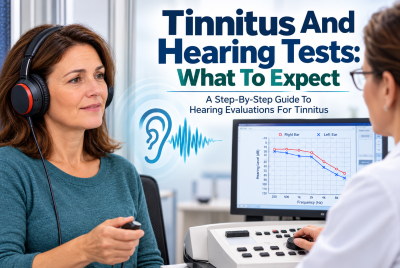
Step 5: Your Hearing May Be Tested
A hearing test is a common part of tinnitus evaluation.
You may listen to tones through headphones and indicate when you can hear them.
This can reveal hearing loss that was not obvious during everyday life.
It can also show whether one ear differs significantly from the other.
Step 6: Additional Testing May Be Recommended
Not everyone with tinnitus needs an MRI, CT scan, or other imaging.
In fact, guidelines recommend against routine imaging when tinnitus is not one-sided or pulsatile and there is no asymmetric hearing loss or focal neurological abnormality.
Imaging becomes more relevant when certain features are present, including:
- Unilateral tinnitus
- Pulsatile tinnitus
- Asymmetric hearing loss
- Focal neurological abnormalities
Your healthcare provider determines whether imaging is appropriate based on your complete clinical picture.
What Should You Bring To Your Tinnitus Appointment?
A little preparation can make your appointment more useful.
Tinnitus can be surprisingly difficult to describe once you are sitting in the examination room.
Instead of trying to remember everything on the spot, write down the important details beforehand.
Record When Your Tinnitus Started
Try to remember:
- Approximate date
- Whether onset was sudden or gradual
- What you were doing around that time
- Any recent illness
- Any major noise exposure
- Any changes in medications
You do not need to identify the cause yourself.
Simply record what happened.
Describe The Sound
Write down whether your tinnitus sounds like:
- Ringing
- Buzzing
- Hissing
- Humming
- Roaring
- Whistling
- Clicking
- Whooshing
- Another sound
Also record whether it is high-pitched, low-pitched, rhythmic, or pulse-like.
Note Which Ear Is Affected
Record whether tinnitus occurs in:
- Left ear
- Right ear
- Both ears
- Your head without a clear side
If the location changes, write that down too.
Track When It Happens
Is tinnitus:
- Constant?
- Intermittent?
- Worse at night?
- More noticeable after poor sleep?
- More noticeable after loud noise?
- Different after exercise?
- Affected by stress?
- Changed by moving your jaw or neck?
These observations can help your healthcare provider understand your experience.
Make A Medication List
Include:
- Prescription medications
- Over-the-counter medicines
- Vitamins
- Supplements
Include the dose when possible.
Again, do not discontinue prescribed medication simply because you suspect it might contribute to tinnitus.
Write Down Your Questions
Appointments can go quickly.
Questions you might want to ask include:
- Should I have a hearing test?
- Could earwax or another ear problem be contributing?
- Do my symptoms require an ENT evaluation?
- Is my tinnitus pattern something that needs additional testing?
- Could any of my medications be contributing?
- What can I do to make tinnitus less noticeable?
- What should I do if my symptoms change?
- Which symptoms should prompt me to seek care sooner?
Writing questions beforehand can prevent you from remembering them only after you leave.
Use Our Free Tinnitus Doctor Visit Checklist
If you have ever walked out of a doctor’s office and suddenly remembered the question you meant to ask, you know how useful preparation can be.
That is why we created the Free Tinnitus Doctor Visit Checklist – Questions & Symptoms To Write Down Before Your Appointment.
The printable checklist gives you one place to organize important information before your visit, including:
- When your tinnitus started
- Which ear is affected
- How you would describe the sound
- Whether tinnitus is constant or intermittent
- Hearing changes
- Dizziness or balance symptoms
- Noise exposure
- Medications
- Questions you want to ask
You can fill it out before your appointment and bring it with you.
The goal is not to diagnose yourself.
It is simply to help you remember the details your healthcare provider may need.
Download the Free Tinnitus Doctor Visit Checklist and complete it before your next appointment.
You may also find it helpful to use a Tinnitus Trigger Tracker & 30-Day Symptom Diary before your visit. Recording tinnitus levels alongside sleep, stress, caffeine, noise exposure, exercise, symptoms, and notes can make it easier to describe patterns rather than relying entirely on memory.
What If The Doctor Cannot Find A Specific Cause?
This is an important possibility to understand before your appointment.
You might hope that your doctor will identify one clear cause and immediately eliminate the sound.
Sometimes that happens.
For example, a treatable ear problem may be contributing.
But in many cases, tinnitus does not have a single easily reversible cause.
That does not mean your symptoms are imaginary or that nothing can be done.
NIDCD notes that there currently is no cure for tinnitus overall, but several approaches may help reduce its impact, including sound therapies, hearing aids when hearing loss is present, and behavioral approaches.
Cognitive behavioral therapy (CBT) has particularly good evidence for improving quality of life and reducing tinnitus-related distress, even though it is not intended to eliminate the tinnitus sound itself.
Your next step may therefore shift from: How do I make this sound disappear immediately?
To: How can I make this sound less disruptive to my life?
That can include addressing hearing loss, improving sleep, reducing excessive monitoring of the sound, using appropriate background sound, managing stress, protecting your hearing from excessive noise, and learning tinnitus coping strategies.
Do Not Ignore Changes Just Because You Already Have Tinnitus
People who have lived with tinnitus for years sometimes assume every new ear symptom is simply part of their existing tinnitus.
That is not always a safe assumption.
Pay attention when your usual pattern changes significantly.
For example, contact a healthcare professional if previously stable tinnitus suddenly becomes one-sided, changes to a heartbeat-like rhythm, or occurs alongside new hearing problems, significant dizziness, or other concerning symptoms.
Having chronic tinnitus does not mean every future hearing or ear symptom should automatically be attributed to it.
FAQs About When To See A Doctor About Tinnitus
1. Should I See A Doctor If My Ears Have Been Ringing For A Few Days?
A few days of tinnitus does not automatically indicate a serious problem.
Consider what happened before it started and whether you have other symptoms.
If tinnitus followed loud noise exposure, avoid additional excessive noise and monitor your hearing. If the ringing persists, becomes bothersome, repeatedly returns, or is associated with hearing changes or other symptoms, contact a healthcare professional.
Sudden hearing loss is different: seek urgent medical evaluation rather than waiting for it to improve on its own.
2. Should I See A Doctor For Tinnitus In Only One Ear?
Persistent one-sided tinnitus should be evaluated.
Unilateral tinnitus does not automatically mean a serious condition is present, but healthcare professionals may want to compare your hearing between the two ears and determine whether additional evaluation is appropriate.
Clinical guidelines recommend audiologic evaluation for unilateral tinnitus.
3. Is Pulsatile Tinnitus An Emergency?
Pulsatile tinnitus—particularly a sound that seems synchronized with your heartbeat—deserves medical evaluation because it can sometimes have an identifiable vascular or structural cause.
Whether it requires emergency care depends on the circumstances and accompanying symptoms.
Seek urgent medical attention when pulsatile tinnitus occurs with sudden neurological symptoms, sudden hearing loss, severe acute symptoms, or another possible emergency. Otherwise, arrange prompt medical evaluation rather than ignoring persistent heartbeat-like tinnitus.
4. Can My Doctor Actually Do Anything About Tinnitus?
Yes, although the goal is not always to eliminate the tinnitus sound.
Your healthcare team can check for potentially treatable causes, assess your hearing, review medications, decide whether additional testing is appropriate, and discuss strategies for reducing the impact tinnitus has on your life.
If hearing loss is present, hearing treatment may help. Sound-based approaches and CBT may also be useful for some people with bothersome tinnitus.
5. What Is The Most Important Tinnitus Warning Sign?
There is no single warning sign that covers every situation, but sudden hearing loss with tinnitus is especially important not to ignore.
Sudden sensorineural hearing loss is considered a medical emergency, and prompt evaluation can improve the opportunity for effective treatment.
Other symptoms that deserve timely evaluation include persistent one-sided tinnitus, pulsatile tinnitus, asymmetric hearing changes, and tinnitus associated with focal neurological abnormalities.
Final Thoughts: Knowing When To Get Tinnitus Checked
Most tinnitus is not associated with a dangerous medical condition.
That is reassuring—but it does not mean every type of tinnitus should simply be ignored.
The important thing is to pay attention to the pattern and accompanying symptoms.
Tinnitus that is occasional and short-lived is very different from tinnitus that suddenly appears with hearing loss. Persistent one-sided tinnitus is different from symmetrical ringing after years of noise exposure. Heartbeat-like pulsatile tinnitus is different from a steady high-pitched tone.
If tinnitus persists, becomes bothersome, affects your sleep or concentration, occurs mainly in one ear, or accompanies hearing changes, consider arranging an evaluation.
If you experience sudden hearing loss, seek medical attention immediately.
And remember that the purpose of seeing a healthcare professional is not only to search for a serious condition. It is also an opportunity to identify hearing changes, rule out potentially treatable causes, understand your tinnitus better, and find practical ways to reduce its impact on everyday life.
Before your appointment, write down your symptoms and questions, or use our Free Tinnitus Doctor Visit Checklist so you do not have to remember everything once you are sitting in the examination room.
Medical Disclaimer: This article is provided for general educational and informational purposes only and does not substitute for professional medical advice, diagnosis, or treatment. Seek appropriate medical care for symptoms that concern you, and seek urgent or emergency care for sudden or severe symptoms.
Explore more:
- Tinnitus Doctor Visit Checklist
- Tinnitus Trigger Tracker And 30-Day Symptom Diary
- The Complete Beginner’s Guide To Tinnitus
- Tinnitus Treatment And Management
- Tinnitus At Night: Complete Sleep Guide
- Tinnitus And Stress: Understanding The Cycle
- Tinnitus In One Ear Vs Both Ears
- Common Tinnitus Symptoms
- Tinnitus And Hearing Tests
- Common Tinnitus Causes
- Common Tinnitus Triggers
- What Is Pulsatile Tinnitus?
- Can Tinnitus Go Away?
- Living With Tinnitus