Tinnitus And Hearing Tests: What To Expect Before, During, And After Your Appointment
A Step-By-Step Guide To Hearing Evaluations For Tinnitus
What is the connection between tinnitus and hearing tests? If you have tinnitus, you may be surprised when a doctor recommends a hearing test even if you feel that you can hear perfectly well.
After all, your main concern may be ringing, buzzing, humming, hissing, or another unexplained sound. You might not have noticed any obvious difficulty hearing conversations, watching television, or talking on the phone.
So why test your hearing?
The connection between tinnitus and hearing tests is important because tinnitus and hearing changes frequently occur together. The National Institute on Deafness and Other Communication Disorders (NIDCD) notes that most people with tinnitus have some degree of hearing loss, although tinnitus can also occur when a standard hearing test appears normal.
A hearing evaluation can tell your healthcare team much more than simply whether you are “hard of hearing.”
It can show how softly you can hear sounds at different pitches, whether one ear hears differently from the other, whether hearing loss follows a particular pattern, and whether additional evaluation may be appropriate.
The good news is that routine hearing testing is generally straightforward, painless, and noninvasive.
You usually sit in a quiet testing space, listen to different sounds through headphones or earphones, and respond when you hear them. Depending on your symptoms, the audiologist may also perform other tests involving speech, the middle ear, or additional parts of your auditory system.
This guide walks you through the process from preparing for your appointment to understanding your audiogram so you know what to expect.
Quick Answer: Tinnitus And Hearing Tests
Hearing testing is commonly recommended for people with tinnitus because tinnitus is frequently associated with hearing loss, including changes that may not be obvious during everyday life.
A comprehensive audiologic evaluation can identify the presence, type, degree, and pattern of hearing loss and determine whether there are important differences between your ears. Clinical guidance recommends audiologic evaluation particularly when tinnitus is one-sided, chronic, bothersome, or accompanied by reported hearing changes.
The most familiar test is pure-tone audiometry, which measures the quietest sounds you can hear across different frequencies. Your results are plotted on a chart called an audiogram.
Depending on your symptoms, additional testing may also be performed.
Key Takeaways
Most likely cause: Tinnitus is frequently associated with changes somewhere in the auditory system, and hearing loss is one of its strongest associations.
Usually serious? No. Tinnitus is rarely associated with a serious medical problem, but certain patterns—including one-sided tinnitus, pulsatile tinnitus, asymmetric hearing loss, or neurological symptoms—can require further investigation.
First thing to check: A hearing evaluation can determine whether hearing loss is present and whether your left and right ears have similar hearing thresholds.
Best solution: Understanding tinnitus and hearing tests can make your appointment less intimidating and help you ask better questions about your hearing, tinnitus, and possible next steps.
Why Is Hearing Testing Performed For Tinnitus?
The first reason is simple: Hearing loss and tinnitus often occur together.
Tinnitus is not itself a hearing test result. It is the perception of sound without a corresponding external sound source.
You can experience tinnitus with obvious hearing loss, subtle hearing loss, or apparently normal hearing on a conventional audiogram.
Testing therefore provides objective information that your perception alone cannot provide.
You May Have Hearing Changes Without Realizing It
Hearing loss does not always feel like “I can’t hear.”
Gradual changes can be surprisingly easy to adapt to.
Instead, you may notice that:
- People seem to mumble more.
- Conversations in restaurants are harder to follow.
- You turn the television volume up slightly.
- You understand some voices better than others.
- You miss softer consonants.
- One ear seems clearer on the telephone.
- You need people to repeat themselves occasionally.
Because hearing loss often develops gradually, you may compensate without consciously realizing that your hearing has changed.
NIDCD notes that noise-related hearing loss can develop gradually enough that people may not notice it until the effects become more pronounced.
A formal hearing test can detect changes that everyday observation may miss.
Testing Compares Your Two Ears
Another important reason for testing is to determine whether your ears hear similarly.
For example, tinnitus may occur only in your left ear.
Does your left ear also have more hearing loss? Or are both ears similar?
That information can help guide the evaluation.
Clinical guidance recommends comprehensive audiologic evaluation for tinnitus that is unilateral, chronic, bothersome, or accompanied by hearing changes. Audiometry can help identify the degree and type of hearing loss as well as differences between the ears.
Hearing Results Can Influence Tinnitus Management
If hearing loss is identified, it may change what your healthcare team recommends.
For some people with both hearing loss and tinnitus, hearing aids can improve access to everyday environmental sounds. Increasing outside sound may also make tinnitus less noticeable for some users.
If your hearing is normal on standard testing, that information is useful too.
It tells your healthcare team something different about your auditory function and may help determine what should happen next.
Before Your Tinnitus Hearing Test Appointment
You generally do not need complicated preparation before a standard hearing evaluation.
However, collecting some information beforehand can make your visit considerably more productive.
Write Down When Your Tinnitus Started
Try to remember approximately when you first noticed it.
Was the onset:
- Sudden?
- Gradual?
- After a concert?
- After using loud equipment?
- After an illness?
- After starting or changing a medication?
- After a head or neck injury?
- Impossible to connect with anything specific?
You do not need to identify the cause yourself.
The timeline is simply one piece of information your healthcare professional may use.
Identify Where You Hear It
Before your appointment, think about whether tinnitus is:
- In your left ear
- In your right ear
- In both ears
- More noticeable on one side
- Difficult to locate
- Perceived somewhere inside your head
If it moves or changes sides, mention that too.
Describe The Sound
Tinnitus does not describe one particular sound.
People may describe it as:
- Ringing
- Buzzing
- Hissing
- Whistling
- Humming
- Roaring
- Clicking
- Static
- Crickets
- Electrical noise
- Whooshing
Your description does not have to match a medical term.
Explain what you actually hear.
Know Whether It Follows Your Heartbeat
This is particularly important.
If your tinnitus seems rhythmic, compare the rhythm with your pulse.
Tinnitus synchronized with your heartbeat is generally described as pulsatile tinnitus and may require a different type of medical evaluation from typical non-pulsatile tinnitus.
NIDCD notes that imaging such as MRI, CT, or ultrasound may be ordered when tinnitus pulsates, depending on the clinical situation.
Avoid Unnecessary Loud Noise Before Your Appointment
You do not need to spend the day in complete silence.
Simply use normal hearing protection when you are exposed to genuinely hazardous noise.
If possible, avoid unnecessary high-volume listening or significant recreational noise immediately before your test.
Most importantly, tell your audiologist if you have recently experienced unusual noise exposure.
Your Hearing History: What The Audiologist May Ask
Before testing begins, your audiologist will usually want to understand your hearing history.
An audiologist is a healthcare professional trained to evaluate hearing loss and related conditions, including tinnitus and balance disorders.
Do not treat this conversation as unimportant small talk.
Your history provides context for the numbers that appear later on your audiogram.
Questions About Your Tinnitus
You may be asked:
- When did tinnitus begin?
- Is it constant or intermittent?
- Which ear is affected?
- Has it changed?
- How loud does it seem?
- Does it pulse?
- Does jaw or neck movement change it?
- Does it affect sleep?
- Does it interfere with concentration?
- How bothersome is it?
Try to describe your experience rather than giving the answer you think the audiologist expects.
Questions About Hearing
You may also be asked whether you have difficulty:
- Following conversations
- Hearing in restaurants
- Understanding soft voices
- Hearing television
- Using the telephone
- Understanding people when several people are talking
- Hearing from another room
- Distinguishing speech from background noise
These real-world situations matter because an audiogram does not capture every aspect of everyday listening.
Questions About Noise Exposure
Your clinician may ask about past or current exposure to:
- Loud music
- Concerts
- Headphones
- Machinery
- Construction equipment
- Power tools
- Lawn equipment
- Motorcycles
- Firearms
- Military noise
- Workplace noise
Noise exposure is associated with both tinnitus and hearing loss.
Questions About Your Health
Depending on the circumstances, you may also discuss:
- Ear infections
- Ear surgery
- Earwax problems
- Dizziness or vertigo
- Balance problems
- Ear pressure
- Ear pain
- Head or neck injuries
- Jaw symptoms
- Family history of hearing loss
- Medical conditions
- Prescription medications
- Over-the-counter medications
- Supplements
Bring an accurate medication list rather than trying to remember everything during the appointment.
Do not stop prescribed medication because you suspect it may affect tinnitus unless the healthcare professional responsible for your medication advises you to do so.
The Ear Examination: What Happens Before The Hearing Test?
Before placing headphones or earphones in your ears, the clinician may examine your ear canals.
This is generally quick and painless.
An instrument called an otoscope allows the clinician to look inside the ear canal and examine the eardrum.
Why does this matter?
Because hearing changes and tinnitus can sometimes be associated with relatively straightforward ear problems.
For example, NIDCD lists earwax blockage and fluid related to ear infection among issues that may contribute to tinnitus.
The clinician may therefore look for:
- Excessive earwax
- Ear canal blockage
- Signs of infection
- Eardrum abnormalities
- Other visible ear problems
If something prevents accurate testing, it may need to be addressed first.
The Audiogram: The Main Hearing Test Explained
For many people, the word “hearing test” means pure-tone audiometry.
This is the test that produces the familiar graph known as an audiogram.
It is considered a fundamental part of formal hearing assessment. NIDCD describes formal audiometric testing as the gold standard for diagnosing hearing loss and monitoring treatment.
What Happens During Pure-Tone Testing?
You will typically sit in a quiet or sound-treated space.
You may wear headphones or have small insert earphones placed in your ears.
The audiologist presents tones at different:
- Pitches
- Loudness levels
- Ears
Your job is straightforward.
Whenever you hear a tone, even if it is extremely faint, you indicate that you heard it.
You might:
- Press a button
- Raise your hand
- Give another agreed response
Do not wait until the sound becomes obvious.
Respond when you believe you hear it.
The audiologist is trying to determine your hearing threshold, approximately the softest level at which you can detect a particular sound under test conditions.
What Do The Beeps Mean?
The tones represent different frequencies.
Frequency is measured in hertz (Hz) and relates roughly to pitch.
Lower frequencies correspond to lower-pitched sounds.
Higher frequencies correspond to higher-pitched sounds.
Your hearing sensitivity may not be identical across all frequencies.
For example, someone might hear lower-frequency sounds relatively well while having reduced sensitivity at higher frequencies.
This is one reason saying “my hearing is good” does not provide the same information as an audiogram.
What Does The Audiogram Show?
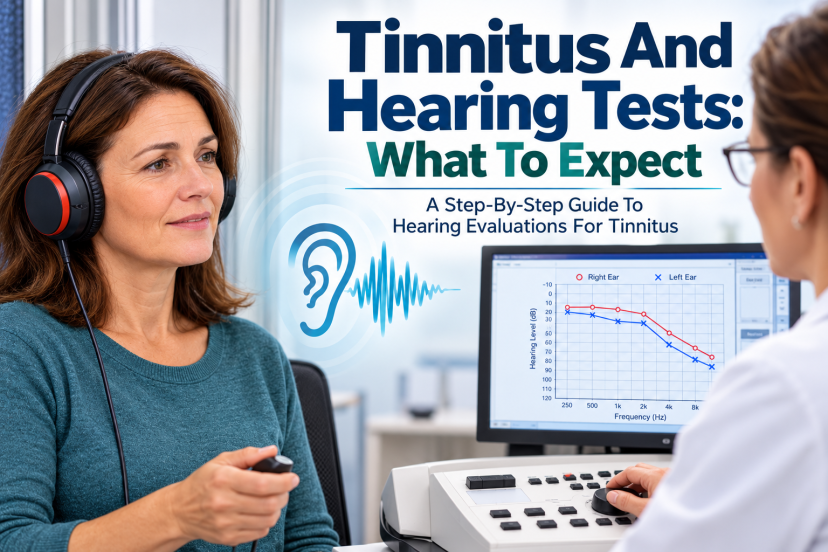
Your audiogram plots hearing thresholds across different frequencies for each ear.
Broadly speaking:
- The horizontal axis represents frequency or pitch.
- The vertical axis represents hearing level in decibels.
- Separate symbols are generally used for the right and left ears.
The audiologist can use this graph to examine:
- Whether hearing loss is present
- How much hearing loss is present
- Which frequencies are affected
- Whether both ears show a similar pattern
- Whether one ear is significantly different
Formal audiometric testing provides frequency-specific hearing information rather than simply categorizing someone as able or unable to hear.
Air Conduction And Bone Conduction
You may notice that the audiologist does not perform every part of testing through regular headphones.
Bone-conduction testing may also be used.
A small device is placed against the bone behind your ear or elsewhere on the skull. It sends vibrations through the skull toward the inner ear.
Comparing air-conduction and bone-conduction results helps clinicians determine the type of hearing loss.
Broadly, hearing loss may be described as:
Conductive hearing loss: A problem involving transmission of sound through the outer or middle ear.
Sensorineural hearing loss: Hearing loss involving the inner ear or auditory pathways.
Mixed hearing loss: A combination of conductive and sensorineural components.
Your audiologist can explain what your specific pattern means.
Other Hearing Tests You May Encounter
An audiogram is important, but it may not be the only test performed.
The exact testing battery depends on your symptoms, hearing history, age, examination findings, and the clinic.
Speech Testing
Hearing pure tones is different from understanding spoken language.
For this reason, speech testing may be included.
You may listen to words through headphones and repeat what you hear.
The audiologist may measure how softly you can recognize speech or how accurately you understand words at a comfortable listening level.
NIDCD notes that an accurate hearing assessment includes information about the ability to understand speech in addition to hearing thresholds.
This can provide useful context for real-world complaints such as:
“I can hear people talking, but I can’t always understand what they’re saying.”
Tympanometry
Another test you may encounter is tympanometry.
Rather than testing how well you consciously hear tones, tympanometry assesses aspects of middle-ear function.
A small probe is placed in the ear canal and changes air pressure while measurements are made.
You do not have to press a button when you hear something.
The test can help clinicians assess how the eardrum and middle-ear system are functioning.
It may be useful when middle-ear problems are suspected.
Acoustic Reflex Testing
Some hearing evaluations include acoustic reflex measurements.
These assess involuntary muscle responses within the middle ear when sounds are presented.
Again, you do not need to “pass” this test.
It is simply another objective measurement that can provide information about parts of the auditory pathway.
Otoacoustic Emissions
You may also encounter a test called otoacoustic emissions, often shortened to OAEs.
A small probe delivers sounds and measures tiny responses generated by the inner ear.
This provides information about the function of sensory structures within the cochlea.
You usually sit quietly while the equipment takes the measurement.
Auditory Brainstem Response
In selected circumstances, an auditory brainstem response test—often called an ABR—may be recommended.
Electrodes placed on the head measure electrical responses generated by the auditory system after sounds are presented.
ABR is not automatically performed for every person with tinnitus.
It may be used when additional information about auditory pathway function is needed.
Balance Testing
If tinnitus occurs alongside significant dizziness, vertigo, or balance problems, additional vestibular testing may sometimes be appropriate.
The specific tests depend on your symptoms.
Imaging Is Not A Routine Hearing Test
People with tinnitus sometimes worry that they will automatically need an MRI or CT scan.
That is generally not the case.
Clinical guidelines advise against routine imaging solely for tinnitus when it is not one-sided or pulsatile, and there is no asymmetric hearing loss or focal neurological abnormality.
Imaging becomes more relevant when specific features suggest that additional investigation is appropriate.
Understanding Your Hearing Test Results
Once testing is complete, your audiologist should explain the results.
Do not be afraid to ask for plain-language explanations.
You are not expected to understand an audiogram simply by looking at it.
Is There Hearing Loss?
Your first question may be: Do I have hearing loss?
If so, ask:
- How much?
- In which ear?
- At which frequencies?
- What type?
- Is it symmetrical?
These details matter more than simply hearing the words “hearing loss.”
Are Both Ears Similar?
The relationship between your ears is particularly important when evaluating tinnitus.
If tinnitus occurs mainly in one ear, clinicians may pay particular attention to whether that ear also has different hearing thresholds.
Asymmetric hearing loss can influence whether additional medical evaluation is recommended.
What Does Mild Hearing Loss Mean?
Do not assume that a “mild” test result means your experience cannot be significant.
Even relatively small changes can affect particular listening situations.
Someone may communicate very well in a quiet room but struggle when:
- Several people are speaking.
- A restaurant is noisy.
- A speaker is far away.
- Voices are soft.
- Speech contains high-frequency consonants.
The audiogram is valuable, but it does not perfectly reproduce every challenge you encounter in daily life.
NIDCD has noted that although the audiogram is the gold standard for measuring the degree and type of hearing loss, it does not by itself capture a person’s complete self-reported hearing function.
Your real-world experience still matters.
What If My Hearing Test Is Normal But I Have Tinnitus?
This is one of the most important questions for tinnitus patients.
You may go into your appointment expecting the test to reveal hearing loss.
Then the audiologist says, “Your hearing is within the normal range.”
You may immediately wonder: Then why do I still have tinnitus?
A normal conventional audiogram does not mean that your tinnitus is imaginary.
It also does not mean that you are somehow “failing” to explain your symptoms.
Tinnitus is a symptom, and the conventional audiogram measures only certain aspects of hearing sensitivity.
An Audiogram Does Not Measure Tinnitus Itself
A standard hearing test primarily measures how softly you can detect particular sounds across selected frequencies under controlled conditions.
Tinnitus is different. It is the perception of sound without an external source.
The test therefore does not work like a scanner that locates tinnitus and displays its cause on a graph.
Your audiogram can provide useful information about your hearing, while your tinnitus remains very real regardless of whether conventional thresholds fall inside the normal range.
Normal Hearing Does Not Mean Every Aspect Of Hearing Is Identical
Hearing is more complex than detecting quiet beeps.
Real-world listening also involves:
- Speech understanding
- Listening in background noise
- Auditory processing
- Attention
- Sound tolerance
- Differences across frequencies
- Differences between ears
This is one reason clinicians consider your symptoms and history alongside the audiogram.
Your Results Become A Baseline
A normal test can still be useful.
It gives you a documented baseline of your current hearing.
If your hearing changes later, future testing can be compared with earlier results.
That can be particularly helpful for people with ongoing occupational or recreational noise exposure.
Tinnitus Can Exist Without An Obvious Cause
Sometimes an evaluation does not reveal one clear explanation for tinnitus.
NIDCD notes that tinnitus has many possible associations and that some people develop tinnitus for no known reason.
That does not mean you should keep pursuing increasingly complex tests indefinitely.
Instead, your healthcare professional can determine whether your tinnitus pattern warrants further medical investigation and discuss management strategies when no reversible cause is found.
One Important Exception: Sudden Hearing Changes
Routine tinnitus testing is generally calm and non-urgent.
But sudden hearing loss is different.
If your hearing suddenly decreases in one ear—particularly if accompanied by tinnitus, ear fullness, or dizziness—do not simply schedule a routine hearing test several weeks away.
Sudden sensorineural hearing loss is considered a medical emergency.
NIDCD advises immediate medical attention because delaying diagnosis and treatment can reduce treatment effectiveness.
People sometimes mistake sudden hearing loss for:
- Earwax
- Congestion
- Allergies
- A blocked ear
- A temporary ear problem
Do not diagnose sudden hearing loss yourself. Seek prompt medical evaluation.
Questions To Ask After Your Tinnitus Hearing Test
Once your hearing evaluation is finished, take advantage of the opportunity to understand your results.
Consider asking:
Is My Hearing Within The Expected Range?
Ask the audiologist to explain your overall hearing rather than simply handing you the audiogram.
Are My Ears Similar?
If one ear differs from the other, ask whether that difference is significant.
What Type Of Hearing Loss Do I Have?
If hearing loss is present, ask whether it appears conductive, sensorineural, or mixed.
Which Frequencies Are Affected?
Knowing where your hearing changes occur can make the audiogram easier to understand.
Could My Hearing Results Be Related To My Tinnitus?
Your clinician cannot always establish a direct cause-and-effect relationship, but they can explain whether your hearing pattern is commonly associated with tinnitus.
Do I Need To See An ENT?
This is especially useful if tinnitus is one-sided, pulsatile, associated with asymmetric hearing, or accompanied by other ear or neurological symptoms.
Do I Need Additional Testing?
Ask why another test is or is not recommended.
More testing is not automatically better.
Testing should have a clinical reason.
Would Hearing Aids Be Appropriate?
If you have hearing loss, ask whether hearing aids might improve your everyday communication.
For some people with both hearing loss and tinnitus, amplification may also make tinnitus less noticeable by increasing access to external sound.
What Should I Do If My Tinnitus Changes?
Before leaving, ask which changes should prompt another appointment.
Examples might include:
- Sudden hearing loss
- Significant new asymmetry
- New pulsatile tinnitus
- Severe dizziness
- New neurological symptoms
Knowing what to watch for can reduce uncertainty later.
Prepare For Your Appointment With Your Free Checklist
It is surprisingly easy to forget important details during a medical or audiology appointment.
You may remember the date your tinnitus began but forget to mention dizziness.
Or you may spend the entire appointment discussing the ringing and realize afterward that you forgot to ask about your hearing test.
That is why preparation helps.
Before your appointment, use the Tinnitus Doctor Visit Checklist: Questions & Symptoms to Write Down Before Your Appointment.
You can record:
- When tinnitus began
- Which ear is affected
- What the tinnitus sounds like
- Whether it is constant or intermittent
- Whether it pulses with your heartbeat
- Hearing changes
- Dizziness or balance problems
- Ear pressure or pain
- Noise exposure
- Current medications
- Questions you want to ask
You can then bring the completed checklist with you.
If your tinnitus varies considerably from day to day, our Tinnitus Trigger Tracker & 30-Day Symptom Diary can also help you record patterns involving tinnitus level, sleep, stress, caffeine, noise exposure, exercise, symptoms, and other observations.
These tools are not designed to diagnose the cause of tinnitus.
Their purpose is much simpler: Help you arrive at your appointment with better information.
FAQs About Tinnitus And Hearing Tests
1. Can A Hearing Test Detect Tinnitus?
A conventional hearing test does not “detect” tinnitus in the same way that an imaging test might detect a physical structure.
Instead, audiologic testing measures aspects of your hearing and can identify hearing loss that may occur alongside tinnitus.
Your tinnitus description, medical history, ear examination, hearing results, and other symptoms are considered together.
This is why the conversation before and after your audiogram is an important part of the evaluation.
2. Can I Have Tinnitus And Still Pass A Hearing Test?
Yes. Some people with tinnitus have hearing thresholds that fall within the conventional normal range on a standard audiogram.
That does not make their tinnitus imaginary.
A conventional audiogram measures hearing sensitivity at selected frequencies and levels; it does not measure every aspect of auditory function or directly measure the tinnitus experience.
Your clinician can determine whether your symptoms suggest that additional evaluation is appropriate.
3. Does Everyone With Tinnitus Need A Hearing Test?
Not every brief episode of tinnitus automatically requires extensive testing.
However, audiologic evaluation is particularly important when tinnitus is chronic, bothersome, occurs in one ear, or is accompanied by hearing changes. Clinical guidance recommends referral for comprehensive audiologic evaluation in these circumstances.
If you are unsure whether testing is appropriate for you, discuss your symptoms with your healthcare provider.
4. Will A Hearing Test Make My Tinnitus Worse?
Routine audiologic testing uses controlled sounds designed for hearing assessment.
Some people with tinnitus are also sensitive to sound, so tell the audiologist beforehand if ordinary sounds feel unusually uncomfortable or if you have significant sound sensitivity.
The audiologist can take your symptoms into account when planning the evaluation.
If you feel uncomfortable during any part of testing, communicate with the clinician rather than trying to endure it silently.
5. What Happens If My Hearing Test Shows Hearing Loss?
The next step depends on the type, degree, pattern, and possible cause of the hearing loss.
Your healthcare team may discuss:
- Monitoring
- Hearing protection
- Hearing aids
- Medical evaluation
- ENT referral
- Additional testing
- Communication strategies
- Tinnitus management
Hearing loss in both ears may lead to a different plan from significant asymmetric hearing loss.
Your audiologist or doctor should explain what your individual results mean rather than expecting you to interpret the audiogram yourself.
Final Thoughts: Your Hearing Test Is One Piece Of The Tinnitus Puzzle
If you are nervous about having your hearing tested because of tinnitus, remember that the process is generally straightforward.
You are not taking an exam that you can pass or fail.
You are simply gathering information.
Your hearing evaluation may reveal hearing loss that you had not previously noticed. It may show that one ear differs from the other. Or your conventional hearing thresholds may fall within the normal range.
Each of those results provides useful information.
The relationship between tinnitus and hearing tests is also a reminder that tinnitus should not be evaluated based only on how loud the ringing seems.
Healthcare professionals consider the complete picture:
Your tinnitus pattern + hearing results + symptoms + medical history + physical examination.
Together, these pieces help determine whether further evaluation is needed and which management strategies may be worth considering.
If your tinnitus is persistent, bothersome, one-sided, or associated with hearing changes, asking about a comprehensive hearing evaluation is a reasonable next step.
And if you experience sudden hearing loss, especially in one ear, do not wait for a routine appointment. Seek prompt medical evaluation because sudden sensorineural hearing loss is considered a medical emergency.
Before your appointment, take a few minutes to write down your tinnitus history, hearing concerns, medications, noise exposure, and questions.
Better preparation can help you get more from the appointment and leave with a clearer understanding of both your hearing and your tinnitus.
Medical Disclaimer: The information in this article is intended for general educational purposes only and does not substitute for professional medical advice, diagnosis, or treatment. Consult an appropriately qualified healthcare professional about tinnitus, hearing changes, or other symptoms that concern you. Sudden hearing loss or other sudden or severe symptoms require prompt medical evaluation.
Explore more:
- Tinnitus Doctor Visit Checklist
- Tinnitus Trigger Tracker And 30-Day Symptom Diary
- The Complete Beginner’s Guide To Tinnitus
- Tinnitus Treatment And Management
- Tinnitus At Night: Complete Sleep Guide
- Tinnitus And Stress: Understanding The Cycle
- Tinnitus In One Ear Vs Both Ears
- Common Tinnitus Symptoms
- Common Tinnitus Causes
- Common Tinnitus Triggers
- What Is Pulsatile Tinnitus?
- Living With Tinnitus