Common Tinnitus Symptoms: What Different Sounds And Patterns May Mean
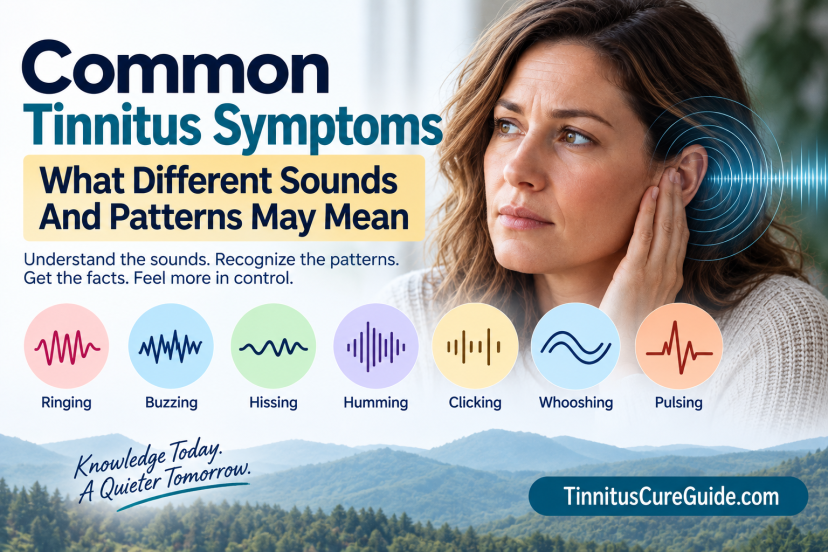
Ringing, Buzzing, Pulsing Or Hissing? Understanding What Your Tinnitus May Be Telling You
If you hear ringing, buzzing, hissing, humming, clicking, or another sound that nobody around you seems to hear, you are experiencing one of the most recognizable common tinnitus symptoms. But the sound itself is only part of the picture.
Tinnitus can behave in surprisingly different ways.
Some people hear a steady high-pitched tone in both ears. Others notice a low hum that comes and goes. The sound may appear primarily in one ear, switch between ears, become more noticeable at night, change when you move your jaw, or pulse in rhythm with your heartbeat.
These differences can be confusing, especially when tinnitus is new.
While the particular sound or pattern can sometimes provide useful clues, it usually cannot tell you the exact cause by itself. Ringing does not automatically mean one condition, just as buzzing or hissing does not automatically point to another.
What matters is the whole pattern: what the tinnitus sounds like, where you hear it, when it occurs, whether it changes, and whether you have other symptoms such as hearing loss, dizziness, ear pressure, pain, or balance problems.
This guide explains common tinnitus sounds and patterns, what they may suggest, what details are worth tracking, and when tinnitus should be evaluated by a healthcare professional.
Quick Answer: What Are The Most Common Tinnitus Symptoms?
Tinnitus symptoms most commonly involve hearing sound without an outside source. People may describe the sound as ringing, buzzing, hissing, humming, whistling, roaring, clicking, whooshing, or pulsing.
Tinnitus may occur in one ear, both ears, or seem to come from inside the head. It can be constant or intermittent, high- or low-pitched, and may change in volume or character.
These patterns can provide useful information, but the sound alone generally cannot identify the cause. Hearing changes, noise exposure, ear conditions, medications, jaw or neck factors, and other health conditions may all be associated with tinnitus.
Key Takeaways
Common sounds: Tinnitus may sound like ringing, buzzing, hissing, humming, whistling, roaring, clicking, whooshing, or pulsing.
Common patterns: It may affect one or both ears, remain constant, come and go, fluctuate in intensity, or change with movement, stress, sleep, or surrounding sound.
What the pattern may tell you: The characteristics of tinnitus can give healthcare professionals useful clues, but they rarely identify the exact cause by themselves.
First thing to track: Note when your tinnitus started, what it sounds like, which ear is affected, whether it is constant or intermittent, and any other symptoms occurring with it.
When to seek care: New, persistent, one-sided, pulsatile, or significantly changing tinnitus should be discussed with an appropriate healthcare professional. Sudden hearing loss or certain neurological symptoms require prompt medical attention.
What Can Tinnitus Sound Like?
“Tinnitus” is often described simply as ringing in the ears.
That description can be misleading because many people with tinnitus don’t hear anything they would describe as ringing.
The sound may be tonal, mechanical, rhythmic, or difficult to describe at all.
It can also change over time.
Ringing
Ringing is probably the sound most closely associated with tinnitus.
It may resemble:
- A high electronic tone
- A distant alarm
- A telephone-like ring
- A continuous pure tone
- A faint high-frequency whistle
Some people notice a very high-pitched sound that seems to sit in the background throughout the day.
Others only become aware of it when the room becomes quiet.
Ringing can occur with hearing loss and noise exposure, but the fact that your tinnitus sounds like ringing does not establish its cause.
Buzzing
Buzzing tinnitus may resemble an electrical appliance, insect, fluorescent light, or faint electrical current.
It can be continuous or fluctuate.
Some people find that the sound is difficult to locate precisely. It might feel as though it is coming from one ear, both ears, or somewhere inside the head.
Again, “buzzing” is a description rather than a diagnosis.
Hissing
Hissing tinnitus may sound similar to:
- Air escaping
- Steam
- Static
- Running water
- White noise
For some people, the sound is broad rather than tonal. Instead of hearing one distinct pitch, they hear something more like a layer of static.
This may be particularly noticeable in quiet environments.
Humming
A low humming sound can sometimes be mistaken for an environmental noise.
You might initially wonder whether a refrigerator, ventilation system, electrical device, or distant engine is responsible.
One clue that the sound may be internal is noticing it in multiple environments when other people cannot hear it.
However, don’t assume every unexplained hum is tinnitus. Environmental low-frequency sounds can be genuinely difficult to locate.
Whistling Or Squealing
Some tinnitus sounds are extremely high-pitched.
People may describe them as whistling, squealing, screeching, or an electronic tone.
The pitch itself doesn’t tell you how severe the underlying issue is.
A quiet high-pitched sound can be very distracting to one person while another person adapts to a much louder perceived sound.
Roaring
Some people describe tinnitus as roaring or rushing.
Because different ear and hearing conditions can produce overlapping tinnitus descriptions, a roaring sound should be considered alongside other symptoms rather than interpreted on its own.

For example, if changes in hearing, ear fullness, or dizziness occur alongside tinnitus, those additional symptoms are important to report during an evaluation.
Clicking
Clicking tinnitus may sound different from a continuous ringing tone.
Some clicking or repetitive sounds can have mechanical causes involving structures around the ear, although it is not possible to determine the source simply from the description.
If you repeatedly hear clicking that does not appear to come from your environment, note whether it is rhythmic, whether it changes when you swallow or move your jaw, and whether you have other ear or jaw symptoms.
Whooshing Or Pulsing
Whooshing deserves particular attention when it follows your heartbeat.
This pattern is often called pulsatile tinnitus.
Rather than a continuous tone, you may hear something resembling:
whoosh… whoosh… whoosh…
or a thumping or pulsing sensation that appears synchronized with your pulse.
Pulsatile tinnitus is evaluated differently from typical non-pulsatile tinnitus because blood-flow or structural factors can sometimes be involved.
Understanding Tinnitus Patterns
The behavior of tinnitus can be just as informative as the sound itself.
When talking with a doctor or audiologist, saying: “I have tinnitus”
provides some information.
But saying: “I developed a constant high-pitched sound in my left ear about six weeks ago, and I’ve also noticed that my hearing seems different on that side”
provides much more useful information.
Several characteristics help describe your tinnitus pattern:
- Sound
- Pitch
- Location
- Timing
- Duration
- Rhythm
- Changes in intensity
- Associated symptoms
- Situations that make it more or less noticeable
You don’t need to become obsessed with monitoring every fluctuation.
The purpose is simply to identify the larger pattern.
High-Pitched Vs Low-Pitched Tinnitus
Tinnitus can occur at many perceived pitches.
High-pitched tinnitus is commonly described as ringing, squealing, or whistling.
Lower-pitched tinnitus may resemble humming, roaring, or machinery.
Pitch can be useful information during a tinnitus or hearing assessment, but it generally isn’t enough to diagnose the underlying cause.
Tinnitus That Changes Volume
Many people expect tinnitus to remain exactly the same.
It often doesn’t.
You might have:
- Quiet mornings and louder evenings
- Several relatively easy days followed by a difficult day
- Changes after poor sleep
- Changes after noise exposure
- Increased awareness during stress
- Greater awareness in quiet rooms
A temporary increase does not necessarily mean the underlying problem has permanently worsened.
Instead of judging tinnitus based on one hour or one day, look for patterns over longer periods.
Tinnitus That Changes With Jaw Or Neck Movement
Try not to repeatedly “test” your tinnitus, but you may naturally notice that certain movements change it.
For example, tinnitus might briefly become louder or change pitch when you:
- Clench your jaw
- Open your mouth
- Turn your neck
- Move your head
- Press or tense certain muscles
This type of modulation may be relevant to what is sometimes called somatosensory tinnitus.
Jaw or neck symptoms occurring at the same time are useful details to discuss with a healthcare professional.
Tinnitus That Seems Worse At Night
Tinnitus often becomes much more obvious at bedtime.
This does not necessarily mean something physically changes in your ears every night.
During daytime life, you are surrounded by environmental sound.
At night, that sound disappears.
The contrast between a quiet bedroom and an internal tinnitus sound can make tinnitus seem much more prominent.
Fatigue, stress, and focusing on whether you will be able to sleep may increase your awareness even further.
Gentle background sound can help some people reduce this contrast.
Learn more: Why Is My Tinnitus Worse At Night?
Tinnitus In One Ear Vs Both Ears
Where you perceive tinnitus is an important part of the pattern.
Some people hear tinnitus equally in both ears.
Others hear it mainly on one side.
And some cannot clearly locate it at all.
Tinnitus In Both Ears
Bilateral tinnitus means tinnitus is perceived in both ears.
This is a common pattern and can occur alongside hearing changes or a history of noise exposure, among other possible factors.
The sounds do not necessarily have to be identical.
One ear might have a stronger tone than the other, or you may perceive different pitches.
Tinnitus In One Ear
Unilateral tinnitus means tinnitus occurring primarily in one ear.
There are many possible explanations, and unilateral tinnitus does not automatically mean something dangerous is happening.
However, persistent one-sided tinnitus is a pattern worth discussing with a healthcare professional because it can affect what type of evaluation is recommended.
Make sure to mention accompanying symptoms such as:
- Hearing changes on the same side
- Ear pressure or fullness
- Ear pain
- Dizziness
- Balance difficulties
- Facial symptoms
- Pulsing
The combination of symptoms is often more informative than the tinnitus alone.
Learn more: Why Do I Have Tinnitus In One Ear?
Tinnitus That Switches Ears
Some people become concerned when tinnitus seems to move.
Perhaps it is noticeable in the right ear one day and the left ear another day.
Or the sound may temporarily become much stronger on one side.
Changing perception doesn’t necessarily mean that something is physically moving from ear to ear.
Tinnitus perception involves both the auditory system and the brain’s processing of sound, and awareness can fluctuate.
Still, persistent or substantial changes are worth recording and discussing if they continue.
Learn more: Why Does My Tinnitus Switch From One Ear To The Other?
Tinnitus That Feels Like It Is Inside Your Head
Not everyone perceives tinnitus as coming from an ear.
Some people describe the sound as being:
- In the center of their head
- Behind their ears
- Everywhere
- Impossible to locate
This can feel strange, but tinnitus is a sound perception rather than an ordinary external sound with an easily identifiable physical location.
Constant Vs Intermittent Tinnitus
Another useful question is: Is the tinnitus always there?
Constant Tinnitus
Constant tinnitus is present continuously or nearly continuously.
Its intensity may still fluctuate.
You might barely notice it while busy and become much more aware of it while lying in bed.
That doesn’t necessarily mean the sound completely disappeared during the day. Your attention and surrounding environment can strongly influence how noticeable it becomes.
Persistent tinnitus is worth discussing with a healthcare or hearing professional, particularly if it is new or affecting your quality of life.
Intermittent Tinnitus
Intermittent tinnitus comes and goes.
It might occur:
- A few times a week
- During certain situations
- After noise exposure
- When you’re very tired
- During stressful periods
- Without any obvious pattern
Occasional brief tinnitus is experienced by many people.
However, frequent episodes, changing symptoms, or tinnitus accompanied by other ear or neurological symptoms deserve appropriate evaluation.
Sudden Short Bursts Of Ringing
Some people occasionally experience a sudden tone in one ear that lasts seconds or a short period and then fades.
A brief isolated episode isn’t the same pattern as persistent tinnitus.
What matters is whether these episodes become frequent, prolonged, or occur with other symptoms.
If the pattern changes significantly, mention it during an appropriate medical or hearing evaluation.
Pulsatile Vs Non-Pulsatile Tinnitus
One of the most useful distinctions in tinnitus is whether the sound follows your heartbeat.
Non-Pulsatile Tinnitus
Most tinnitus is non-pulsatile.
This includes many of the familiar sounds:
- Ringing
- Buzzing
- Hissing
- Whistling
- Humming
The sound does not consistently match your pulse.
Non-pulsatile tinnitus is often associated with the auditory system, although many possible factors can contribute.
What Is Pulsatile Tinnitus?
Pulsatile tinnitus usually has a rhythmic quality.
People often describe:
- Whooshing
- Thumping
- Beating
- Pulsing
The key question is whether the rhythm appears synchronized with your heartbeat.
You can sometimes notice the relationship more clearly when sitting quietly.
Do not repeatedly press on your neck or attempt to manipulate blood vessels to investigate the sound yourself.
Why Pulsatile Tinnitus Is Different
Typical tinnitus is usually a perception generated somewhere within the auditory system without a corresponding outside sound source.
Pulsatile tinnitus can sometimes be related to blood flow near the ear or other structural or vascular factors.
There are multiple possible explanations, some relatively straightforward and others requiring further investigation.
For that reason, tinnitus that consistently beats in time with your pulse should receive medical evaluation rather than being treated simply as another ordinary tinnitus sound.
Associated Symptoms: What Else Are You Experiencing?
One of the most important parts of understanding tinnitus symptoms is looking beyond the sound.
Tinnitus plus another symptom may provide considerably more useful information than tinnitus alone.
Hearing Changes
Ask yourself whether you’ve noticed:
- Difficulty following conversations
- Trouble understanding speech in noisy places
- Needing the television louder
- Sounds seeming muffled
- One ear hearing differently from the other
- Sudden loss of hearing
Tinnitus and hearing loss frequently occur together.
However, you can experience tinnitus while feeling that your hearing is normal.
That is one reason a formal hearing test can be useful.
Most importantly, sudden hearing loss requires prompt medical attention. Don’t simply wait to see whether it improves because tinnitus happened at the same time.
Learn more: Why Is My Ear Ringing But My Hearing Seems Normal?
Ear Fullness Or Pressure
Some people experience a feeling of fullness, blockage, or pressure alongside tinnitus.
There are numerous possible explanations for ear pressure, including relatively common ear problems.
The combination becomes especially useful to report when it occurs with hearing changes or dizziness.
Avoid assuming that pressure means you simply have earwax.
An examination is a better way to determine what is happening.
Dizziness And Vertigo
“Dizziness” can mean different things.
Some people mean lightheadedness.
Others mean imbalance.
Vertigo usually refers to a sensation of movement or spinning.
If tinnitus occurs with repeated dizziness or vertigo, mention both symptoms during your medical evaluation.
Sudden severe vertigo combined with other concerning symptoms may require more urgent medical assessment.
Ear Pain
Tinnitus itself isn’t typically described as ear pain.
If you have pain as well as tinnitus, tell your healthcare professional.
Ear pain may have a separate or related explanation, and an ear examination can help identify common problems such as infection or other ear conditions.
Jaw Pain, Clicking Or Teeth Grinding
The jaw joint sits close to the ear.
If tinnitus occurs alongside:
- Jaw pain
- Clicking or popping
- Teeth grinding
- Jaw stiffness
- Frequent clenching
- Changes in tinnitus when moving the jaw
Mention those symptoms.
They may be relevant to determining whether jaw-related factors are contributing.
Learn more: Can Tight Jaw Muscles Cause Tinnitus?
Neck Pain Or Tension
Some people find that neck movement or muscle tension changes their tinnitus.
If you have tinnitus plus persistent neck discomfort, stiffness, a previous neck injury, or a strong relationship between neck movement and the tinnitus sound, record that information.
It does not prove that your neck is the cause, but it may be relevant.
Headache Or Migraine Symptoms
Some people experience tinnitus in association with headaches or migraine.
If the two repeatedly occur together, note the timing and discuss the pattern with your healthcare professional.
Again, the objective is not to diagnose the cause yourself.
It is to provide a clearer picture.
Anxiety, Stress And Sleep Problems
Tinnitus can have emotional and practical effects that are just as important as its physical characteristics.
You may find yourself:
- Constantly checking the sound
- Worrying that tinnitus will get worse
- Searching online repeatedly
- Struggling to concentrate
- Becoming anxious in quiet environments
- Dreading bedtime
- Waking during the night
- Feeling exhausted the next day
These problems deserve attention.
Tinnitus distress isn’t measured simply by how loud the sound seems.
A relatively quiet sound can cause substantial distress, while another person may adapt to louder tinnitus.
If tinnitus is interfering with your sleep, emotional well-being, concentration, or ability to enjoy everyday life, tell your healthcare professional.
What Should You Track About Your Tinnitus?
When tinnitus first appears, it’s tempting to monitor it constantly.
Try not to turn tracking into another source of stress.
You do not need to record every change.
Instead, collect enough information to identify meaningful patterns.
1. When It Started
Write down approximately when you first noticed tinnitus.
Was the onset:
- Sudden?
- Gradual?
- After loud noise?
- During an illness?
- After an ear problem?
- After an injury?
- Around the time of a medication change?
- Without any obvious event?
Don’t worry if you can’t identify a trigger.
“No obvious cause” is still useful information.
2. What It Sounds Like
Choose the description that comes closest:
- Ringing
- Buzzing
- Hissing
- Humming
- Whistling
- Clicking
- Roaring
- Whooshing
- Pulsing
- Something else
If there are multiple sounds, record that too.
3. Where You Hear It
Note whether tinnitus is:
- Left ear
- Right ear
- Both ears
- Mostly one side
- Switching sides
- Inside the head
- Difficult to locate
4. Whether It Is Constant Or Intermittent
- Does the tinnitus remain present throughout the day?
- Does it disappear completely?
- Does it occur only occasionally?
- Does it happen in predictable situations?
A general description is usually enough.
5. Whether It Follows Your Heartbeat
This is particularly important.
If the sound appears rhythmic, compare the rhythm with your pulse without pressing or manipulating your neck.
If it consistently matches your heartbeat, tell your healthcare professional.
6. Hearing Changes
Record any perceived changes in hearing, especially if one ear seems different from the other.
Sudden hearing loss should not simply be entered into a diary and watched — it needs prompt medical assessment.
7. Other Symptoms
Note meaningful associated symptoms such as:
- Dizziness or vertigo
- Ear fullness
- Ear pain
- Headaches
- Jaw discomfort
- Neck problems
- Balance difficulties
8. Possible Triggers
If your tinnitus fluctuates, look for repeatable relationships with:
- Sleep
- Stress
- Loud noise
- Illness
- Congestion
- Jaw clenching
- Changes in routine
- Medication changes
Avoid making conclusions from a single event.
If tinnitus happens to be louder after drinking coffee once, that doesn’t prove caffeine is your personal trigger.
Repeated patterns are much more useful.
Use A Tinnitus Diary Without Obsessing Over The Sound
A simple daily rating is often enough.
For example:
Morning tinnitus: Mild / Moderate / Strong
Evening tinnitus: Mild / Moderate / Strong
Sleep: Good / Average / Poor
Stress: Low / Moderate / High
Unusual noise exposure: Yes / No
Other symptoms: Short note
This takes less than a minute.
The goal is to understand tinnitus — not spend your entire day thinking about it.
If your tinnitus changes from day to day, our Free Tinnitus Trigger Tracker And 30-Day Symptom Diary can help you record sounds, patterns, sleep, stress, noise exposure, and possible triggers without relying on memory.
When Should You Seek Medical Care For Tinnitus Symptoms?
Most tinnitus isn’t a medical emergency.
However, certain patterns deserve evaluation, and some combinations of symptoms require prompt attention.
Arrange A Routine Evaluation If Tinnitus Is Persistent
Consider talking with a doctor, audiologist, or other appropriate healthcare professional if your tinnitus:
- Persists
- Regularly returns
- Is primarily in one ear
- Has noticeably changed
- Is interfering with sleep
- Makes concentration difficult
- Is causing substantial distress
- Occurs with perceived hearing changes
A basic evaluation can check for treatable ear problems and determine whether a hearing assessment or further investigation is appropriate.
Get Pulsatile Tinnitus Evaluated
If you hear a sound that repeatedly beats or whooshes in time with your heartbeat, seek medical evaluation.
Pulsatile tinnitus has different potential causes from typical non-pulsatile tinnitus and may require additional investigation.
Do not try to diagnose the cause based on internet descriptions.
Sudden Hearing Loss Requires Prompt Attention
This is one of the most important points in this entire guide.
If tinnitus suddenly appears alongside a rapid or sudden loss of hearing, seek prompt medical care.
Do not assume that the ear is simply blocked.
Sudden sensorineural hearing loss can require time-sensitive treatment, so early medical evaluation matters.
Seek Prompt Care For Concerning Neurological Or Injury-Related Symptoms
Tinnitus should also receive prompt medical attention when it develops alongside concerning symptoms such as significant neurological changes or after a serious head injury.
Examples that warrant urgent assessment can include sudden facial weakness, significant new balance problems, or severe neurological symptoms.
The appropriate response depends on the exact symptoms and circumstances, so use local emergency or urgent medical services when necessary.
If you’re planning an appointment, use our Free Tinnitus Doctor Visit Checklist to write down your symptoms, hearing changes, possible triggers, medications, and questions before you go.
What Your Tinnitus Pattern Can — And Cannot — Tell You
Learning about tinnitus symptoms can make the experience less mysterious.
The sound and pattern matter.
Whether your tinnitus rings, buzzes, hisses, hums, clicks, or pulses can help describe what you’re experiencing. Whether it affects one ear or both, remains constant or comes and goes, changes with movement, or appears alongside hearing or balance problems can provide additional clues.
But tinnitus patterns have limits.
A particular sound does not reliably diagnose a particular disease.
You cannot safely conclude: “Mine is high-pitched, so it must be hearing loss.”
Or: “Mine is in one ear, so it must be something serious.”
Or: “Mine comes and goes, so I don’t need to mention it.”
Instead, think of your tinnitus pattern as information.
Observe it without becoming consumed by it.
Write down the important characteristics. Pay attention to meaningful changes. Track associated symptoms and repeatable triggers. Protect your hearing appropriately. And seek professional evaluation when the pattern warrants it.
The more clearly you understand what you’re experiencing, the easier it becomes to explain your tinnitus to a healthcare professional — and to focus on practical steps that may make everyday life more comfortable.
Your Next Steps
If you’re trying to understand your tinnitus symptoms for the first time, start simply.
1. Describe the sound.
Is it ringing, buzzing, hissing, humming, clicking, whooshing, pulsing, or something else?
2. Identify the pattern.
Notice whether it occurs in one ear or both and whether it is constant or intermittent.
3. Check for associated symptoms.
Pay particular attention to hearing changes, dizziness, ear pressure, pain, balance problems, jaw symptoms, and other significant changes.
4. Track meaningful changes.
A short tinnitus diary can help identify patterns involving sleep, stress, noise exposure, illness, or other factors without requiring you to monitor tinnitus all day.
If your tinnitus changes from day to day, our Free Tinnitus Trigger Tracker And 30-Day Symptom Diary can help you record sounds, patterns, sleep, stress, noise exposure, and possible triggers without relying on memory.
5. Don’t diagnose yourself from the sound alone.
Different tinnitus causes can produce similar sounds and patterns.
6. Arrange an appropriate evaluation when needed.
Persistent, changing, one-sided, pulsatile, or significantly bothersome tinnitus deserves discussion with a healthcare professional.
7. Act promptly when tinnitus occurs with sudden hearing loss or other concerning symptoms.
Some situations are time-sensitive and should not be handled by simply waiting to see what happens.
Understanding your tinnitus pattern is not about finding a frightening explanation for every sound.
It is about learning which details matter, which changes are worth tracking, and when professional evaluation is appropriate.
For many people, that understanding is an important first step toward feeling less uncertain — and more confident about what to do next.
Medical Disclaimer: The information in this guide is for general educational purposes only and does not substitute for professional medical advice, diagnosis, or treatment.
Explore more:
- Tinnitus Doctor Visit Checklist
- Tinnitus Trigger Tracker And 30-Day Symptom Diary
- The Complete Beginner’s Guide To Tinnitus