How Can I Stop Tinnitus Naturally? 10 Practical Ways To Make The Ringing Less Noticeable
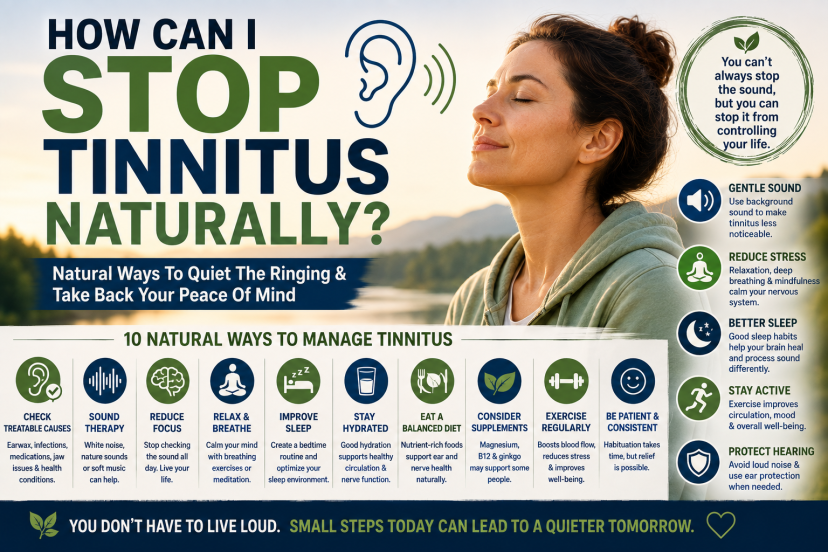
Reduce Ringing And Make Tinnitus Less Noticeable
How can I stop tinnitus naturally? Constant ringing, buzzing, humming, hissing, or whooshing can make quiet moments surprisingly difficult. Tinnitus may interfere with concentration during the day and become even more noticeable when you climb into bed at night. Add poor sleep and worry about whether the sound will ever stop, and tinnitus can begin taking up far too much of your attention.
If you’ve been asking, how can I stop tinnitus naturally, it’s important to start with realistic expectations. There is currently no natural remedy proven to permanently eliminate every type of tinnitus. However, some tinnitus improves when an underlying cause is treated, and persistent tinnitus can often become far less intrusive.
Sound enrichment, stress reduction, better sleep, safe hearing habits, relaxation, and treatment of hearing or jaw problems can all play a role. The goal isn’t necessarily to force tinnitus into silence overnight. It’s to reduce its impact and help your brain gradually stop treating the sound as something important.
🔎 Quick Answer: How Can I Stop Tinnitus Naturally?
If you’re wondering how to stop tinnitus naturally, start by identifying possible underlying causes and protecting your hearing. Gentle background sound, relaxation exercises, better sleep, regular activity, and reduced stress can make tinnitus less intrusive. Hearing aids may help when hearing loss is present. No herb, vitamin, diet, or home remedy has been proven to permanently stop every form of tinnitus, so be cautious with products promising a cure.
Key Takeaways
Most likely cause: Persistent tinnitus is often associated with hearing changes or noise exposure, although ear problems, medications, jaw tension, and other conditions may contribute.
Usually serious? Usually not, but sudden, pulsatile, one-sided, or rapidly changing tinnitus deserves medical evaluation.
First thing to check: Have your hearing and ears evaluated if tinnitus is persistent, particularly if you’ve noticed hearing changes or recently experienced significant noise exposure.
Best solution: If you’re asking how to stop tinnitus naturally, combine appropriate treatment of underlying causes with sound enrichment, hearing protection, stress reduction, better sleep, and healthy daily habits.
👂 Start By Understanding Why You Have Tinnitus
Tinnitus isn’t a single disease. It is a symptom—the perception of sound without a corresponding external source.
People may hear:

- Ringing
- Buzzing
- Hissing
- Humming
- Whistling
- Clicking
- Whooshing
One of the most common associations is hearing loss. Changes in auditory input can affect how the brain processes sound, potentially contributing to tinnitus.
Other possible contributors include earwax blockage, ear infections, loud-noise exposure, certain medications, jaw or neck problems, and other health conditions.
That’s why the first step shouldn’t be randomly trying supplements.
If something treatable is contributing to your tinnitus, identifying it gives you a more useful path forward.
🌿 1. Check For Treatable Causes First
Some tinnitus improves when its underlying trigger is addressed.
For example, impacted earwax can cause hearing changes and tinnitus. Professional removal may improve symptoms when wax is responsible.
If tinnitus began after starting or changing a medication, discuss the timing with your doctor or pharmacist. Don’t stop prescription medication on your own.
Jaw clenching and temporomandibular joint problems may also influence tinnitus in some people.
Notice whether the sound changes when you:
- Clench your teeth
- Open your mouth
- Move your jaw sideways
- Turn your neck
- Tighten facial muscles
A consistent change with movement may suggest a somatosensory component worth discussing with a healthcare professional.
🎧 2. Use Sound Therapy Instead Of Chasing Silence
If you’re constantly asking how can I stop tinnitus naturally, one of the simplest things to try is adding comfortable sound to your environment.
Tinnitus often seems louder in silence because there are fewer outside sounds competing for your brain’s attention.

Try:
- White noise
- Pink or brown noise
- Rain sounds
- Ocean waves
- A quiet fan
- Nature recordings
- Soft instrumental music
- A tabletop sound machine
Apps such as myNoise, Calm, Headspace, and Insight Timer also provide soundscapes and relaxation audio.
Keep the volume low and comfortable.
You don’t necessarily need to completely cover the tinnitus. Gentle background sound may be enough to reduce the contrast and make the ringing less dominant.
This can be especially helpful when reading, relaxing, or trying to sleep.
🧠 3. Stop Checking Your Tinnitus All Day
When tinnitus first appears, monitoring it feels natural.
You may repeatedly ask:
“Is it louder?”
“Has the pitch changed?”
“Can I still hear it?”

Unfortunately, checking the sound over and over teaches your brain that tinnitus is important.
Try doing the opposite.
When you notice tinnitus, acknowledge it without testing it and gently return your attention to whatever you’re doing.
Over time, your brain may begin treating the sound as less significant.
This process is called habituation.
Habituation doesn’t necessarily mean tinnitus physically disappears. Instead, you may reach a point where you go hours without consciously noticing it.
For many people, that represents meaningful recovery.
🧘 4. Reduce Your Stress Response
Stress doesn’t make tinnitus imaginary, but it can strongly influence how intrusive tinnitus feels.

When you’re anxious, your nervous system becomes more alert. You may also tighten your shoulders, clench your jaw, sleep poorly, and pay closer attention to tinnitus.
Try practicing relaxation before tinnitus becomes overwhelming.
Simple Slow-Breathing Exercise
Sit comfortably and relax your shoulders.
Breathe gently and slowly. Allow your abdomen to expand naturally, then exhale without forcing the breath.
As you exhale, soften your:
- Forehead
- Jaw
- Neck
- Shoulders
- Hands
Continue for several minutes.

Other useful options include mindfulness, meditation, progressive muscle relaxation, gentle yoga, walking, and guided relaxation.
The goal is not to “think tinnitus away.” You’re reducing the nervous system’s reaction to the sound.
💤 5. Improve Your Sleep
Tinnitus and poor sleep can create a difficult feedback loop.
Tinnitus keeps you awake.
Then fatigue and stress make tinnitus harder to tolerate the following day.
At bedtime, complete silence may work against you.

Try a fan, bedside sound machine, rainfall, or another low-level sound.
Also strengthen your sleep routine:
- Keep a consistent wake-up time
- Reduce caffeine late in the day
- Dim lights before bedtime
- Limit stimulating screen use
- Keep your bedroom comfortable
- Stop repeatedly checking the clock
If you’re lying awake becoming frustrated, get out of bed briefly and do something calming in dim light. Return when you feel sleepy.
Persistent insomnia may benefit from cognitive behavioral therapy for insomnia (CBT-I).
🚶 6. Exercise And Support Your Overall Health
No workout has been proven to cure tinnitus, but physical activity supports several areas that matter when you’re trying to manage it.
Exercise can support:
- Cardiovascular health
- Sleep quality
- Stress management
- Mood
- General well-being
You don’t need an extreme exercise program.
Walking, cycling, swimming, gardening, or another enjoyable activity can be enough to make movement part of your routine.
A balanced diet is also more sensible than following restrictive “tinnitus diets.”
Eat a variety of vegetables, fruits, whole grains, lean protein, and healthy fats while staying appropriately hydrated.
If you believe coffee, alcohol, salt, or another food consistently affects your tinnitus, keep a diary and look for repeatable patterns.
Don’t eliminate multiple foods based on one bad tinnitus day.
💊 7. Be Realistic About Natural Tinnitus Supplements
Searching for how to stop tinnitus naturally will quickly lead you to supplements promising to silence the ringing.
Three commonly promoted options are ginkgo biloba, magnesium, and vitamin B12.
Ginkgo Biloba
Ginkgo has been widely studied for tinnitus, but evidence has not consistently shown reliable benefits for most people.
It can also interact with certain medications and may increase bleeding risk in some circumstances.
Magnesium
Magnesium is essential for normal nerve and muscle function.
Correcting a true deficiency is important, but magnesium supplements aren’t a proven universal tinnitus treatment.
Vitamin B12
Vitamin B12 plays an important role in neurological health.
If blood testing shows you’re deficient, your healthcare provider may recommend treatment. But taking extra B12 when your levels are already adequate isn’t proven to stop tinnitus.
Talk with your doctor or pharmacist before taking supplements, especially if you use prescription medications.
🔊 8. Protect Your Hearing From Additional Damage
Noise exposure is an important preventable contributor to hearing damage.
Use appropriate hearing protection around genuinely loud environments, including:
- Firearms
- Power tools
- Loud concerts
- Industrial machinery
- Motorcycles
- Very loud sporting events
Also be sensible with headphones and earbuds.
Volume and listening time both matter. Give your ears regular breaks and avoid trying to drown out tinnitus with loud music.
At the same time, don’t wear earplugs throughout ordinary daily life unless advised to do so.
Excessive hearing protection can reduce normal environmental sound and make tinnitus seem more noticeable.
🦻 9. Treat Hearing Loss If It’s Present
Some people with tinnitus don’t realize they have hearing loss.
You may still understand normal conversations while having hearing changes at particular frequencies.
A formal hearing test can identify these changes.
If hearing loss is present, hearing aids may help by restoring access to environmental sound. This can reduce the contrast between tinnitus and your surroundings.
Some modern hearing devices available through U.S. audiologists also include tinnitus-management sound features.
Hearing aids aren’t appropriate for everyone, but they’re worth discussing when tinnitus and hearing loss occur together.
🌅 10. Measure Progress Differently
If your only definition of success is “I hear absolutely nothing,” you may overlook significant improvement.
Instead, ask:
- Am I sleeping better?
- Do I think about tinnitus less?
- Can I concentrate again?
- Am I enjoying quiet activities?
- Do tinnitus spikes scare me less?
- Can I go several hours without checking it?
Those changes matter.
Tinnitus may still be audible while becoming much less important to your brain.
For many people, this shift happens gradually rather than overnight.
Don’t judge your long-term progress based on one loud evening or stressful week.
⚠️ Avoid “Instant Natural Cure” Claims
Be cautious of advertisements promising that a pill, herbal mixture, oil, or secret technique can permanently eliminate tinnitus in days.
Tinnitus has many potential causes.
That alone should make you skeptical of any treatment claiming to work for everyone.
A responsible tinnitus approach should acknowledge limitations and encourage medical evaluation when appropriate.
“Natural” isn’t the same as proven, and natural products can still cause side effects or medication interactions.
🩺 When To See An ENT Or Audiologist
If tinnitus is persistent, increasingly bothersome, or interfering with your sleep or daily activities, consider seeing an audiologist or ENT.
A hearing evaluation can identify hearing loss you may not realize you have.
Seek prompt medical attention if tinnitus:
- Starts with sudden hearing loss
- Occurs persistently in one ear
- Pulses in time with your heartbeat
- Follows a significant head injury
- Is accompanied by severe dizziness
- Occurs with neurological symptoms
- Suddenly changes dramatically
Sudden hearing loss accompanied by tinnitus needs urgent medical evaluation because treatment can be time-sensitive.
❓ Frequently Asked Questions
Can Tinnitus Be Stopped Naturally?
Some temporary tinnitus may resolve when its underlying cause improves. Chronic tinnitus doesn’t have a proven universal natural cure, but sound enrichment, stress reduction, sleep improvement, hearing care, and habituation can make it significantly less intrusive.
What Is The Fastest Natural Way To Reduce Tinnitus?
There is no proven instant natural treatment. If silence makes tinnitus bothersome, gentle background sound combined with slow breathing and relaxation may provide relatively quick relief from tinnitus distress.
What Home Remedy Helps Tinnitus?
Low-level background sound, healthy sleep habits, relaxation, and avoiding excessive noise are practical home strategies. Home remedies should not replace evaluation of persistent or concerning tinnitus.
Can Tinnitus Go Away On Its Own?
Yes, some tinnitus resolves spontaneously, particularly when associated with temporary conditions. Other tinnitus persists but may become much less noticeable over time through habituation.
What Vitamin Helps Tinnitus?
No vitamin has been proven to treat all tinnitus. If you have a diagnosed nutritional deficiency, correcting it may be important for overall neurological health, but routine high-dose supplements aren’t a proven tinnitus cure.
Can Drinking More Water Stop Tinnitus?
Dehydration can affect general well-being, so maintaining adequate hydration is sensible. However, drinking extra water isn’t a proven treatment for chronic tinnitus.
How Do I Train My Brain To Ignore Tinnitus?
Reduce repeated tinnitus checking, maintain normal activities, use gentle environmental sound, improve sleep, and work on reducing your emotional reaction to the sound. Cognitive behavioral therapy can also help reduce tinnitus-related distress.
🌿 Final Thoughts: You May Not Need Complete Silence To Feel Better
So, how can I stop tinnitus naturally?
Start by moving away from the idea that you need one special remedy that immediately switches the sound off.
Instead, build a tinnitus-management routine.
Check for treatable causes. Protect your hearing. Add gentle background sound when silence becomes uncomfortable. Improve your sleep, move your body regularly, relax your jaw and shoulders, and practice stress-management techniques consistently.
Most importantly, stop measuring every hour by how loud your tinnitus sounds.
Recovery can also mean sleeping through the night, enjoying conversations again, concentrating on work, returning to hobbies, and realizing at lunchtime that you haven’t thought about your tinnitus all morning.
Those are meaningful victories.
With patience, consistent self-care, and appropriate professional support, tinnitus can often become a much smaller part of your life—even when some sound remains.
Medical Disclaimer: This article is for general educational purposes only and isn’t intended to diagnose, treat, or cure a medical condition. Consult a qualified healthcare professional about persistent, sudden, pulsatile, one-sided, or otherwise concerning tinnitus.
 Explore more: