🔊 How To Train Your Brain To Stop Tinnitus (What Actually Works According To Science)

🔥 Why The Brain—Not The Ears—Is The Key To Tinnitus Relief
If you’ve been living with tinnitus for any length of time, you’ve probably realized something frustrating:
Even when your ears are healthy, the ringing doesn’t always stop.
That’s because tinnitus is not just an ear problem. It’s a brain-based perception issue.
This is why so many people are now asking a critical question:
How to train your brain to stop tinnitus—rather than trying to “fix” your ears alone?
The encouraging news is this:
Modern neuroscience shows that the brain is highly adaptable. With the right techniques, many people are able to reduce tinnitus volume, intensity, and emotional impact—sometimes dramatically.
This article explains exactly how tinnitus becomes “locked in” by the brain, and more importantly, how to retrain your brain to tune it out using evidence-based, non-medical strategies.

🧠 Why Training The Brain Is Essential For Tinnitus
To understand how to train your brain to stop tinnitus, you first need to understand why the brain is involved at all.
Tinnitus often begins with a physical trigger, such as:
-
Noise exposure
-
Hearing loss
-
Ear inflammation
-
Jaw or neck tension
-
Stress or illness
But once tinnitus starts, the brain takes over.
🔊 What The Brain Does With Tinnitus
-
Detects an unusual sound signal
-
Label it as important or threatening
-
Increases attention to it
-
Amplifies neural activity around it
Over time, tinnitus becomes a learned signal, not just a random noise.
The good news?
Anything the brain can learn, it can also unlearn.
🔊 How To Train Your Brain To Stop Tinnitus: The Core Principle
The central goal of brain training for tinnitus is habituation.
🧠 What Is Habituation?
Habituation is the brain’s ability to filter out unimportant signals.
You already experience habituation every day:
-
You stop noticing the hum of a refrigerator
-
You tune out traffic noise
-
You forget you’re wearing clothes
Tinnitus relief happens when the brain reclassifies the ringing as irrelevant.
Training your brain to stop tinnitus doesn’t mean silencing the sound completely—it means teaching your brain to stop reacting to it.
🔁 Why Fighting Tinnitus Makes It Worse
One of the biggest mistakes tinnitus sufferers make is trying to:
-
Monitor the sound
-
Check if it’s getting louder
-
Resist or fight it
-
Search constantly for silence
This unintentionally trains the brain to keep tinnitus active.
🧠 The Attention Effect
The brain prioritizes whatever you focus on.
The more attention tinnitus receives, the stronger the neural pathways become.
Training your brain to stop tinnitus means removing importance, not increasing control.
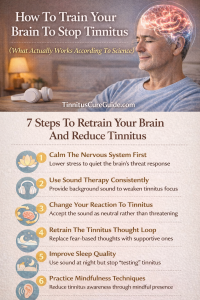
🧘♀️ Step 1: Calm The Nervous System First
You cannot retrain a brain that’s stuck in fight-or-flight mode.
Tinnitus is amplified by a hyper-alert nervous system.
🔊 Why This Matters
-
Stress raises cortisol
-
Cortisol increases sound sensitivity
-
Anxiety tells the brain that tinnitus is dangerous
Before any sound-based technique works, the nervous system must calm down.
🌿 Simple Nervous System Reset Techniques
-
Slow nasal breathing (4–6 breaths per minute)
-
Progressive muscle relaxation
-
Gentle stretching or walking
-
Short mindfulness sessions
These don’t remove tinnitus—but they lower the brain’s alarm response, which is critical for retraining.
🎧 Step 2: Use Sound Therapy To Retrain The Brain
Silence is the enemy of tinnitus habituation.
When the environment is quiet, the brain turns inward and amplifies tinnitus.
🔊 How Sound Therapy Works
Sound therapy provides a neutral background sound that reduces contrast between tinnitus and silence.
This teaches the brain:
“This sound isn’t important. There’s nothing to react to.”
🎶 Effective Sound Options
-
White noise
-
Pink noise
-
Rainfall or nature sounds
-
Low-volume ambient music
The sound should be:
-
Non-intrusive
-
Emotionally neutral
-
Used consistently
Over time, this weakens tinnitus-related neural activity.
🧠 Step 3: Change Your Emotional Response To Tinnitus
Your emotional reaction determines how loud tinnitus feels.
Fear, frustration, or panic tells the brain:
“This sound is a threat.”
Calm acceptance tells the brain:
“This sound is safe and irrelevant.”
🔊 This Is Not “Giving Up”
Acceptance does not mean liking tinnitus or ignoring treatment.
It means removing fear so the brain can down-regulate the signal.
This is one of the most powerful ways to train your brain to stop tinnitus.
🧠 Step 4: Cognitive Reframing (Train The Thought Loop)
Your thoughts directly influence tinnitus intensity.
🚫 Unhelpful Thoughts
-
“This will never stop.”
-
“My brain is broken.”
-
“I can’t live like this.”
These thoughts strengthen the tinnitus-stress loop.
✅ Helpful Reframes
-
“This is a benign brain signal.”
-
“My nervous system is overreacting.”
-
“My brain can adapt over time.”
Cognitive reframing doesn’t silence tinnitus—it reduces emotional amplification, which makes tinnitus quieter.
💤 Step 5: Train The Brain During Sleep And Rest
The brain rewires most efficiently during sleep.
Poor sleep keeps tinnitus circuits active.
🌙 Sleep-Support Strategies
-
Consistent bedtime and wake time
-
Sound enrichment at night
-
No checking tinnitus volume before bed
-
Limit caffeine late in the day
Many people notice tinnitus improves significantly once sleep stabilizes.
🧘♂️ Step 6: Mindfulness And Attention Training
Mindfulness trains your brain to observe without reacting.
This weakens tinnitus pathways over time.
🧠 How Mindfulness Helps
-
Reduces limbic system activation
-
Lowers stress hormones
-
Retrains attention away from tinnitus
You don’t meditate on tinnitus—you learn to let it exist without resistance.
Even 5–10 minutes daily can help retrain the brain.
🦻 Step 7: Support Hearing And Sensory Input
When the brain lacks sound input, it fills the gap with tinnitus.
🔊 Helpful Strategies
-
Hearing aids (if hearing loss is present)
-
Environmental sound during the day
-
Avoid total silence
The brain prefers real sound over phantom sound.
⏳ How Long Does Brain Training For Tinnitus Take?
This varies, but many people notice improvement within:
-
Weeks for reduced distress
-
2–3 months for lower awareness
-
6–12 months for strong habituation
Consistency matters more than speed.
Training your brain to stop tinnitus is a process, not a switch.
❌ What Does NOT Retrain The Brain
Be cautious of approaches that:
-
Promise instant silence
-
Encourage constant tinnitus monitoring
-
Focus only on the ears
-
Increase fear or urgency
These reinforce the problem instead of solving it.
❓ FAQs: How To Train Your Brain To Stop Tinnitus
1. Can the brain really stop tinnitus?
Yes, many people experience a significant reduction through habituation and brain retraining.
2. Does tinnitus ever fully disappear?
Sometimes, but the main goal is reducing awareness and distress, so it no longer matters.
3. Why does tinnitus feel louder at night?
Silence and fatigue increase brain sensitivity to sound.
4. Is tinnitus retraining therapy effective?
Yes, especially when combined with sound therapy and stress reduction.
5. Can anxiety training worsen tinnitus?
Yes—constant checking and fear reinforce the signal.
6. How do I know retraining is working?
You notice tinnitus less often and react less emotionally.
7. Is brain retraining safe?
Yes—it’s non-invasive and supported by neuroscience.
❗ Conclusion: Your Brain Is Not The Enemy—It’s The Solution
Learning how to train your brain to stop tinnitus changes everything.
Tinnitus doesn’t persist because you’re broken.
It persists because your brain learned to focus on a harmless signal.
And what the brain learns, it can unlearn.
By calming the nervous system, reducing fear, using sound strategically, and changing attention patterns, many people reclaim peace—even if the sound doesn’t vanish completely.
Relief comes not from fighting tinnitus…
But from teaching your brain that it no longer matters.
⚠️ Medical Disclaimer
This content is for informational purposes only and does not replace professional medical advice. Always consult a qualified healthcare provider regarding tinnitus or hearing concerns.
 Explore more:
- Can Shoulder Pain Cause Tinnitus?
- When to See a Doctor for Tinnitus
- Can Changes In Diet & Caffeine Intake Impact Tinnitus?