
Medical Disclaimer: This resource is for general educational and organizational purposes only and is not a diagnostic tool or a substitute for professional medical advice, diagnosis, or treatment.
Tinnitus can feel different from one day to the next. Some days, the ringing, buzzing, humming, or other sounds may barely get your attention. On other days, they may seem much more noticeable.
Keeping a simple daily record can help you build a clearer picture of your own experience.
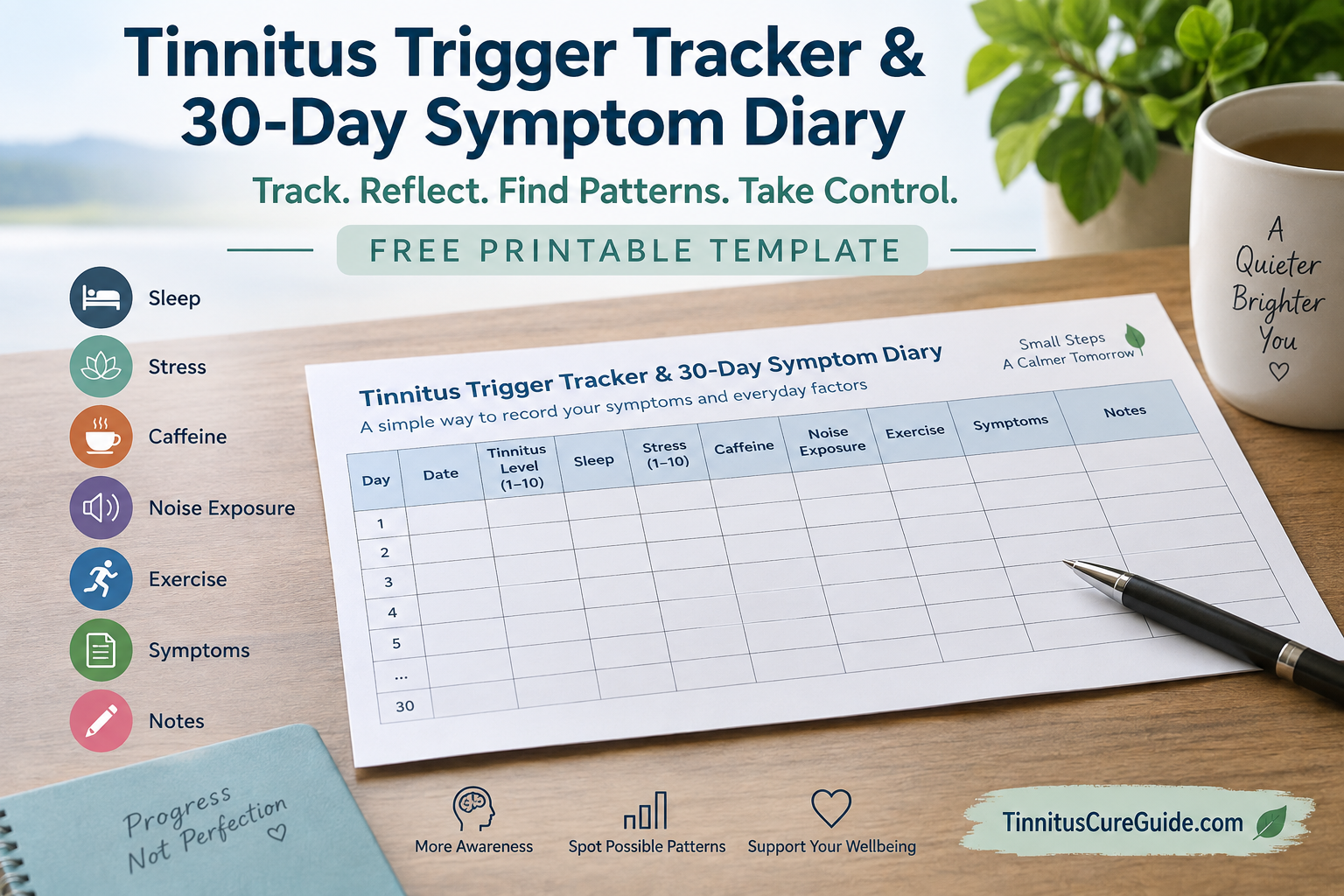
This Tinnitus Trigger Tracker & 30-Day Symptom Diary is a free, simple resource designed to help you record your tinnitus level alongside everyday factors such as sleep, stress, caffeine, noise exposure, exercise, symptoms, and anything else you think may be worth remembering.
The goal isn’t to diagnose the cause of your tinnitus or prove that a particular activity is a trigger. Instead, the diary gives you one convenient place to organize your observations over 30 days.
You can copy and paste the template into a document, print it, or simply use it as inspiration for your own tinnitus journal.
What Is A Tinnitus Trigger Tracker?
A tinnitus trigger tracker is a simple diary that lets you record how noticeable your tinnitus feels while also tracking everyday factors such as sleep, stress, caffeine, noise exposure, and exercise.
Over time, your notes may help you notice patterns that you hadn’t previously recognized. However, an apparent pattern doesn’t necessarily mean that a particular food, activity, or lifestyle factor is causing your tinnitus.
This tracker is intended for personal organization and awareness—not diagnosis or treatment.
Why Keep A Tinnitus Diary?
When you’re trying to remember how you felt several days or weeks ago, it’s surprisingly difficult to be precise.
You might remember having a particularly difficult tinnitus day but not remember whether you slept poorly the night before, had an unusually stressful day, attended a loud event, or experienced other symptoms.
A diary creates a written record.
After several weeks, you can look back at what was actually happening rather than relying entirely on memory.
Your diary may also make it easier to explain your experience if you decide to discuss your tinnitus with a doctor, audiologist, or another qualified healthcare professional.
Most importantly, you don’t need to make the diary complicated.
A few minutes each day is enough.
How To Use The 30-Day Tinnitus Symptom Diary
Try to complete one row each day for 30 days.
You don’t need to document every detail of your day. Keep your entries short and consistent.
Here’s what each column means.
Date
Enter the date of your diary entry.
Tinnitus Level
Give your tinnitus a simple rating from 1 to 10 based on how noticeable it felt that day.
For example:
1 = Barely noticeable
5 = Moderately noticeable
10 = Extremely noticeable
This isn’t a medical scale. It’s simply your own personal rating system.
Try to use the scale consistently throughout the 30 days.
Sleep
Record how you slept the previous night.
You can keep this very simple:
Good / Fair / Poor
Or record approximately how many hours you slept.
Stress
Rate your overall stress for the day.
You could use another simple 1–10 scale:
1 = Very little stress
10 = Extremely stressful day
Again, this is simply a personal reference rather than a clinical measurement.
Caffeine
Record approximately how much caffeine you consumed.
For example:
None
1 coffee
2 coffees
Tea + coffee
There’s no need to calculate the exact number of milligrams unless you already track that information.
Noise Exposure
Write down any significant or unusual noise exposure.
Examples might include:
- Concerts or live music
- Power tools
- Lawn equipment
- Loud workplaces
- Sporting events
- Extended headphone or earbud use
- Other unusually noisy environments
If nothing unusual happened, simply write None or Normal.
Exercise
Record whether you exercised and, if useful, what you did.
For example:
30-minute walk
Gym – 45 minutes
Gardening
No exercise
This gives you another piece of everyday information to compare with your other entries.
Symptoms
Use this column to record anything about your tinnitus or hearing experience that you particularly want to remember.
For example:
Ringing seemed louder in the evening
Buzzing in left ear
Tinnitus came and went
Sound seemed different today
You can also note other symptoms or changes that you intend to discuss with a healthcare professional.
Notes
This is your flexible space.
Write down anything that seems relevant or simply something you want to remember.
For example:
Very busy day at work
Went to a concert
Slept badly
Long flight
Had a cold
Spent most of the day somewhere quiet
You don’t need to fill this section every day.
Free 30-Day Tinnitus Trigger Tracker & Symptom Diary
Download the Tinnitus Trigger Tracker & 30-Day Symptom Diary PDF
Copy-And-Paste 30-Day Tinnitus Diary
Prefer to keep a digital copy? Copy the table below and paste it into Google Docs, Microsoft Word, or another document editor. You can also download the printable PDF version above.
| Day | Date | Tinnitus Level (1–10) |
Sleep | Stress (1–10) |
Caffeine | Noise Exposure | Exercise | Symptoms | Notes | |
|---|---|---|---|---|---|---|---|---|---|---|
| 1 | ||||||||||
| 2 | ||||||||||
| 3 | ||||||||||
| 4 | ||||||||||
| 5 | ||||||||||
| 6 | ||||||||||
| 7 | ||||||||||
| 8 | ||||||||||
| 9 | ||||||||||
| 10 | ||||||||||
| 11 | ||||||||||
| 12 | ||||||||||
| 13 | ||||||||||
| 14 | ||||||||||
| 15 | ||||||||||
| 16 | ||||||||||
| 17 | ||||||||||
| 18 | ||||||||||
| 19 | ||||||||||
| 20 | ||||||||||
| 21 | ||||||||||
| 22 | ||||||||||
| 23 | ||||||||||
| 24 | ||||||||||
| 25 | ||||||||||
| 26 | ||||||||||
| 27 | ||||||||||
| 28 | ||||||||||
| 29 | ||||||||||
| 30 |
Prefer writing things down by hand? Download our free printable 30-day tinnitus diary.
What To Look For After 30 Days
Once you’ve completed your diary, take a few minutes to review it from beginning to end.
You’re not trying to diagnose yourself.
Instead, look for simple patterns or observations that may be worth remembering or discussing with a healthcare professional.
You might ask yourself:
- Were there particular days when my tinnitus was more noticeable?
- Were there days when I barely noticed it?
- Did my tinnitus seem different after nights when I slept poorly?
- Were particularly stressful days also days when I noticed my tinnitus more?
- Did I record any changes following unusually loud noise exposure?
- Did the sound or location of my tinnitus change during the month?
- Did any other symptoms repeatedly occur at the same time?
- Is there anything in my diary that I would like to discuss with my doctor or audiologist?
You may find a pattern. And may find several possible patterns. Or you may find no obvious pattern at all. All three outcomes are useful observations.
Be Careful About Assuming Something Is A Trigger
One of the most important things to remember when using a tinnitus diary is that two things happening together doesn’t necessarily mean that one caused the other.
Suppose you notice that your tinnitus seemed more noticeable on several days when you drank more coffee.
That observation doesn’t establish that caffeine caused the change.
Perhaps those were also stressful days. Maybe you slept poorly. Perhaps you were paying more attention to your tinnitus. Or the timing could simply have been coincidental.
The same principle applies to sleep, exercise, foods, stress, noise exposure, and other factors you record.
Think of your diary as a collection of observations rather than a diagnostic test.
If you notice something that concerns you, discuss it with an appropriately qualified healthcare professional rather than making significant health or medication changes based solely on your diary.
Don’t Let Tracking Make You Focus On Tinnitus All Day
Keeping a tinnitus diary should be simple.
You don’t need to monitor your tinnitus continuously or repeatedly check whether the sound has changed.
In fact, constantly focusing on it may make the diary unnecessarily stressful.
Consider choosing one convenient time each day to complete your entry—perhaps in the evening.
Think about your day, make your notes, and move on.
The goal is to create a useful record without allowing the tracker to become the focus of your day.
Bringing Your Tinnitus Diary To An Appointment
If you’re planning to speak with a doctor, audiologist, or another qualified healthcare professional about tinnitus, you may want to bring your completed diary with you.
Instead of trying to remember everything that happened during the previous month, you’ll have a simple written record.
You can point out things you’ve noticed, such as:
- When you first noticed a change
- Whether the tinnitus seems constant or intermittent
- Changes in how noticeable it feels
- Changes in the sound or location
- Significant noise exposure
- Other symptoms you’ve recorded
- Questions or concerns that came up during the month
Your healthcare professional can decide which information is medically relevant.
You Can Continue Beyond 30 Days
Thirty days is simply a convenient starting point.
You can stop after one month, repeat the tracker for another month, or return to it occasionally when you feel it would be useful.
You might also use it for a shorter period when something changes, and you want to keep a record to discuss at a future appointment.
You don’t need to track tinnitus indefinitely. Use the tracker when it’s useful to you.
Keep Your Completed Diary Private
Remember that a completed tinnitus diary may contain personal health information.
If you save it digitally, store it somewhere appropriate for your own privacy preferences.
If you print the diary, consider keeping it with your other personal health documents rather than leaving it somewhere others can easily access.
TinnitusCureGuide.com does not need to receive your completed diary for you to use this template.
Medical Disclaimer
This Tinnitus Trigger Tracker & 30-Day Symptom Diary is provided for general informational, educational, and personal organizational purposes only.
It is not a medical or diagnostic tool and cannot determine the cause of tinnitus, hearing changes, or any other symptom or medical condition.
Information or patterns recorded in this diary should not be used to diagnose a condition, determine treatment, stop or change medication, or replace professional medical advice.
If you experience tinnitus, hearing changes, or other symptoms that concern you, consult an appropriately qualified healthcare professional. Seek prompt medical attention for sudden or severe symptoms or whenever you believe you may be experiencing a medical emergency.
A Simple Record Can Make Things Easier To Remember
Living with tinnitus can sometimes make it difficult to remember exactly when something changed or what was happening around that time.
That’s why this tracker is intentionally simple.
Date | Tinnitus Level | Sleep | Stress | Caffeine | Noise Exposure | Exercise | Symptoms | Notes
A few minutes of notes each day can give you a much clearer 30-day record than trying to reconstruct an entire month from memory.
Use the Tinnitus Trigger Tracker & 30-Day Symptom Diary as a personal organizational resource, keep the information in perspective, and take any medical questions or concerns to an appropriately qualified healthcare professional.
Explore more tools: